

More news on this day
San Francisco International Airport is entering one of its most constrained operating periods in decades, as a six-month runway closure in 2026 combines with new federal landing restrictions to cut the Bay Area hub’s capacity and set up months of potential delays.
Get the latest news straight to your inbox!
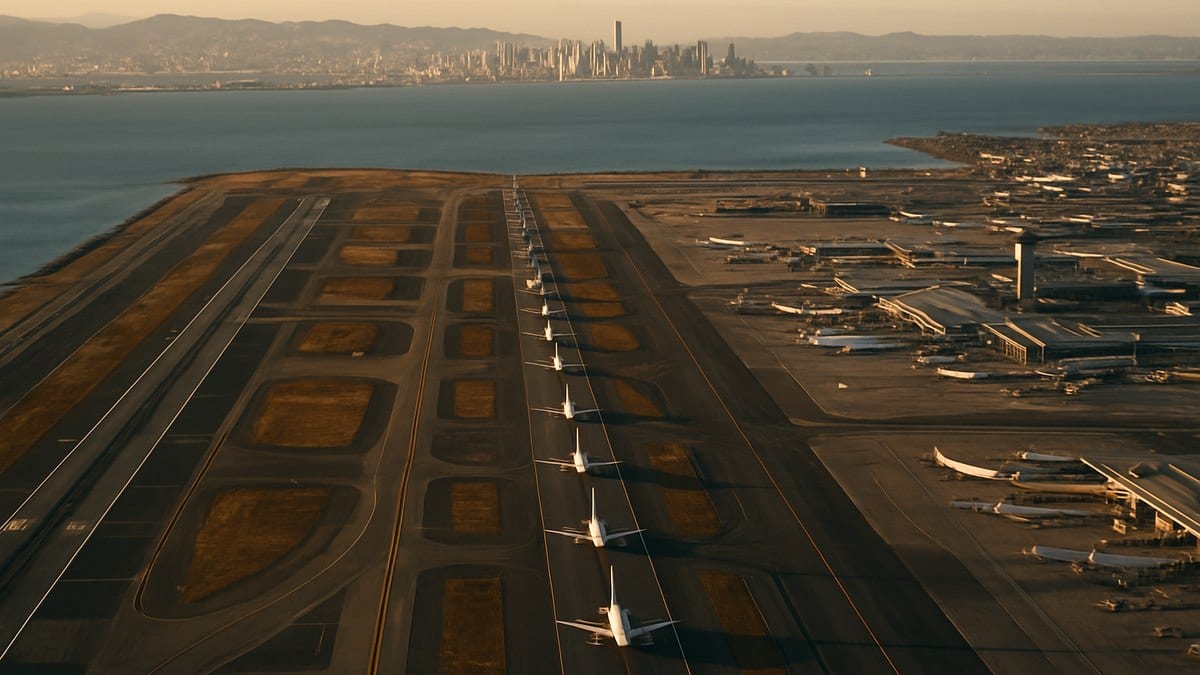
Major Runway Out of Service From March to October 2026
Publicly available airport planning documents show that San Francisco International Airport has closed Runway 1R/19L for a full repaving and airfield upgrade program, with the outage scheduled from March 30 to early October 2026. During this six month window, the airport is consolidating takeoffs and landings onto its primary east west pair, Runways 28L and 28R, while converting the parallel Runway 1L into an additional taxiway to ease ground congestion in the construction zone.
Industry coverage indicates that the project is part of a broader modernization push targeting aging pavement, lighting and taxiway geometry on the airport’s north south runways. The work follows several years of planning and environmental review and is framed as necessary maintenance for a facility that routinely handles heavy domestic and long haul international operations in constrained airspace.
The north south runway closure removes a key outlet for departures during peak traffic flows, especially in the common “West Plan” configuration where the 1s typically handle outbound flights while the 28s absorb most arrivals. With 1R out of service and 1L reassigned as a taxiway, SFO loses a major operational lever just as federal regulators are tightening rules on how closely aircraft can arrive on the remaining runways.
Airport facing communities have been briefed on the construction phasing, and public materials describe the current closure as the first in a sequence of airfield works that will at times require additional maintenance on the 28 runways themselves. That prospect has heightened concern that the disruption in 2026 will not be limited to a single six month period, but could ripple into future seasons as follow on projects are scheduled.
FAA Limits Parallel Arrivals and Cuts Hourly Landing Rate
Separate from the construction program, the Federal Aviation Administration has introduced new restrictions on the side by side arrivals that have long defined operations at San Francisco. Published coverage of the policy change notes that regulators are curbing the visual procedures that once allowed simultaneous approaches to Runways 28L and 28R, a move that effectively treats the closely spaced pair as a single arrival stream for much of the day.
Analyses in aviation trade outlets report that the combined impact of the repaving project and the landing rule change has reduced SFO’s maximum arrival rate from roughly 54 flights per hour to about 36. That one third cut in inbound capacity is expected to translate directly into longer holding patterns, more frequent ground stops and a higher risk of missed connections for passengers using the airport as a transfer point.
Travel and aviation publications indicate that the new federal limits are intended to enhance safety margins at a complex airport layout that sits between hills to the west and water to the east, with additional traffic streams feeding in and out of Oakland and San José. Under the revised regime, controllers have less flexibility to squeeze arrivals into tight gaps, particularly during busy bank periods when major carriers build dense clusters of flights to feed their networks.
While the landing rate reduction is framed as a national safety initiative, consumer focused travel reports emphasize its immediate practical effect for Bay Area travelers. With fewer arrivals permitted per hour during and after the construction, even minor weather disruptions could have outsized consequences, and the combined constraints are expected to keep on time performance under pressure throughout much of 2026.
Capacity Squeeze Reverberates Across Bay Area Travel
Forecasts from aviation analysts suggest that the six month runway closure and reduced arrival rate will ripple far beyond the immediate construction window. Schedules filed by airlines for the spring and summer travel seasons show continued heavy reliance on San Francisco as a hub, even as the airport’s theoretical maximum throughput drops. That mismatch raises the likelihood of chronic congestion during morning and evening peaks.
Regional coverage points out that the Bay Area technically has significant overall airport capacity when Oakland and San José are included, yet carriers continue to concentrate long haul and premium domestic traffic at SFO. With the airport now operating under stricter landing constraints, that strategy may be tested as delay statistics accumulate and travelers weigh the tradeoffs of connecting through alternative gateways.
Travel industry reporting notes that some airlines are already tweaking their schedules, smoothing banks by spacing out departures and trimming marginal frequencies on shorter routes that have nearby alternatives. However, as of early April 2026, publicly available timetables do not indicate a wholesale redeployment of capacity away from SFO to neighboring airports, leaving much of the adjustment to be absorbed in the form of delays rather than cancellations.
Airport planning documents and independent simulations prepared before the latest changes indicated that SFO was already operating close to its modeled capacity during peak hours. With a critical runway offline and parallel arrivals curtailed, the effective ceiling is significantly lower, increasing the sensitivity of the system to even routine hiccups such as minor fog, runway inspections or late arriving aircraft from other congested hubs.
What Travelers Can Expect Through the 2026 Peak Seasons
Consumer advisories compiled by travel media outlets converge on a simple message for passengers using SFO during the six month runway closure period: build in extra time and prepare for potential schedule changes. The combination of construction and landing restrictions means that buffers in the system are thinner, and recovery from morning disruptions can take longer than usual.
Analysts indicate that the most acute pressure is likely to appear around the traditional morning departure push and the evening arrival banks, when demand for runway time is highest. In those windows, even on clear days, the airport’s reduced hourly arrival rate could force air traffic managers to meter inbound flights, leading to ground delays at origin airports or extended arrival sequencing over the Bay.
Reports focused on passenger strategy highlight a few practical implications. It is expected that tighter minimum connection times routed through SFO will be harder to achieve reliably, particularly for international to domestic transfers that require clearing immigration and reentering the security system. Early morning nonstop departures from the Bay Area to the East Coast and Europe may also feel more fragile, because a disruption late the previous evening can cascade into aircraft and crew shortages the next day.
At the same time, neighboring airports are being cast as pressure valves. Public information from Oakland and San José indicates that both fields are continuing to add a limited number of domestic routes in 2026, and travel columns suggest that Bay Area residents with flexible plans may increasingly look to those options to avoid the worst of the congestion at SFO while the runway project runs its course.
Longer Term Questions About Capacity and Growth
Beyond the immediate disruption, the 2026 runway closure is sharpening debate about San Francisco’s long term capacity and its role in the national air network. Planning studies referenced in airport documentation have long acknowledged that SFO’s four tightly clustered runways leave little room to expand without major environmental and engineering challenges.
With the new federal restrictions on parallel arrivals expected to remain in place beyond the current construction window, aviation commentators argue that SFO may emerge from 2026 with permanently lower peak throughput than before, even after the repaved runway returns to service. That prospect raises questions about how airlines will structure their West Coast operations in the coming years and whether more long haul traffic will be redirected to alternative hubs.
Some regional analyses frame the current project as both a necessary safety and maintenance investment and a stress test of the Bay Area’s broader transportation ecosystem. If traffic continues to grow while SFO’s effective capacity plateaus or declines, policymakers may face renewed pressure to encourage greater use of secondary airports or to accelerate improvements in rail and ground connectivity that can substitute for short haul airline travel.
For now, the focus remains on getting through the next six months of work on Runway 1R and its surrounding taxiways. By early October 2026, the physical construction is expected to wind down, but the operational story at San Francisco International Airport is likely to continue evolving as regulators, airlines and travelers adjust to a new baseline for what the region’s busiest airport can reliably handle.