

More news on this day
San Francisco International Airport is entering one of its most disruptive construction periods in years, with a six-month runway closure in 2026 expected to reduce capacity, increase delays and push more Bay Area travelers toward alternative airports.
Get the latest news straight to your inbox!
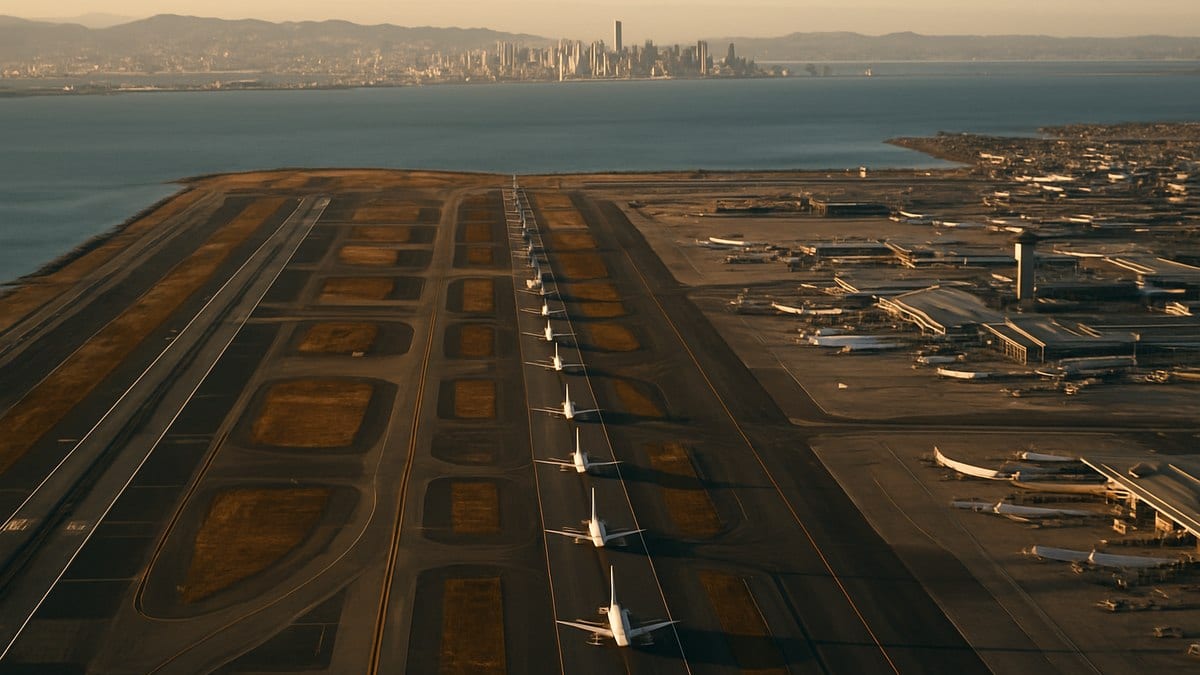
Major Runway Works to Shut 1R/19L for Half the Year
Publicly available information from San Francisco International Airport shows that Runway 1R/19L, one of the airport’s north–south runways, is scheduled to close for roughly six months in 2026 for a full repaving and airfield upgrade program. Planning documents and recent press materials describe a project focused on rehabilitating the runway surface, improving drainage, updating lighting and signage, and tying the work into a new Taxiway W to streamline movements around the airfield.
Reports indicate that the closure window runs from late March to early October 2026, with March 30 and October 2 widely cited as target dates for the start and end of the outage. During this period, the runway closest to Highway 101 will be unavailable for takeoffs or landings, effectively removing one of SFO’s primary pieces of pavement during the busy spring, summer and early fall travel seasons.
The project follows a series of large-scale airfield overhauls at SFO in recent years, including previous work on its main east–west runways. Airport planning documents describe the 1R/19L rehabilitation as part of a broader capital program intended to keep one of the nation’s busiest international gateways within safety and performance standards as traffic rebounds from the pandemic.
Construction industry reports note that preconstruction work has been underway since mid-2025, covering detailed design, phasing and coordination with air-traffic authorities. The 2026 window is reserved for heavy construction on the runway itself, when closures and operational constraints will be most visible to passengers.
FAA Arrival Cap Tightens Capacity During the Closure
The runway shutdown coincides with a significant shift in how many flights can land at SFO each hour. Recent coverage of Federal Aviation Administration decisions indicates that regulators have reduced the airport’s maximum arrival rate from about 54 flights per hour to 36 during the construction period, citing a mix of airfield configuration and safety considerations.
The cut reflects the challenge of managing SFO’s two sets of closely spaced parallel runways once one of the north–south pair is unavailable. With 1R/19L out of service and accompanying restrictions on certain types of parallel approaches, controllers have less flexibility to run side‑by‑side arrivals, a technique that has helped the airport handle heavy traffic during good weather.
Airport briefings and performance outlooks suggest that the combination of construction and the lower arrival cap will constrain overall capacity through at least early October 2026. Published analyses by industry and local outlets describe SFO as a likely bottleneck in the national network on peak days, particularly during summer holiday periods and major events drawing visitors to the Bay Area.
While departures are generally expected to be less affected than arrivals, the reduced inbound flow can ripple throughout airlines’ schedules, limiting how quickly aircraft and crews reposition for outbound flights. This dynamic may be especially visible at SFO, where a large share of traffic involves connections to long‑haul and transcontinental routes.
Projected Delays and What Travelers Can Expect
Forecasts compiled in local coverage and airport briefings point to a noticeable, though uneven, impact on punctuality during the six‑month closure. Some planning documents and public statements reference expectations that a single‑digit share of flights could face delays attributable to the runway work itself, with many of those disruptions clustering in the morning and evening peaks.
Other analyses, including reporting that factors in the new FAA arrival cap, suggest a higher share of affected flights and a wider spread of delays when weather, heavy demand or upstream disruptions combine with the construction constraints. Estimates in those reports describe scenarios in which roughly a quarter of arriving flights could be delayed by 30 minutes or more on challenging days.
Passengers are likely to notice the biggest effects during busy travel periods, when airlines are operating close to the reduced hourly limit and there is little slack in the system. Morning bank arrivals feeding onward connections and evening banks bringing travelers back to the Bay Area are both highlighted as vulnerable to knock‑on delays.
Operational summaries published in aviation outlets advise travelers to build in additional time for connections at SFO during the construction window, to monitor airline alerts closely, and to consider earlier flights in the day when possible. The same sources note that on days with good weather and lighter demand, operations may still run relatively smoothly despite the structural capacity cut.
Ripple Effects Across the Bay Area Airport Network
The six‑month closure is not occurring in isolation. The Bay Area is served by a trio of major commercial airports, and analysts expect the runway constraints at SFO to accelerate a gradual shift in traffic patterns that has been underway for several years.
Travel and aviation coverage suggests that Oakland and San Jose airports could see incremental gains in demand from passengers seeking alternatives to potential delays at SFO, especially for domestic point‑to‑point routes. Some airline schedule changes already indicate modest growth in service at competing regional airports in 2026, reflecting a broader strategy to diversify operations across the Bay Area rather than concentrate them at a single hub.
Regional planners have long pointed to the interconnected nature of Bay Area airspace, where changes at one airport can echo across others. With SFO’s north–south runway capacity temporarily reduced, carriers may lean more heavily on east–west operations at 28L and 28R and on nearby airports for relief. This could shift noise footprints and traffic flows over certain communities, a concern that has already generated local attention as residents along the Peninsula brace for altered flight paths and sustained construction activity.
At the same time, the runway project and associated FAA restrictions are prompting fresh debate about long‑term capacity in the region. Policy discussions documented in airport planning reports and transportation studies revisit questions about adding new infrastructure, reshaping airspace procedures or relying more on high‑speed rail and other ground transport to ease pressure on Bay Area skies.
Long-Term Upgrades Aimed at Future Reliability
Despite the near‑term disruption, airport planning materials and construction briefings frame the 1R/19L closure as an investment in reliability and safety that should pay off over the coming decades. The rehabilitation is designed to extend the life of a critical runway, replace aging pavement and subsurface structures, and integrate modern lighting and navigation systems.
The Taxiway W component, highlighted in construction and engineering reports, is expected to reduce ground congestion by providing more efficient routing options between the runway system, terminals and maintenance areas. Over time, this could shorten taxi times, cut fuel burn and lower emissions, aligning the project with broader sustainability goals outlined in SFO’s recent capital improvement plans.
Industry analysts note that many large U.S. airports are navigating a similar cycle of disruptive yet necessary infrastructure work, often under tighter safety scrutiny and evolving air‑traffic rules. In this context, SFO’s 2026 runway shutdown is seen as part of a national pattern in which short‑term constraints are traded for long‑term operational resilience.
For travelers, the practical message is that 2026 will be a year of adjustment when flying through San Francisco. The combination of a six‑month runway closure, a lower arrival cap and a reshuffled Bay Area network may test patience in the short run, even as the upgrades aim to keep one of the West Coast’s busiest gateways functioning more smoothly in the years ahead.