

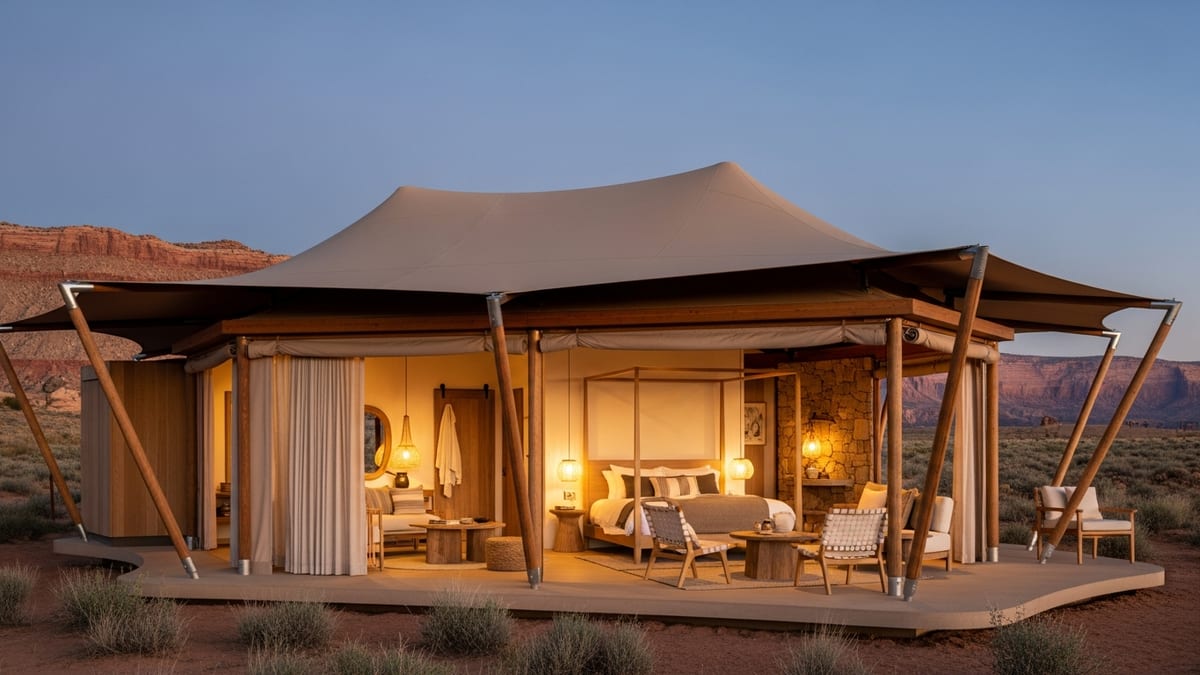
In a move that underscores the growing allure of America’s canyon country for luxury travelers, IHG Hotels & Resorts has announced plans for Six Senses Camp Korongo, a 480-acre “desert sanctuary” outside Kanab in southern Utah.
Marketed as a canyon oasis where wellness, sustainability and high design meet red rock drama, the tented resort is slated to open in 2029 and will bring the Six Senses brand into the heart of one of the United States’ most spectacular and competitive desert landscapes.
More News
- Flying in 2026: New Rules Make Airline Refunds Faster and Clearer Worldwide
- Upper Shoal River: Florida’s New Panhandle Escape for Hikers and Paddlers
- Ryanair Warns of ‘Messy’ Summer 2026 Amid Europe Air Traffic Control Strains
A new luxury footprint in Utah’s canyon country
Six Senses Camp Korongo, frequently described in early communications as a desert sanctuary and canyon oasis, will occupy a vast swath of high desert terrain near Kanab, a small gateway town roughly equidistant from several of the American Southwest’s marquee parks. The site sits amid sculpted sandstone, juniper forest and far-reaching desert horizons that have long drawn hikers, film crews and road trippers.
The project, announced in late January 2026, is being developed in partnership with Canyon Global Partners and will be part of IHG’s Luxury & Lifestyle portfolio. It marks a significant expansion of the Six Senses flag in the United States, following planned openings in Telluride, Napa Valley and along the South Carolina coast. For Utah tourism officials and regional stakeholders, it represents another high-profile endorsement of southern Utah’s rising status as a global luxury destination.
With 41 tented pavilions and 12 branded residences scattered across nearly 500 acres, Camp Korongo will be low-slung but far from small. The resort is being pitched as an ultra-luxury outpost that still feels intimate, with guest accommodations dispersed to maximize privacy, panoramic views and a sense of immersion in the desert environment.
The announcement comes as southern Utah continues to see major investment in upscale hospitality, from experiential hot springs concepts to architect-driven desert retreats. Six Senses’ arrival adds one of the world’s most recognizable wellness and sustainability brands to that mix.
Designing a canyon oasis in tented form
Architecturally, Camp Korongo will lean into the tented-camp aesthetic that Six Senses has refined in remote landscapes around the world. The resort’s pavilions are being designed by South Africa based studio Luxury Frontiers, known for nature-centric resorts and safari-style lodges tailored to fragile ecosystems.
Preliminary descriptions emphasize a palette that pulls directly from the site’s geology and vegetation. The tents and common spaces are expected to feature contrasting textures and colors that echo rust-colored cliffs, pale sand and the green of juniper and sage. Renderings released with the announcement highlight soft, curving forms and canvas structures that attempt to sit lightly in the terrain rather than dominate it.
Much like other high-end desert properties in the region, the resort will balance openness to the elements with refuge from them. Shaded outdoor living areas, deep overhangs and carefully oriented windows are intended to capture canyon breezes while mitigating intense summer sun. Night sky considerations are also central to the design, with low-impact lighting and open decks designed to frame the Milky Way as a nightly show.
Inside the pavilions, the design brief calls for calm, tactile environments that foreground natural materials and soft, muted tones. Six Senses has signaled that interiors will be curated less as traditional hotel rooms and more as restorative sanctuaries, where texture, scent and light are consciously orchestrated to heighten the sensory connection to the surrounding desert.
Wellness, spa rituals and star-filled nights
True to the brand’s DNA, wellness will sit at the core of the Camp Korongo experience. Plans call for a full-service Six Senses Spa anchoring the property, with programs likely to blend high-tech recovery concepts with traditional therapies and nature-based rituals. Early indications suggest customizable journeys that can be as intensive or as light-touch as guests choose, from longevity-focused treatments to simple post-hike massages.
Beyond the spa walls, the resort will use its location and night skies as wellness assets in their own right. Stargazing is being heavily promoted, with the site offering some of the darkest skies in the region. Guided astronomy walks, soundscapes under the stars and screen-free evening programming are expected to reinforce the feeling of retreat from everyday overstimulation.
Daytime activities are being framed through a similar lens of mindful immersion rather than adrenaline alone. While canyoneering, rock scrambling and long-distance hikes will be on offer, Six Senses is also spotlighting slower-paced pursuits: contemplative desert walks, breathwork sessions in natural amphitheaters and meditative sunrise viewing from the canyon rim.
Nutrition will form another pillar of the wellness positioning. Although detailed food and beverage concepts have yet to be fully outlined, the brand’s existing playbook suggests a focus on seasonal, locally sourced ingredients, plant-forward menus and educational components such as cooking classes or workshops centered on desert botanicals and regional food traditions.
Gateway to four national parks and red rock icons
Location has always been Kanab’s calling card, and Camp Korongo is set to capitalize aggressively on that geography. From the planned resort site, guests will have relatively easy access to Zion and Bryce Canyon national parks, the North Rim of the Grand Canyon and the more distant Arches landscape, all highlighted in the project’s early marketing as visible or reachable from the property.
This cluster of protected areas has long been a magnet for international travelers, but itineraries have typically involved long driving days and basic motel or rental-house stays. By planting a fully serviced luxury resort in the middle of this web, Six Senses is effectively recasting the region as a place where travelers can base themselves for a week of curated exploration, rather than simply passing through on a whirlwind road trip.
The resort’s experiences team is expected to offer guided access not only to headline parks but also to lesser-known slot canyons, high plateaus and cultural sites scattered across the surrounding public lands. That could include private sunrise outings to remote overlooks, interpretive walks with local naturalists and Navajo or other Indigenous guides, and photography-focused excursions timed to the region’s dramatic light.
For Kanab and nearby communities, the development signals a shift toward a more immersive, longer-stay model of tourism. While questions remain about traffic, workforce housing and infrastructure, backers argue that high-spend visitors staying multiple nights can provide more sustainable economic benefits than higher volumes of day-trippers.
Sustainability promises in a fragile desert
Six Senses has built its global reputation on pairing luxury with environmental and social commitments, and those credentials will be closely watched in Utah’s drought-sensitive canyon country. Early statements on Camp Korongo emphasize sustainability, from resource-efficient construction to operational practices intended to minimize the resort’s footprint.
The tented typology itself is being presented as a lower-impact alternative to conventional concrete and steel, with modular elements that can be installed and potentially removed with less disturbance to the land. The project is also expected to incorporate water-saving technologies, renewable energy sources and careful landscape planning to avoid unnecessary disturbance of native vegetation and wildlife corridors.
Waste management and dark-sky protections are likely to be key issues as the design progresses, given the region’s limited landfill capacity and its prized stargazing conditions. Observers will also be looking for concrete commitments around groundwater use, as large-scale hospitality projects in arid environments face increasing scrutiny over wells, landscaping and guest water consumption.
Beyond environmental metrics, Six Senses has signaled an intent to engage with the cultural context of southern Utah, referencing the area’s Indigenous histories and ranching heritage. How that translates into on-the-ground partnerships, interpretation and hiring practices will be a focal point for local communities and advocacy groups once construction moves forward.
Economic ripple effects for Kanab and the region
The arrival of a global luxury brand is poised to reshape the economic landscape around Kanab, a town historically associated with cattle, small-scale tourism and Hollywood Westerns. Stakeholders expect Camp Korongo to generate a significant number of jobs during both construction and operations, from hospitality roles to guiding, transportation and specialized wellness services.
Local businesses may see new opportunities in supplying the resort with food, crafts, design elements and off-site experiences. Restaurants, outfitters and small tour operators could benefit from higher-spending guests looking to explore beyond the resort’s curated offerings, particularly if Six Senses leans into its typical model of partnering with regional producers and experts.
At the same time, the project is likely to intensify existing debates around housing affordability and land use in and around Kanab. As more national brands and high-end developers turn their attention to southern Utah, smaller communities have struggled to balance growth with quality of life for year-round residents. How Camp Korongo approaches staff housing, transportation and integration into town life will be closely scrutinized as part of that broader conversation.
Regional tourism boards are already viewing the resort as a potential anchor for new marketing campaigns that position southern Utah not only as an adventure playground but also as a global-caliber wellness and retreat destination. That shift could influence everything from airline capacity into nearby airports to the mix of events and festivals seeking a home base in canyon country.
Six Senses’ broader push into the American West
Camp Korongo does not exist in isolation within the Six Senses portfolio. It is part of a deliberate push into the North American market, particularly the American West, where the brand sees strong alignment between its ethos and travelers’ appetite for nature-focused, transformative experiences.
In Colorado, Six Senses Telluride is slated to bring the brand’s blend of residential-style lodging and comprehensive wellness to a classic Rocky Mountain ski town. Additional projects planned in California wine country and on the South Carolina coast are designed to reinforce Six Senses’ presence across a range of U.S. landscapes, from vineyards to barrier islands.
Together, these developments suggest a strategic bet that American and international travelers will increasingly prioritize destinations where outdoor immersion, spa culture and environmental sensitivity are packaged at the highest luxury level. Camp Korongo, with its access to four national parks and its remote-feeling setting, offers a powerful test case for that thesis.
For IHG, the Utah resort also deepens its footprint in the ultra-luxury bracket at a time when major hotel groups are racing to capture the top end of the market. The company has described Camp Korongo as both a brand-builder and a signal of its intention to compete head-on with established desert icons across the American Southwest.
A long runway to a 2029 opening
With nearly three years between the signing announcement and the targeted 2029 opening, Six Senses Camp Korongo remains at the early stages of its journey from concept to canyon oasis. Detailed designs, permitting processes and community consultations are expected to unfold over the coming months and years, alongside more granular announcements about programming, pricing and access.
Industry analysts note that long lead times are common for remote, design-intensive projects of this scale, particularly in sensitive environments where environmental review and infrastructure planning can be complex. Weather, construction logistics and broader economic conditions may also shape the final timeline.
For now, the project’s reveal has added a new name to the shortlist of future desert retreats to watch. It signals that southern Utah, once an overlooked corner of the American West, is firmly on the radar of global luxury brands and travelers looking beyond traditional beach and city escapes.
If Six Senses delivers on its promise of a canyon oasis that meaningfully blends wellness, sustainability and sense of place, Camp Korongo could help redefine what a high-end desert stay looks like in the United States, turning a remote patch of juniper and sandstone into one of the most talked-about addresses in canyon country by the close of the decade.