

More news on this day
The Greek island of Skiathos is stepping into the spotlight as a leader in inclusive travel, launching a new autism-focused tourism program that aims to make the destination accessible, predictable, and welcoming for neurodivergent visitors and their families.
Get the latest news straight to your inbox!
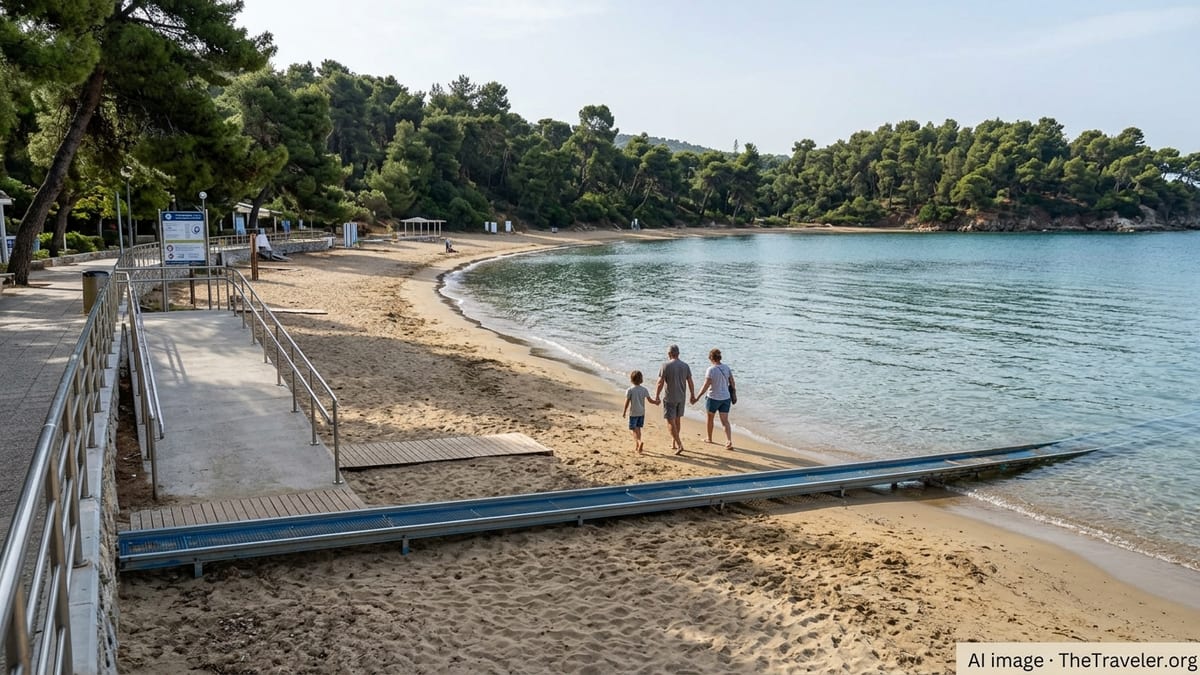
From Accessible Beaches to Autism-Inclusive Vision
Skiathos has already built a reputation as one of Greece’s most accessible islands, with recent years marked by investments in barrier-free infrastructure, adapted public transport, and autonomous sea-access systems on popular beaches. Publicly available information shows that the island has been recognized by UN Tourism as a best-practice case study in accessible tourism, highlighting its beaches equipped with Seatrac devices, an adapted trail at Koukounaries, and a modern bus service designed to support travelers with mobility challenges.
Building on this foundation, local authorities and partners are now pivoting towards cognitive and sensory accessibility, positioning Skiathos as Greece’s first “autism-friendly island.” Reports indicate that the island’s latest initiative frames accessibility not only as a human-rights priority but also as a long-term tourism strategy, designed to attract visitors who require quieter environments, clear information, and consistent support throughout their stay.
The new program is emerging as part of a broader national conversation on inclusive tourism in Greece, where recent initiatives have sought to expand both visitor access and employment opportunities for people on the autism spectrum. Skiathos stands out within this context as a pilot destination, using its compact size and established infrastructure to test what a truly autism-aware island experience can look like.
Structured Support for Neurodivergent Travelers
According to published coverage, the Skiathos initiative is built around a set of practical tools intended to reduce uncertainty and sensory stress for autistic visitors. These include clearer pre-arrival information about what to expect at airports, ports, and key transfer points, as well as detailed guidance on busy times, noise levels, and potential sensory triggers across the island’s main beaches, streets, and attractions.
The program also emphasizes predictable routines and environments. Publicly available plans describe efforts to coordinate with local businesses so that staff are prepared for guests who may communicate differently, need more time to process instructions, or prefer quieter seating areas and simplified check-in procedures. Visual aids, calm spaces, and flexible check-in and dining arrangements are among the measures being promoted to help families manage changes in routine.
At the same time, the island’s existing network of accessible paths and beach facilities is being reframed to serve a broader range of needs. Trails and waterfront areas already adapted for physical accessibility are now being mapped and described through an autism-inclusive lens, with information on gradients, surfaces, shade, and likely crowd levels so that travelers can plan outings around their own sensory comfort zones.
Training, Partnerships, and Employment Pathways
Skiathos’ autism inclusion drive aligns with a wider shift in Greek tourism policy toward specialized training and employment pathways for neurodivergent people. National-level initiatives announced in late 2025 introduced structured programs that support skills development and job placement for individuals on the autism spectrum in tourism and hospitality, with cooperation between research institutes, NGOs, and major industry stakeholders.
Reports indicate that these national programs focus on practical competencies, on-the-job support, and awareness training for employers, with the goal of creating stable, long-term roles rather than short seasonal placements. Skiathos, as a high-profile island destination, is positioned to benefit from this effort by integrating autism-trained staff into hotels, restaurants, transport services, and cultural venues.
Local tourism stakeholders on the island are described as increasingly engaging with these opportunities, viewing autism inclusion as part of a broader quality upgrade. Training in communication, sensory-aware design, and crisis de-escalation is being presented as a way to improve service for all guests, including those with hidden disabilities, rather than as a niche add-on.
Recognition on the Global Accessible Tourism Stage
The island’s latest autism-focused steps come after Skiathos was spotlighted internationally as a model for accessible tourism. UN Tourism’s recent compendium of good practices in accessible destinations lists Skiathos among a select group of places worldwide that have combined infrastructure upgrades with community-awareness efforts, reinforcing its profile as a laboratory for “tourism for all.”
Coverage of the initiative notes that Skiathos has used this recognition to refine its positioning in global markets. Rather than relying solely on its well-known beaches and nightlife, the island is being promoted as a destination where travelers with disabilities and their families can expect thoughtful design, transparent information, and a coherent accessibility strategy that extends from arrival to departure.
This international attention is also helping to frame autism inclusion as a competitive advantage. By moving early in this space, Skiathos is seeking to differentiate itself from other Aegean islands, appealing to visitors who might otherwise choose larger resorts or specialized autism-friendly complexes elsewhere in the Mediterranean.
What an Autism-Friendly Holiday in Skiathos Could Look Like
For travelers and families, Skiathos’ evolving program is intended to translate into more predictable, lower-stress holidays. An autism-aware arrival experience may include clearer wayfinding at the port and airport, staff familiar with alternative communication methods, and access to information about quieter transfer times to accommodations around the island.
On the beaches, the existing accessible infrastructure is expected to be complemented by guidance on sensory aspects such as crowd density, typical sound levels, and the availability of shaded, calmer zones. For many autistic travelers, this type of granular information can be as important as ramps or lifts, enabling them to choose spaces and times of day that better match their sensory profiles.
In town, hotels and guesthouses that participate in the program are described as working toward more consistent room layouts, clearer signage, and optional tools such as visual schedules or simple social stories explaining local customs and daily routines. Restaurants and cafes are being encouraged to provide quiet corners, minimize sudden sensory changes such as loud music, and give guests the option to preview menus and space layouts in advance.
While the initiative is still in development and not every service on the island will be fully autism-adapted, Skiathos’ direction of travel is evident. With recognition from international tourism bodies and alignment with national inclusion policies, the island is positioning itself as a real-world test case for how a mainstream Mediterranean destination can welcome autistic travelers in a comprehensive and considered way.