

More news on this day
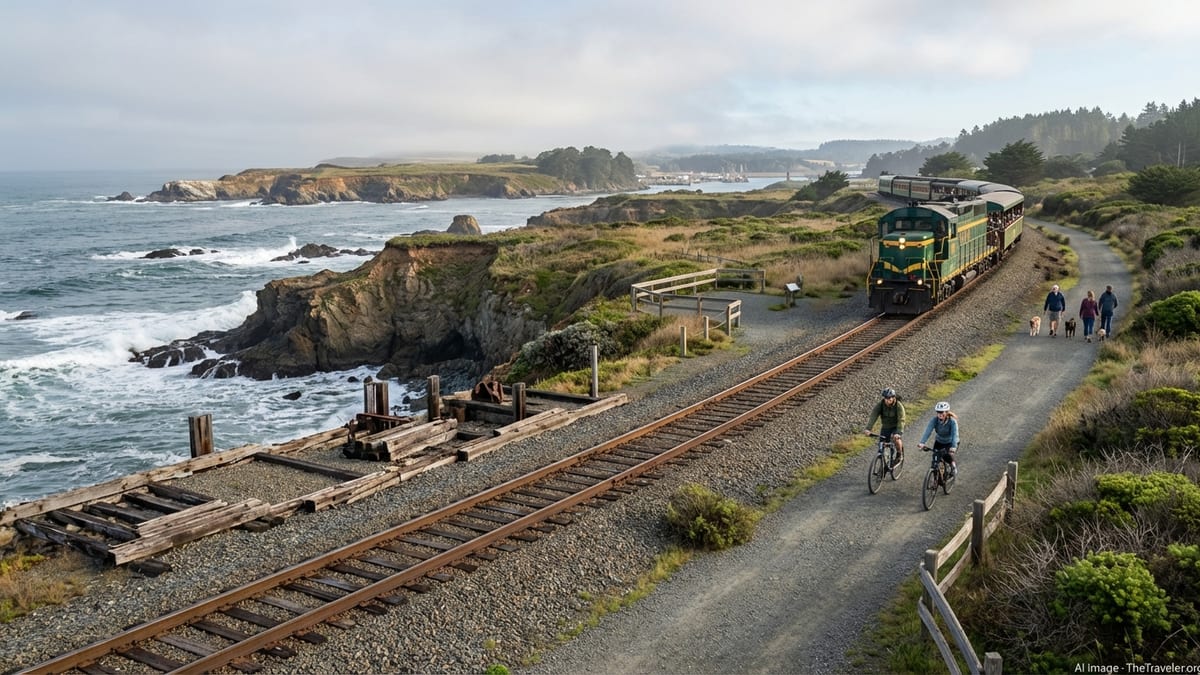
On a fog-softened stretch of California’s Mendocino Coast, the century-old Skunk Train is at the center of an ambitious rail-and-trail vision that aims to turn Fort Bragg’s working waterfront and former mill lands into a spine of eco-friendly recreation, heritage tourism and coastal access through the redwoods.
From Logging Line to Climate-Age Showcase
For more than 135 years, the Skunk Train has rumbled between Fort Bragg and the redwood interior, first as a logging workhorse and later as a nostalgic excursion line. Today, its operators, Mendocino Railway, are positioning the corridor as the backbone of a new kind of visitor experience that blends low-impact travel, outdoor recreation and coastal regeneration. Vintage diesel locomotives still pull open-air carriages through second-growth redwoods, but electric railbikes, forest bathing excursions and seasonal special trains increasingly define the brand.
That evolution is unfolding at a moment when rail is being reimagined across the West as a tool for climate-friendly mobility and trail-based tourism. Regional planners see Fort Bragg’s short line as a compact test case for how an active railroad can coexist with coastal access, bike paths and nature preserves. Advocates say the Mendocino Coast’s mix of headlands, harbor and redwood canyons gives the Skunk corridor unusual potential to showcase both carbon-light travel and habitat restoration within a walkable distance of downtown.
The company’s most visible recent innovations, including two-person electric-assist railbikes and extended runs deeper into the Noyo River canyon, are explicitly marketed as car-free, human-scale adventures. Visitors depart from central depots in Fort Bragg and Willits rather than remote trailheads, and the experience emphasizes immersion in the forest and river landscape instead of speed. In promotional material and public meetings, Mendocino Railway executives increasingly frame the Skunk as an “experiential gateway” rather than merely a ride.
That repositioning dovetails with the wider Great Redwood Trail concept, which envisions a 320-kilometer corridor of paths and multi-use trail stretching north from Willits toward Humboldt Bay. While recent federal rail rulings have complicated immediate trail conversion around Fort Bragg, planners and local leaders continue to explore hybrid rail-with-trail options that would allow hikers and cyclists to parallel portions of the historic line without displacing it.
Mill-Site Makeover: Rail, Trails and New Waterfront Life
The physical and symbolic heart of the rail-and-trail vision is Fort Bragg’s 415-acre former Georgia-Pacific mill site, a windswept industrial expanse along the bluffs west of downtown. Closed in 2002 and acquired by Mendocino Railway in 2021, the headlands are now subject to a tentative framework that imagines a blend of public open space, housing, visitor amenities and quiet rail-based circulation. City officials describe the property as a once-in-a-generation chance to reconnect residents with their shoreline and diversify the local economy beyond seasonal tourism.
Following years of litigation over cleanup responsibilities and permitting authority, the Fort Bragg City Council voted in June 2025 to move ahead with a memorandum of understanding that will guide negotiations toward a comprehensive development agreement. A consultant’s Mill Site Development Strategy, now serving as a reference document, sketches out land-use concepts that reserve large portions of the site for parks and nature preserves while clustering mixed-use development closer to existing neighborhoods.
Publicly circulated illustrative plans show the northern headlands dominated by open space and coastal access, with a realigned rail corridor replaced in concept by a quiet electric trolley that runs further inland to reduce visual and noise impacts. In the central section, a proposed 60-acre nature preserve would protect dunes and bluffs while potentially daylighting historic creeks that once flowed across the property into the Pacific. Farther south, the railway’s ideas for lodging, a conference facility and residential blocks generally mirror the city’s draft zoning schemes, with view corridors and public trails integrated between buildings.
Crucially for the rail-and-trail narrative, Mendocino Railway has agreed in principle that roughly 92 percent of the mill site will remain under state and local oversight, leaving only rail-designated land within the narrower umbrella of federal rail jurisdiction. City leaders argue that this commitment, combined with the MOU process, creates new room to negotiate continuous public trails that knit the ocean bluffs, harbor, Pudding Creek and downtown into a single, walkable coastal greenway.
Legal Crossroads: Federal Carrier Status and the Great Redwood Trail
The pace and shape of Fort Bragg’s rail-and-trail future are being heavily influenced by recent decisions in Washington. In late 2025, the federal Surface Transportation Board affirmed Mendocino Railway’s status as a Class III common carrier. That ruling confirmed that the Skunk Train line sits under exclusive federal jurisdiction so long as it retains potential for freight or passenger service, limiting the power of state and local agencies to mandate changes that would interfere with rail operations.
In February 2026, that federal stance crystallized further when the board denied a petition seeking to formally abandon a 40-mile stretch of track between Fort Bragg and Willits, a key segment long eyed for full conversion into the Great Redwood Trail. Regulators concluded that the corridor still holds potential for freight, meaning it must remain part of the interstate rail network rather than be definitively transferred to trail-only use. The decision was widely viewed as a significant victory for Mendocino Railway and a setback for advocates of a continuous long-distance trail.
For Fort Bragg itself, the ruling introduces both uncertainty and opportunity. On one hand, it complicates efforts by the Great Redwood Trail Agency and allied groups to secure a railbanked, unbroken path across Mendocino County. On the other, it effectively locks in the Skunk Train as a permanent fixture of the landscape, giving city negotiators more confidence that investments in stations, trailheads and multimodal hubs will not be stranded by future track removal.
Local officials and planners now speak less about a zero-sum choice between train and trail and more about carefully layered uses along the right-of-way. That might mean narrow greenways and local walking paths beside active tracks in some areas, off-corridor routes that detour around tight canyon sections in others, and a tapestry of neighborhood connectors that link housing and schools to depots, coastal overlooks and inland redwood groves.
Eco-Friendly Recreation at Human Speed
Even as legal battles continue in courtrooms and regulatory hearings, the on-the-ground experience for visitors to the Mendocino Coast is quietly changing. Skunk Train’s electric-assist railbikes, introduced in recent years on the Pudding Creek and Noyo River branches, allow two riders to pedal side by side atop steel rails, gliding under towering redwoods with minimal noise and emissions. The format effectively turns the railroad into a rolling bike trail, with set turnarounds and mid-route forest stops that emphasize silence and slow observation.
From Fort Bragg’s depot, short-run railbike outings follow a 7-mile round-trip along the historic Redwood Route to a forest clearing known as The Glen, where riders disembark for picnics, interpretive walks and, in some seasons, guided mushroom foraging and forest bathing sessions. Longer excursions push more than 20 miles into the Noyo River canyon, reaching remote stretches of moss-draped track that were once accessible only to loggers and railroad crews.
Traditional train excursions continue to anchor the schedule, but even these increasingly foreground environmental themes, from interpretive commentary on salmon habitat and second-growth forestry to partnerships with local parks foundations and conservation nonprofits. Seasonal “Mushroom Train” departures, for example, combine tastings of locally foraged fungi with talks by mycologists and naturalists about forest ecology, erosion control and watershed health. The company frames the trains as rolling classrooms where the region’s logging past and conservation-minded future can be discussed in the same carriage.
Planners envision that, as mill-site redevelopment proceeds and coastal trails are extended, visitors might soon be able to arrive in Fort Bragg by car or bus, leave their vehicles parked for the duration of their stay, and navigate the harbor, headlands and inland forests entirely on foot, by bike or aboard quiet rail vehicles. The goal, local tourism leaders say, is an integrated network of low-speed options that feel less like attractions and more like everyday mobility for residents and guests alike.
Economic Stakes for Fort Bragg and the Redwood Coast
Behind the romance of railcars in the fog and bikes gliding between redwood trunks lie hard economic calculations. Fort Bragg’s working-age population has been stable or declining for years, and many households rely on a narrow band of seasonal tourism jobs. City leaders, business owners and railway executives all see the mill site and rail corridor as critical levers for broadening the local economy beyond summer visitor peaks and weekend traffic from the Bay Area.
The Mill Site Development Strategy commissioned by the city lays out scenarios in which phased construction of housing, a conference facility, hospitality venues and public amenities could generate hundreds of permanent jobs and substantial new tax revenue. In that modeling, rail and trail investments function not merely as visitor attractions but as infrastructure that makes year-round living and working on the coast more viable. Employees could commute by bike or on foot along headlands paths, and visitors attending conferences in shoulder seasons could step directly from lodging to redwood excursions without clogging Highway 1.
Mendocino Railway’s own plans emphasize a mix of revenue streams tied to the corridor’s historic and environmental appeal. Ticket sales from scenic trains and railbikes are supplemented by special-event charters, seasonal themed rides and partnerships with local food and wine producers. A more urbanized depot area on the mill site could add retail and dining, leveraging foot traffic from trails and headlands viewpoints. Tourism analysts note that such clustering can increase visitor spend per trip while reducing vehicle miles traveled if designed to be walkable and integrated with public spaces.
Regional officials also point to the marketing value of a distinctive, rail-linked coastal destination. In a crowded field of West Coast small towns vying for visitors’ attention, a place where guests can arrive, park once, and explore ocean bluffs, working harbor and redwood canyons by rail and trail stands out. That, they argue, could extend average stays by a night or more, with outsized benefits for local restaurants, shops and cultural institutions.
Community Debates Over Growth, Access and Scale
The promise of unprecedented growth and connectivity has not muted skepticism in Fort Bragg. Public workshops over the past year have drawn residents worried about traffic, water supplies, wildfire evacuation routes and the character of a town long defined by fishing boats, mill whistles and modest neighborhoods. At hearings on the mill site strategy and MOU, community members questioned whether large-scale conference facilities or dense housing blocks on the headlands would erode the very sense of place that draws visitors to the Mendocino Coast.
Environmental advocates, including grassroots groups that have monitored the mill site cleanup for years, have pressed for stronger guarantees on habitat restoration, creek daylighting and permanent public access. Several speakers have urged the city not to trade away bluff-top view corridors or coastal prairie for short-term development gains, and to ensure that any rail-aligned trolley or shuttle system enhances, rather than dominates, the headlands experience.
The Skunk Train’s dual identity as both cherished local icon and privately held railroad further complicates the debate. Some residents see Mendocino Railway’s federal carrier status and legal victories as signs that local control is slipping away. Others argue that the company’s willingness to subject the vast majority of its land to local and state oversight, and to invest jointly in planning documents, reflects a genuine commitment to collaboration. City officials have repeatedly stressed that the emerging development agreement will be nonbinding until a full master plan and environmental review are completed.
What is clear is that any rail-and-trail buildout will unfold over many years, with multiple rounds of public review. Coastal Commission approvals, state toxic substances oversight and potential court rulings loom over each step. Within that slow grind, town hall meetings and neighborhood workshops will continue to shape everything from trail alignments and station locations to building heights and the mix of permanent and visitor housing.
What the Future Rail-and-Trail Experience Could Look Like
Projecting forward a decade, local planners and tourism officials sketch a Mendocino Coast where the Skunk Train’s historic tracks anchor a lattice of trails, trolley loops and greenways. Visitors might arrive in Fort Bragg on a weekday morning, walk from hotels near the depot to a headlands trail overlooking the harbor entrance, then drop down to a harborfront promenade lined with working boats, marine labs and small eateries. From there, an electric trolley or railcar could whisk them along the reimagined mill site, stopping at overlooks and interpretive nodes before connecting inland to redwood groves.
Families could rent bikes near the station and follow a separated trail parallel to the active tracks out toward Pudding Creek or south along the bluffs, confident that the path is continuous and kid-friendly. Signage would highlight the area’s Indigenous history, logging era and evolving conservation efforts, while side trails branch toward wetlands, creeks and restored dune systems. In the evenings, themed trains and night-time railbike rides might introduce visitors to the coast’s dark skies, nocturnal wildlife and seasonal mushroom flushes.
For residents, the same network would function as everyday infrastructure. Students might bike to school along a safe multi-use path that skirts the rail line, while workers commute on foot from new housing on the south mill site to jobs downtown. Retirees and long-time locals could use the trails and trolley stops as social spaces and exercise routes, blurring the line between recreation and daily routine. If regional connections to the broader Great Redwood Trail materialize in parallel, Fort Bragg could become both trailhead and terminus for multi-day hikes and bikepacking journeys into the North Coast interior.
In that vision, the Skunk Train remains resolutely itself: a historic railroad threading through redwoods and river canyons. What changes is the context around it. Where rusting mill equipment and fenced-off bluffs once signaled the end of an industrial era, a stitched-together fabric of rail and trail would announce a new one, in which the Mendocino Coast’s natural beauty and working heritage are not just preserved but woven into the region’s everyday paths of travel.