

More news on this day
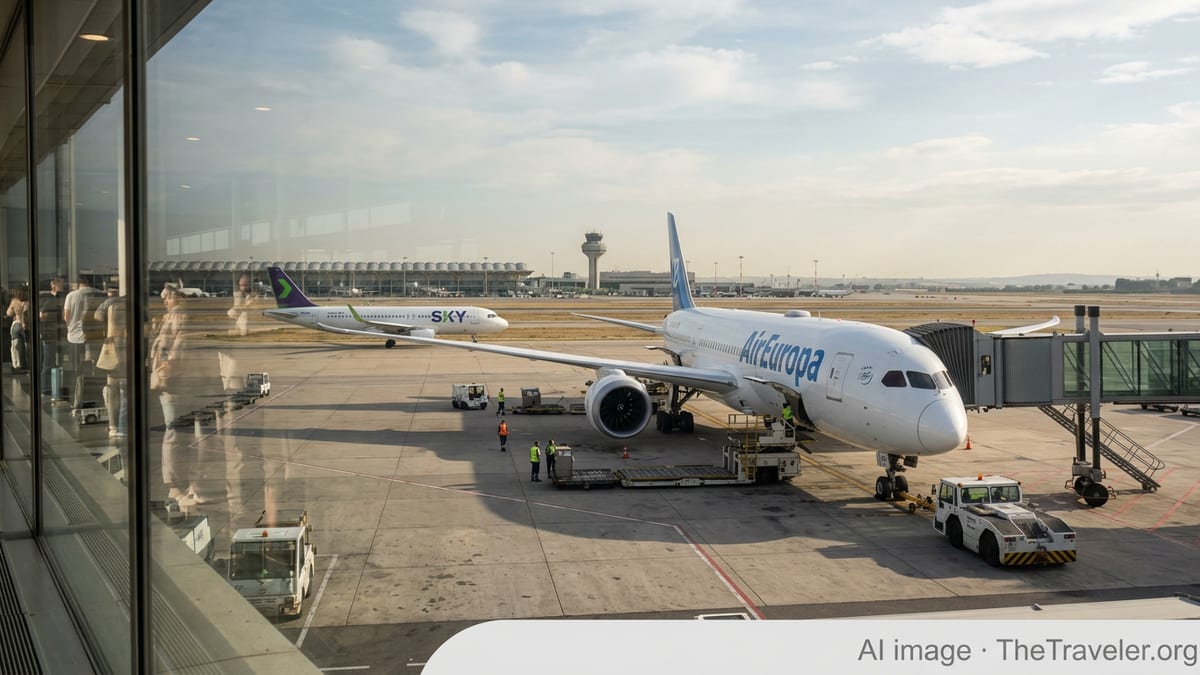
Chilean low cost carrier SKY Airline has signed its first-ever codeshare agreement with Spanish airline Air Europa, creating new one-ticket connections between Madrid and a growing network of destinations in Peru and Chile as both carriers look to capture rising demand between Europe and South America.
Get the latest news straight to your inbox!
Strategic Partnership Links Madrid With SKY’s Andean Network
The new codeshare elevates an existing interline relationship that SKY Airline and Air Europa have maintained since 2024, formalizing a deeper commercial alliance between the two carriers. Under the agreement, Air Europa will place its UX code on select SKY-operated flights in South America, enabling passengers to book seamless itineraries that connect Air Europa’s long haul services from Madrid to secondary cities across Peru and Chile.
The initial phase of the partnership focuses on the Peruvian market, leveraging Air Europa’s Madrid Lima route as a key gateway into the region. From Lima, SKY operates an expanding domestic and regional network, which will now be marketed in Europe under Air Europa codes, making it easier for European travelers to reach destinations that previously required complex self connections or multiple separate tickets.
SKY Airline, headquartered in Santiago and operating an all Airbus A320neo family fleet, has positioned itself as a major low cost player in the Southern Cone, while Air Europa has built its long haul strategy around Madrid as a hub linking Europe with Latin America. The new codeshare aligns these complementary footprints, with SKY providing regional depth in South America and Air Europa offering long haul feed from across Europe.
The deal also reflects the broader trend of European and Latin American carriers tightening commercial ties to shore up connectivity as travel rebounds, particularly on leisure heavy corridors between Spain and the Pacific coast of South America.
What the Codeshare Means for Passengers
For travelers, the most visible change will be the ability to purchase a single itinerary that combines Air Europa and SKY flights, with one booking reference and baggage checked through to the final destination. Instead of booking separate tickets to Lima and then on to secondary cities such as Arequipa or Santiago, passengers will be able to select through journeys marketed by Air Europa, but partially operated by SKY.
The codeshare structure allows European customers to search for destinations in Peru and Chile that previously might not have appeared in Air Europa’s inventory as a single, through option. This simplifies comparison shopping and reduces the risk of missed connections, as minimum connecting times and protection policies are handled within the framework of a coordinated itinerary.
SKY’s role as a low cost operator is expected to help keep total journey prices competitive, even as passengers gain the benefit of a more integrated product. While the finer details around frequent flyer accrual and recognition under the codeshare have not been fully detailed, the agreement is designed primarily to expand choice and connectivity rather than reposition SKY as a full service carrier.
Operationally, both airlines will coordinate schedules and connection windows at key gateways, starting with Lima and expanding to Santiago as the cooperation matures. This should shorten layovers and make itineraries more attractive compared with self connecting via other hubs in the region.
Building on Interline Foundations and a Growing Latin American Strategy
The codeshare follows a series of commercial moves that have steadily integrated SKY Airline into broader international networks. The Chilean carrier has recently signed interline agreements with Air Europa and other long haul operators, including partnerships that link its South American routes with services from Europe and North America, laying the groundwork for deeper cooperation.
For Air Europa, the SKY agreement slots into a wider Latin American strategy that includes serving more than forty destinations across Spain, Europe and the Americas, with a particular emphasis on long haul flying from Madrid to South and Central America. The airline has been investing in fleet renewal and network optimization to reinforce its position as a bridge between Europe and Latin America.
Industry analysts note that codeshares like this one are becoming increasingly important for mid sized carriers that may not have the scale to serve every market with their own metal. Instead, they rely on regional partners to extend their reach, especially in large and geographically diverse countries such as Peru and Chile where domestic connectivity is a prerequisite for capturing long haul demand.
By formalizing a codeshare with SKY, Air Europa gains access to additional city pairs in South America without having to deploy its own aircraft beyond major gateways. SKY, in turn, gains visibility in European sales channels and access to passengers who might otherwise have chosen competing hubs and airlines.
New Options in a Competitive Europe–South America Market
The Europe to South America market has become one of the most contested long haul arenas, with European network carriers, Latin American flag airlines and low cost long haul operators all vying for a share of resurgent leisure and visiting friends and relatives traffic. Spain, in particular, plays an outsized role thanks to historical ties and a shared language with much of the region.
In this environment, differentiated connectivity is a critical competitive lever. The SKY Air Europa codeshare adds new one stop options from Madrid to secondary South American cities that are not always served nonstop from Europe, giving the partnership a niche advantage on certain routes. For travelers in smaller Spanish and European markets feeding into Madrid, the ability to continue seamlessly on to Andean destinations may prove a compelling alternative to connecting through other continental hubs.
The partnership also underscores Madrid’s growing role as a rival to other European hubs for Latin American traffic. As Air Europa and SKY coordinate timetables and expand the scope of the codeshare, Madrid stands to capture additional volumes of passengers who might otherwise have connected via airports in northern Europe or through competing hubs in Brazil and Argentina.
At the same time, the deal intensifies competitive pressure on South American carriers that have traditionally dominated regional flows beyond major gateways. By pairing low cost regional flights with a European long haul network, SKY and Air Europa are positioning themselves to win price sensitive travelers who still value the protection and convenience of a single itinerary.
Future Growth Potential Across Peru and Chile
While the codeshare launches with a focus on Peru, both airlines have signaled that Chile will play a growing role as the partnership evolves. Santiago is one of SKY Airline’s principal hubs and a major South American city with strong demand to and from Europe, both for business and tourism.
As connectivity stabilizes and demand patterns become clearer, additional SKY routes from Santiago and regional Chilean cities could be added under Air Europa’s code, broadening the network of destinations accessible from Madrid. This would further strengthen the carriers’ joint presence in the Southern Cone and provide more alternatives to existing transatlantic and regional combinations.
Fleet developments at both airlines support the long term potential of the collaboration. SKY continues to grow its Airbus A320neo family fleet, which offers lower operating costs on short and medium haul sectors, while Air Europa is in the midst of a widebody and narrowbody renewal program tailored to its transatlantic ambitions. As new aircraft come online, schedules and capacities can be fine tuned to maximize connectivity at Lima and Santiago.
For travelers, the evolution of the codeshare is likely to translate into a broader choice of schedules and destinations between Europe and South America over the next few seasons, reinforcing the role of Madrid, Lima and Santiago as key nodes in an increasingly interconnected transatlantic network.