

More news on this day
Greek airline SKY Express has temporarily suspended all flights between Athens and Tel Aviv after Israel ordered a closure of its airspace, adding to a widening wave of travel disruption across the Middle East and forcing passengers to seek alternative routes.
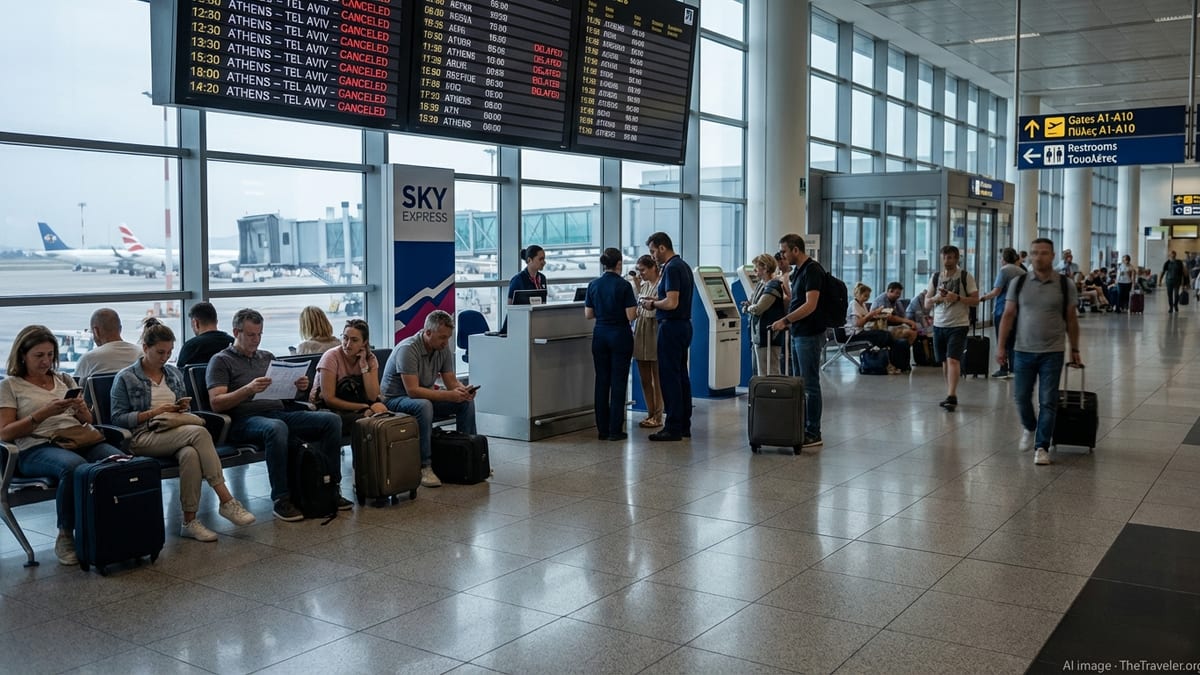
Airspace Closure Forces Sudden Suspension on March 1–2
SKY Express confirmed that all scheduled services between Athens International Airport and Tel Aviv’s Ben Gurion International Airport are cancelled for the period from Sunday March 1 to Monday March 2, citing Israel’s decision to close its airspace to civilian traffic. The move follows a sharp escalation in regional tensions and comes as authorities prioritize operational safety over continuity of service.
The airline said the restriction, communicated through official aviation notices, leaves carriers unable to operate to or from Tel Aviv during the specified window. As of March 1, this effectively severs one of the key short-haul links between Greece and Israel, a route that serves both business travelers and a growing leisure and pilgrimage market.
The Athens based carrier joins a rapidly expanding list of airlines across Europe, the Middle East and Asia that have either halted flights to Israel or rerouted services to avoid the affected airspace. The closure has rippled through global networks, lengthening flight times on some long haul routes and stranding passengers who were due to connect through the region.
What Affected SKY Express Passengers Can Do Now
SKY Express is offering three main options for customers booked on the cancelled Athens–Tel Aviv flights. Passengers can rebook free of charge on a future flight on the same route, choose a credit voucher equal to the value of their ticket, or request a full refund. The free change option is notably generous in scope, allowing rebooking on departures through the end of 2026, offering substantial flexibility for those willing to postpone travel.
Travelers who opt for a credit voucher will receive an amount matching the original ticket price, valid for 12 months from issuance. This approach is designed to keep future travel plans open, particularly for passengers who are unsure when routes will stabilize and are reluctant to lock in new dates immediately.
For those who prefer to cancel outright, SKY Express is processing cash refunds on request. The airline says customers on affected flights have been contacted individually with instructions. Travel agents report that processing times may be slower than usual given the volume of impacted bookings, and passengers are advised to keep all documentation, including original itineraries and payment confirmations, to streamline claims.
Alternatives via Regional Hubs Remain Uncertain
In normal times, passengers between Greece and Israel could reroute via major hubs such as Istanbul, Larnaca, Dubai or Doha. The current situation is more complex. Several Gulf and regional carriers have suspended services or curtailed operations after the wave of airspace closures across Israel and neighboring states, sharply reducing onward options.
From Athens, some travelers are looking at connections via European capitals that still operate limited services to destinations in the eastern Mediterranean. However, with Tel Aviv effectively closed to scheduled commercial traffic during the current restriction, alternatives largely involve waiting for operations to resume or rerouting to nearby countries and completing journeys overland if and when it is deemed safe and legally permissible.
Travel consultants in Athens say demand for last minute changes has spiked, with some passengers seeking to reroute upcoming trips toward alternative city breaks within Greece or to other European cities. Others are choosing to defer travel altogether until there is clearer guidance from aviation authorities and a more predictable operating environment.
Knock On Effects at Athens International Airport
Athens International Airport has seen a growing list of cancellations and diversions tied to the Middle East crisis, with SKY Express’s Tel Aviv suspension adding to a mounting operational challenge. Other carriers serving Israel and nearby destinations have already adjusted schedules, cancelled sectors or shifted routings to avoid closed or congested airspace corridors.
Airport officials have warned that departure and arrival boards may change at short notice as airlines respond to updated safety assessments and regulatory notices. Passengers are being urged to arrive early, monitor their flight status frequently and maintain direct contact with their airline or travel agent, particularly for itineraries that include connections beyond Athens.
The disruption also affects inbound tourism flows into Greece from Israel, a market that has grown steadily in recent years. Hotels and tour operators catering to Israeli visitors are bracing for cancellations and late rebookings, even as they field inquiries from travelers seeking reassurance about future trips later in the year.
Global Context: Middle East Turbulence Reshapes Flight Paths
The SKY Express suspension is part of a broader shock to the global aviation system, triggered by military strikes and retaliatory actions that prompted authorities in multiple Middle Eastern countries to restrict or close their airspace. Long haul routes linking Europe and North America with South and East Asia are among those feeling the impact, with airlines forced to detour around large swathes of the region.
Aviation experts note that rerouting adds flying time, raises fuel burn and drives up costs for carriers already grappling with thin margins. Some airlines have responded by cancelling select services altogether, while others are implementing technical stops for refueling or revising schedules to keep crew within legal duty limits.
For travelers, the result is a patchwork of delays, missed connections and rolling cancellations that can change from hour to hour. Industry analysts say the pace at which airlines and regulators restore normal service will depend on both the security outlook and the speed with which air navigation authorities deem key corridors safe for civilian traffic again.
Until then, passengers booked on SKY Express and other affected airlines are advised to keep plans flexible, use mobile apps or direct airline channels to track changes in real time, and build in additional time for any itinerary that previously relied on transiting through or near the impacted airspace.