

More news on this day
A new player in the emerging space tourism ecosystem is drawing attention in California, as Skydream has unveiled a concept “space camping” travel trailer in Silicon Valley that aims to blend traditional RV comforts with technologies inspired by orbital habitats.
Get the latest news straight to your inbox!
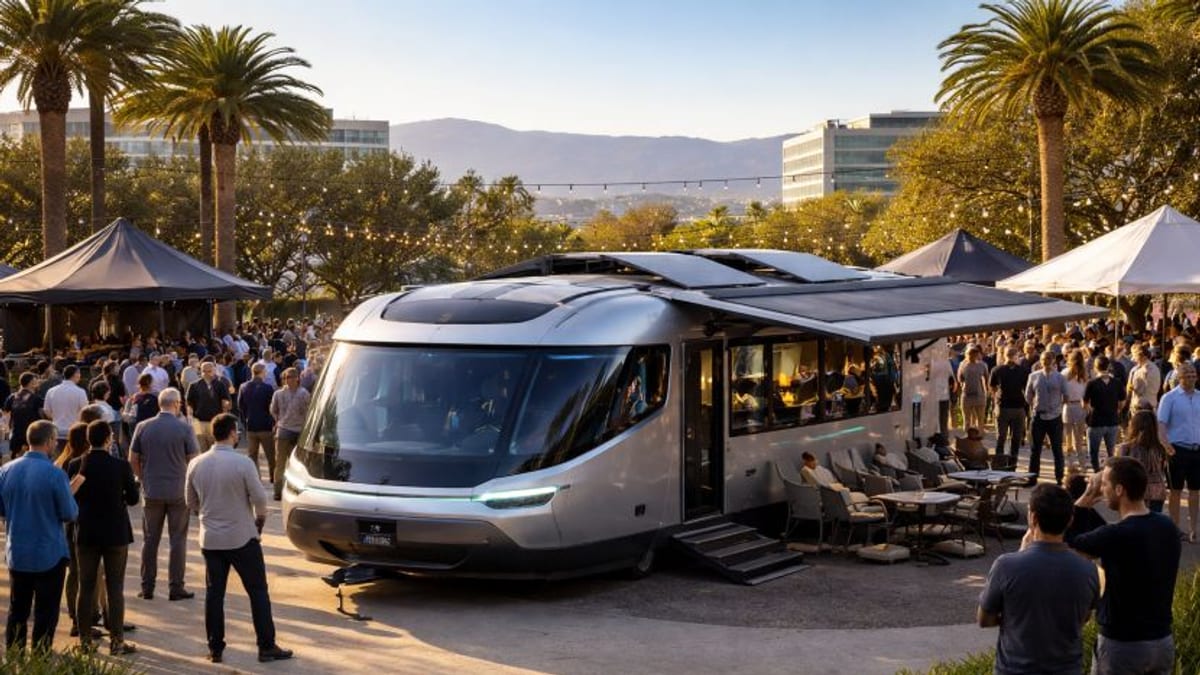
Image by Travel And Tour World
A Concept Bridging RV Culture and Space Tourism
According to available product information and event coverage, Skydream’s space camping travel trailer is being positioned less as a conventional towable and more as a demonstrator for how future travelers might live on the edge of Earth’s atmosphere. The project appears to target early adopters intrigued by private spaceflight, commercial launch services, and high-end overland travel.
Publicly available descriptions indicate that the trailer’s design language borrows heavily from spacecraft aesthetics, with a smooth, capsule-like exterior and an emphasis on modular interiors. Observers note that it is intended to serve as a movable base camp for space launch viewing, astronaut training experiences, or high-tech remote work retreats near spaceport facilities in the United States.
Industry commentary suggests that Skydream is seeking to tap into a convergence of markets: the established RV and travel trailer sector, the growing community around launch tourism, and a broader consumer interest in space-branded experiences. The Silicon Valley unveiling is seen as an effort to connect with investors, engineers, and early customers who are already familiar with both high technology and camping culture.
While details around pricing, production volume, and reservation timelines remain limited, the debut reinforces how terrestrial products are increasingly being marketed through a space exploration lens. Analysts point out that the move follows a pattern of technology-focused brands using Silicon Valley events to showcase transportation concepts that may evolve over several development cycles.
Design Inspired by Orbital Habitats
Available imagery and descriptions emphasize that Skydream’s trailer concept is built around a pressurized, pod-like structure echoing the look of contemporary crewed spacecraft and space station modules. Instead of a traditional wood-and-aluminum RV box, the company appears to favor a curved, composite shell intended to maximize strength while maintaining a futuristic profile.
The interior layout, as described in launch materials, focuses on multi-use zones rather than fixed rooms. Fold-out berths, convertible seating, and integrated storage echo the way space agencies and private operators organize confined habitats. Surfaces are reportedly chosen to be durable, light-colored, and easy to clean, evoking the feel of a spacecraft cabin more than a rustic camper.
Technical notes shared in public channels highlight a strong emphasis on power management. The trailer is expected to feature large battery reserves, roof-mounted solar arrays, and extensive low-voltage lighting similar to that used in aerospace environments. Observers say this approach aligns with the needs of travelers who might park for extended periods at remote locations near launch sites or dark-sky regions.
Ventilation, climate control, and noise insulation also appear to draw on space habitat thinking. The concept is presented as a sealed, energy-efficient environment where temperature and airflow can be finely tuned, an idea borrowed from life support systems but adapted for comfortable long-term camping on Earth.
Targeting Launch Viewers and High-Tech Campers
Reports from the Silicon Valley launch indicate that Skydream is deliberately targeting a niche audience rather than the mass-market RV buyer. The trailer is being marketed to people who already budget for private astronaut experiences, launch viewing trips, and extended off-grid adventures tied to space events.
The company’s messaging, as summarized in coverage, frames the trailer as a mobile “mission base” for journeys to launch ranges, desert test grounds, and remote observatories. Instead of emphasizing campground hookups, Skydream highlights the trailer’s ability to operate for substantial periods using stored power and renewable generation, an attractive proposition for travelers who camp on public lands or near temporary event sites.
Industry analysts note that the timing aligns with a broader rise in space-related tourism in the United States. Commercial launch providers have made rocket liftoffs a regular spectacle along both coasts, while space-themed attractions and training programs have proliferated. Against this backdrop, a trailer specifically marketed as a space camping platform seeks to carve out a new, experience-driven subcategory in the towable market.
Market observers also point out that the concept reflects the influence of technology-centric consumer expectations. Prospective buyers may be less impressed by traditional RV luxury and more interested in integrated sensors, app-based monitoring, and the ability to synchronize the trailer’s systems with personal devices, features that Skydream is expected to emphasize as development progresses.
Advanced Materials, Power Systems, and Connectivity
Technical overviews of the Skydream trailer concept describe a strong focus on lightweight materials and structural efficiency. Composites and aerospace-inspired alloys are reportedly part of the design toolkit, with the aim of keeping towing weights manageable while still allowing for extensive insulation and integrated systems.
Energy independence features prominently in the concept narrative. Skydream is expected to equip the trailer with a large roof-mounted solar array paired with high-capacity batteries, enabling occupants to run climate control, lighting, and communications without constant generator use or campground hookups. This mirrors strategies seen in expedition vehicles and off-grid tiny homes, but wrapped in a space-themed identity.
Connectivity is framed as another defining feature. Publicly available descriptions reference satellite-ready communication options, extensive interior data wiring, and support for remote monitoring of power, temperature, and security. Such systems would allow owners to track their trailer from afar and to prepare it for arrivals at spaceport-adjacent locations or remote star-gazing sites.
In addition, observers say Skydream is likely to experiment with modular external attachments that reinforce the “space mission” motif, such as deployable workstations, observation awnings, or sensor masts. While many of these elements remain at the concept stage, they contribute to the trailer’s positioning as a platform for experimentation rather than a static, finished product.
Positioning Within a Crowded Innovation Landscape
The Silicon Valley launch places Skydream among a wider group of companies exploring how to reimagine ground-based travel experiences through the lens of aerospace innovation. Over the past several years, concept vehicles and trailers tied to electric trucks, autonomous driving, and off-world themes have captured public attention, even when only a fraction of them reach full-scale production.
Industry commentary suggests that Skydream’s challenge will be to move beyond imagery and secure the partnerships, certifications, and supply chain capacity needed for a commercial rollout in the United States. Established RV manufacturers have decades of experience with regulations, dealer networks, and after-sales support, while newer entrants often rely on limited-production models and direct-to-consumer sales.
Observers note that Skydream’s choice of Silicon Valley as a debut venue underscores the company’s focus on technology-forward branding and investment appeal. The region’s ecosystem of hardware startups, venture funds, and space-related firms creates a receptive audience for a concept trailer tied rhetorically to human expansion into space.
As interest in both RV travel and commercial spaceflight continues, analysts expect more crossovers between the two sectors. Skydream’s space camping travel trailer, presented as a bridge between Earthbound road trips and orbital ambitions, illustrates how manufacturers are experimenting with new narratives to capture consumers who view travel as part of a broader fascination with the future of human exploration.