

More news on this day
Private jet charter prices on key routes linking Europe, Asia and the Gulf are soaring to record levels as war in Iran and widespread Middle East airspace closures collide with surging insurance and operating costs, reshaping how the world’s wealthiest travelers and corporations move around the globe.
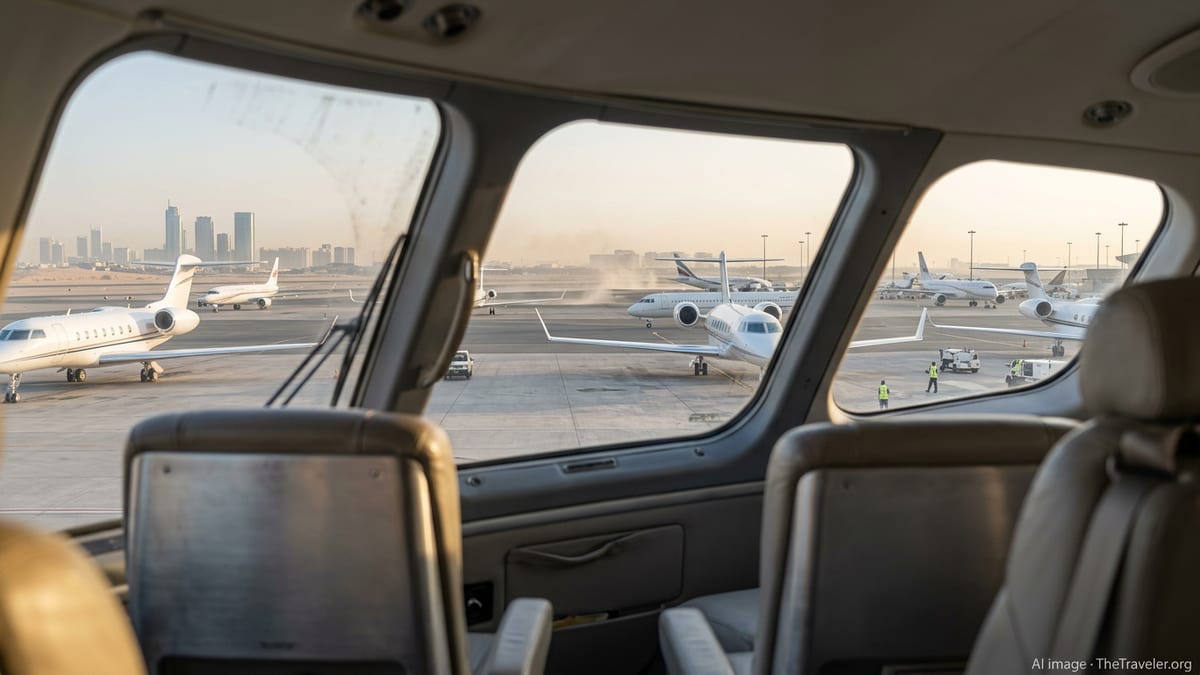
Middle East Conflict Turns Private Jets Into Escape Hatches
The latest escalation of war involving Iran has rapidly transformed private aviation from a discretionary luxury into an emergency lifeline for travelers with the means to pay. As airspace closures rippled across Iran, Iraq, Israel, Bahrain, Kuwait and parts of the Gulf at the end of February 2026, hundreds of thousands of airline passengers were left stranded while high net worth individuals raced to book scarce charter capacity out of the region.
Private jet brokers and operators report that charter requests from Dubai, Abu Dhabi, Doha, Riyadh and Manama have jumped sharply since the conflict intensified. In some cases, stranded travelers are opting to drive for hours to secondary airports in Saudi Arabia or Oman before boarding a charter aircraft capable of reaching Europe or South Asia on non-standard routings that avoid restricted airspace.
The imbalance between surging demand and limited aircraft availability is pushing prices sharply higher. On popular evacuation routes from the Gulf to Europe, charter brokers say quotes that would typically come in around 100,000 euros for a large-cabin jet are now reaching up to 200,000 euros for a single one-way flight, as operators factor in repositioning, circuitous routings and elevated risk.
Iranian Airspace Closures Force Longer, Costlier Routings
The closure of Iranian airspace is central to the cost spike. Iran sits astride one of the most important aviation corridors linking Europe with India, Southeast Asia and Australia, and business jet operators rely heavily on that geography to keep flight times and fuel burn in check. When Tehran’s flight information region is off limits, aircraft must detour via Turkey, Central Asia or the Arabian Sea, often adding an hour or more of flight time to long-haul sectors.
Even when Iran technically reopens its skies, many operators choose to stay clear for longer because their internal risk assessments and insurance requirements treat the region as a conflict zone. That caution mirrors the approach taken after earlier flashpoints, including the April 2024 Iranian strikes on Israel, which prompted temporary airspace closures across the region and forced wide rerouting of commercial traffic.
These detours carry a direct financial hit. Jet fuel already accounts for roughly 30 percent of an aircraft’s operating costs in normal times. With each additional hour in the air, private operators must burn more fuel, pay more in overflight and navigation fees to multiple jurisdictions, and build in extra crew duty time and rest. All of those inputs are now being bundled into charter quotes, with clients bearing the full cost of geopolitical detours they did not anticipate when planning their trips.
War-Risk Insurance Premiums Surge for Business Jets
If longer routings are the most visible impact for passengers, soaring war-risk insurance is the financial shock reverberating through operators’ balance sheets. Aviation insurers entered 2026 already on edge after years of elevated claims linked to the conflicts in Ukraine and the Red Sea. The sudden spread of hostilities involving Iran and the effective shutdown of large chunks of Middle East airspace have intensified that strain, with hull and liability markets now described by brokers as “under duress.”
Specialist underwriters are rapidly repricing cover for any aircraft operating near declared conflict zones, including business jets used for evacuation or repatriation flights. Industry consultants say premiums for aircraft flying evacuation missions in West Asia have jumped sharply in recent weeks, both through explicit war-risk surcharges and higher base rates for hull and liability cover.
The private jet charter sector is particularly exposed because operators cannot easily self-insure these risks and have less leverage than major airlines when negotiating with global insurers. Smaller fleets in Europe, the Gulf and Asia are being asked to shoulder higher annual premiums and to pay ad hoc surcharges for each movement that skirts the conflict region. Those additional insurance costs, sometimes running into tens of thousands of dollars per aircraft, are being passed through directly to charter customers.
Gulf–India and Europe–Asia Routes See Extreme Price Spikes
Among the routes seeing the sharpest disruptions are those linking the Gulf with India and other South Asian destinations. Travel agencies in India report charter quotes of 5 to 7 million rupees for seven or eight seat private jets on short Gulf–India legs, as thousands of workers and tourists attempt to leave the region amid rolling flight cancellations. In several cases, operators have resorted to using narrowbody airliners configured for charter to move larger groups, but even that has not fully relieved the pricing pressure.
Europe–Asia business aviation corridors are also being redrawn. Flights that once cut efficiently across Iran now thread through congested airspace over Turkey, the Caucasus or the southern Arabian Sea, placing additional pressure on neighboring flight information regions and driving up navigation and handling fees. Fixed-base operators from Dubai to Muscat and Jeddah report increased demand for ground support from rerouted business jets, even as regulators prioritize government, military and scheduled commercial flights.
For corporate travel managers booking private aircraft for executives, the cost implications are stark. What might previously have been a predictable six-figure annual spend on selective European or Asian charters is now subject to sudden spikes when itineraries intersect with the Middle East. Some companies are delaying or consolidating trips rather than paying emergency charter rates, while others in sectors such as energy and finance view the higher costs as unavoidable if they are to maintain on-the-ground presence in volatile markets.
Global Private Aviation Rethinks Risk, Pricing and Networks
The upheaval in and around Iran is accelerating a broader recalibration in global private aviation that began with earlier conflicts and supply chain shocks. Industry reports forecast that the private jet charter market will continue to grow in value over the next several years, yet operators warn that rising inputs such as fuel, maintenance, crew salaries and especially insurance are squeezing margins and making traditional pricing models harder to sustain.
Operators are increasingly building geopolitical risk and potential airspace closures into their forward planning. Some are revising charter contracts to include explicit conflict-zone surcharges or to reserve the right to reroute at short notice, even if it lengthens journeys. Others are rebalancing fleets toward aircraft with greater range and fuel efficiency, giving them more routing flexibility when large airspace blocks suddenly become unavailable.
For travelers, the net effect is a private aviation landscape that feels more fragile and more expensive. While demand remains robust in core markets such as North America and parts of Europe, the shocks radiating from the Middle East are a reminder that global connectivity for business jets is only as stable as the political map beneath them. As long as Iranian airspace remains a flashpoint and war-risk premiums stay elevated, charter clients on intercontinental routes can expect higher quotes, tighter availability and a level of uncertainty that no amount of luxury cabin service can fully smooth over.