

More news on this day
Travelers on both sides of the Atlantic are facing fresh disruption as a new wave of flight cancellations involving SkyWest Airlines in the United States and Gulf Air in the Middle East leaves passengers stranded from Michigan’s Upper Peninsula to Istanbul, with knock-on effects for routes to Detroit, Bahrain and beyond.
Get the latest news straight to your inbox!
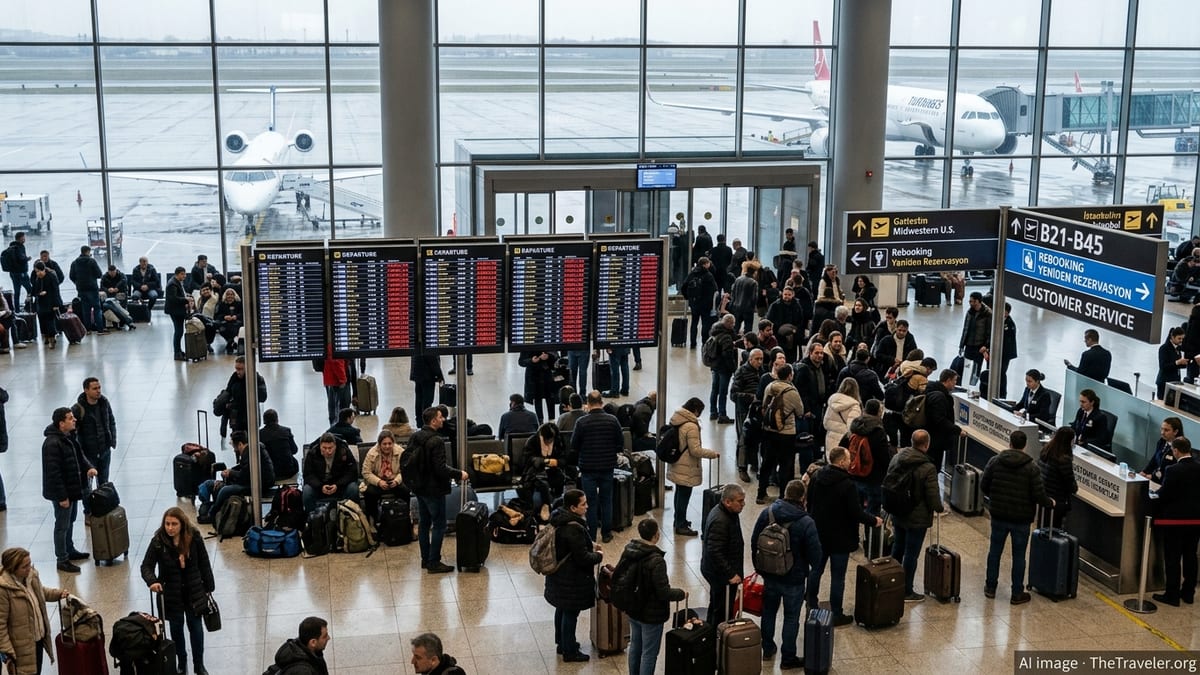
Five More Flights Scrapped as Strain Grows on Key Hubs
Recent schedule updates and operational data indicate that at least five additional services linked to SkyWest-operated routes in the Upper Midwest and Gulf Air’s Bahrain network have been pulled in recent days, compounding an already fragile situation for travelers. The latest cancellations follow weeks of irregular operations at Detroit Metropolitan Wayne County Airport and continuing disruption across Gulf air corridors after the late February escalation in the Iran conflict.
In the United States, SkyWest’s role as a regional operator for major carriers such as Delta means that a single cancellation can quickly cascade across multiple spokes in the network. Earlier March disruptions at Detroit Metro involving SkyWest, Delta and other airlines have already produced significant same-day cancellations and delays, leaving limited slack for recovery when new problems arise.
Across the Middle East, Bahrain-based Gulf Air remains in a prolonged period of reduced or suspended activity following missile and drone strikes that hit Bahrain on February 28, 2026, and triggered broad airspace closures in the region. Publicly available flight-tracking and passenger reports show that Gulf Air has repeatedly extended its free cancellation and rebooking policies into late March, signaling that more flights are being trimmed from the schedule than initially anticipated.
The combined effect is a widening patchwork of cancellations that now touches routes feeding into Istanbul and Detroit, as well as long-haul itineraries that rely on Bahrain as a key transit hub between Europe, Asia and Africa.
Marquette and Detroit Feel the Impact of SkyWest Disruptions
In Michigan’s Upper Peninsula, Marquette’s Sawyer International Airport sits at the end of thin regional routes that are particularly vulnerable when SkyWest-operated services to major hubs are withdrawn. County minutes and airport planning documents show that SkyWest is scheduled to operate new Chicago O’Hare flights later in 2026, underscoring how dependent the region is on a small number of regional jets and carefully timed rotations.
Recent winter weather has added extra stress. A powerful mid-March storm system brought blizzard conditions and record snowfall to parts of Michigan, including the Marquette area, prompting widespread cancellations across Upper Midwest airports. When conditions deteriorate, regional flights are often the first to be cut, and their removal can break critical connections from Marquette through Detroit to the rest of the United States.
Detroit Metro, meanwhile, has been contending with a series of congested days marked by dozens of cancellations and nearly two hundred delays on some dates in early March. Travel coverage focused on Detroit indicates that SkyWest’s delayed or cancelled regional operations have repeatedly fed into this congestion, especially on routes linking smaller Great Lakes communities. Passengers have reported missed connections and overnight stays after regional feeders failed to arrive in time for long-haul departures.
The newest round of five cancellations affecting SkyWest-linked itineraries appears to continue this pattern, undercutting the reliability of connections from Marquette and other spoke cities into Detroit just as demand begins to build for spring travel.
Gulf Air’s Bahrain Hub Remains Constrained After Airspace Crisis
On the other side of the world, Gulf Air is still working through the fallout from late February’s military strikes and the subsequent closure or restriction of airspace across much of the Gulf region. Coverage of the crisis notes that Bahrain, along with Iran, Iraq, Israel, Jordan, Kuwait, Qatar, the United Arab Emirates and other states, imposed sweeping restrictions that forced airlines to cancel flights or adopt lengthy detours around the affected skies.
Reports on Bahrain’s national carrier indicate that Gulf Air relocated aircraft out of Bahrain International Airport and sharply curtailed commercial operations as the situation evolved. While some Gulf corridors have begun to reopen cautiously, passenger accounts and airline policy updates suggest that Gulf Air flights remain heavily disrupted, with free cancellations and changes now extended for departures throughout most of March.
Travelers transiting Bahrain have described multiple cancellations in succession, with itineraries between Europe or Asia and onward destinations such as Muscat, Bangkok or London being rebooked or rerouted at short notice. In some cases, passengers have opted to abandon Bahrain connections entirely, instead seeking alternatives via Istanbul, Doha or European hubs.
The latest five cancellations affecting Gulf Air services appear to fall squarely within this extended disruption window, amplifying uncertainty for those holding onward tickets through Bahrain, including passengers trying to reach or depart from Istanbul.
Istanbul Caught Between European Reroutes and Gulf Cutbacks
Istanbul, one of the world’s busiest transfer hubs, has become a pressure valve for airlines and passengers trying to navigate the partial shutdown of Gulf airspace while also contending with operational turbulence in North America. Travel industry analysis notes that Turkish Airlines and other carriers have adjusted schedules in response to regional tensions, including suspensions of certain routes to Gulf destinations.
With Bahrain and neighboring states limiting operations, Istanbul has absorbed rerouted traffic from airlines that normally rely on Gulf hubs for Europe-to-Asia connectivity. This shifting traffic pattern has brought more passengers into the Istanbul system even as some itineraries via Bahrain and other Gulf cities remain off sale or subject to last-minute change.
For travelers whose journeys were originally planned via Detroit and Bahrain, Istanbul now often appears as a substitute waypoint in rebooked itineraries. However, the added volume increases the risk of bottlenecks when new cancellations arise, whether from SkyWest-linked disruptions upstream in North America or further schedule revisions in the Gulf region.
In practical terms, this means that a single cancellation on a regional flight from Marquette to Detroit can ripple outward, severing connections to transatlantic services and onward links to Istanbul that might otherwise have served as alternatives to disrupted Bahrain routes.
What Affected Travelers Should Watch in the Coming Days
With conditions still evolving, publicly available information from airports, airline schedules and passenger advisories points to several key themes for travelers caught in the latest SkyWest and Gulf Air disruptions. First, flexibility remains crucial. Gulf Air’s extended free cancellation period through late March suggests that further adjustments are possible as Bahrain’s operational status firms up and as airlines refine their use of reopened corridors.
Second, passengers relying on regional feeders, especially those departing from smaller airports such as Marquette, should closely monitor early morning departures and inbound aircraft rotations. Aviation data and prior disruption patterns show that when weather or system constraints force reductions, regional frequencies are often trimmed before mainline services, which can abruptly sever the first link in a multi-leg journey.
Third, travelers connecting through Istanbul, Detroit, or both should be prepared for longer journey times and potential re-routing. Middle East airspace closures have already extended many Europe–Asia flights by two to five hours as carriers bypass restricted zones, and that knock-on impact can tighten aircraft and crew availability across entire fleets.
Finally, while the immediate triggers differ, the SkyWest and Gulf Air disruptions highlight how regional weather, geopolitical shocks and hub congestion can converge into a single travel experience for passengers. With five more flights now canceled across these intertwined networks, travelers heading to or from Istanbul, Detroit, Bahrain and secondary cities like Marquette face a period of heightened uncertainty as airlines work to stabilize schedules.