

More news on this day
Slovenia is preparing for a defining moment in its rise as a cycling nation, with the 2026 European Road Cycling Championships in Ljubljana expected to turn an already fast-growing bike culture into one of the most powerful tourism engines in Europe.
Get the latest news straight to your inbox!
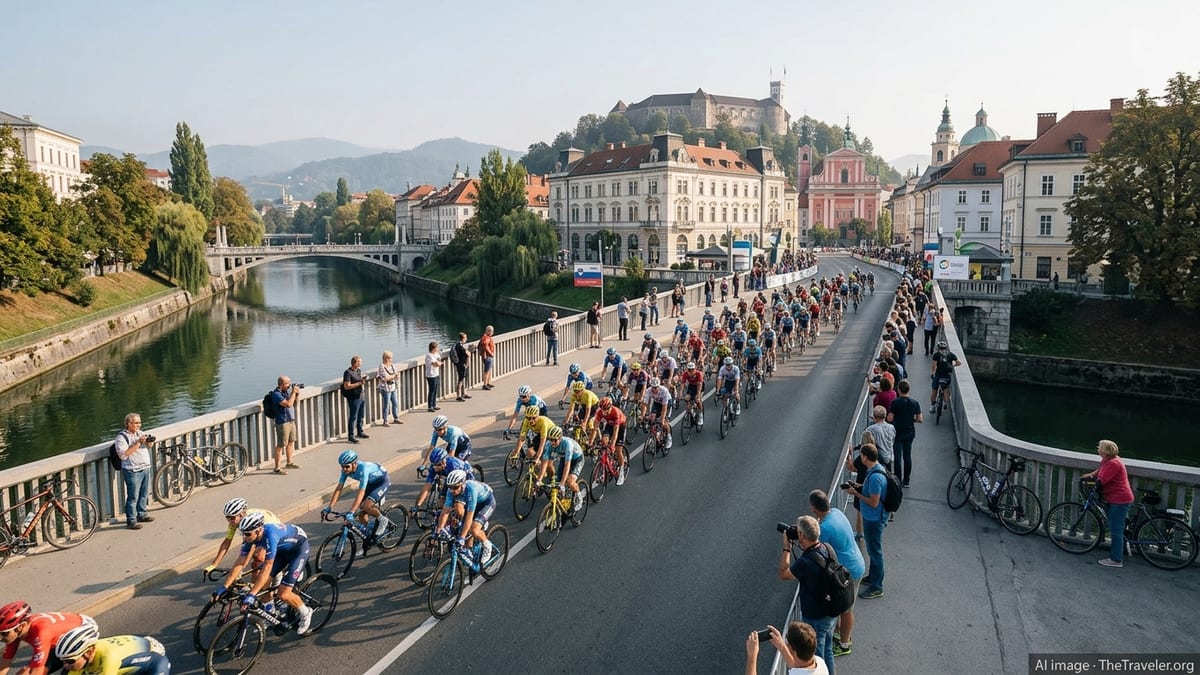
Ljubljana Set to Become Europe’s Cycling Capital in October 2026
Publicly available information from the Union Européenne de Cyclisme shows that Slovenia and its capital Ljubljana will host the 2026 UEC Road European Championships from 3 to 7 October 2026, placing the country at the centre of the continent’s elite road racing calendar. The championships will bring together the best men’s and women’s riders, juniors and elites, for road races and time trials on a compact set of urban and suburban circuits.
Reports indicate that the racing will be concentrated around Ljubljana, using routes that showcase both the historic city core and its green hinterland. The event is expected to lean heavily on Slovenia’s reputation for safe, well-maintained cycling routes and its growing portfolio of car-light infrastructure in and around the capital.
Tourism planners are treating the championships as a flagship moment in a broader multi-year strategy to brand Ljubljana as a premier European city-break destination for active travellers. Sustainability indicators published by local tourism bodies show that the length of cycling paths in the Ljubljana destination has risen markedly in recent years, underscoring how the city has been preparing its streets and green corridors for exactly this kind of showcase.
With the championships falling in early October, just after the peak summer travel period, Slovenian tourism organisations are positioning the event as a way to extend the season. Industry analyses suggest that major cycling championships often deliver a dual benefit: a short-term spike in visitor nights and a visible, televised advertisement that keeps drawing cyclists and spectators long after the medals are awarded.
A Golden Era of Champions Fuels Global Curiosity
Slovenia enters the 2026 championships in the midst of what many in the cycling world have described as a golden era. According to international cycling coverage, Tadej Pogačar and Primož Roglič have transformed the country’s image from an under-the-radar Alpine destination into a global benchmark for high-performance road racing, with multiple Grand Tour victories and world titles between them.
This success has already had tangible tourism effects. The national tourism board has promoted Slovenia as the homeland of cycling champions in major broadcast markets, including extensive placements during Tour de France coverage. Publicly available campaign material emphasises that fans can ride on the same mountain passes and rolling backroads that shaped the country’s elite riders.
Travel operators report that guided tours themed around Slovenia’s star cyclists now form a visible niche segment, particularly in the Julian Alps and around iconic climbs such as Vršič Pass and the ascents above Kranjska Gora and Kobarid. The 2026 championships are widely expected to amplify that demand, especially if home riders line up on the start line as favourites for the European title.
Industry observers note that Slovenia’s profile is unusual in European tourism: it is small, highly photogenic and associated simultaneously with cutting-edge sport and protected natural landscapes. This combination is seen as a powerful draw for visitors who want to blend spectating with their own days on the bike, rather than treating the event as a stand-alone city trip.
Infrastructure Investments Turn Leisure Riders into Long-Stay Visitors
Over the past several years, Slovenia has quietly built the foundations of a cycling revolution. Government data and national promotional materials highlight that public investment in cycling infrastructure has risen significantly, with per-capita spending on new bike paths and connections among the highest in the region. New routes link city centres with surrounding countryside and connect previously fragmented local paths into continuous touring corridors.
Official tourism information describes Slovenia as a popular cycling destination where road, gravel and mountain-bike routes all sit within short travel distances. The Koper to Izola coastal path, the emerald Soča Valley, wine-growing regions in Brda and Štajerska, and the lakes around Bled and Bohinj are singled out as areas where high-quality paths and quiet roads already support a steady flow of foreign cyclists.
European media coverage indicates that cycling tourism in Slovenia generated several million euros in spending in the years following the pandemic, with app-based route tools and local guiding services multiplying quickly. Each visiting cyclist typically spends on accommodation, food, equipment and support services, and organisers hope that the publicity surge around the 2026 championships will further increase average length of stay.
Crucially, Ljubljana’s hosting role is dovetailing with a wider network approach. By showcasing routes that radiate from the capital toward Alpine, karst and wine regions, planners see the championships as a trigger that can disperse visitors across the country, rather than concentrating all benefits in a single urban core.
Economic Windfall and Season Extension Across Regions
Past cycling championships in other European destinations, such as Yorkshire and Flanders, have been followed by reported double-digit increases in visitor numbers along highlighted routes in subsequent years. Slovenian tourism strategists are using these examples as benchmarks when modelling the potential impact of the 2026 event on arrivals and overnight stays.
Slovenia’s tourism statistics already show strong momentum. Data for 2023 recorded around 6.2 million tourist arrivals and more than 16 million overnight stays nationally, both new records at the time. Analysts tracking the sector argue that integrating high-profile sports events into this growth trajectory could lift the value of tourism receipts more rapidly than incremental marketing alone.
Accommodation providers in Ljubljana and surrounding regions are preparing for a surge in demand not only during race week but also in the months around it, as amateur cyclists book reconnaissance trips to ride parts of the course. Rural guesthouses, wine estates and farm stays situated near likely training roads are being promoted as authentic, low-impact bases for longer holidays.
There is also an expectation that the championships will support new jobs in guiding, bike maintenance, transport and event operations. Tourism researchers point out that cycling visitors tend to travel outside the most intense summer weeks, which helps smooth demand and makes seasonal employment more stable, a key objective for many Slovenian regions.
Positioning Slovenia as Europe’s Model for Green Cycling Tourism
Slovenia has long marketed itself under a green tourism brand, and cycling is rapidly becoming one of the clearest expressions of that strategy. National campaign materials present cycling as a low-emission way to experience protected landscapes, from Triglav National Park to the Karst plateau and the Drava cycling route in the northeast.
According to sustainability indicators published for Ljubljana, the city has continued to increase the density of cycling paths while monitoring local residents’ attitudes toward tourism. Recent figures show relatively high levels of citizen support for tourism development, suggesting that investments in active mobility and careful visitor management are helping to mitigate some of the pressures seen in larger European capitals.
Destination managers are using the run-up to 2026 to pilot crowd-dispersion tools, improved public transport links for bikes and clearer wayfinding between train stations and key cycling routes. The intention is to ensure that new visitors attracted by the championships can move through the city and out into the countryside without overwhelming sensitive areas or local communities.
With its compact size, strong rail connections to neighbouring countries and a rapidly expanding network of bike paths, Slovenia is positioning the 2026 European Road Cycling Championships as a proof point for how elite sport, everyday mobility and sustainable tourism can reinforce one another. If forecasts are borne out, the event will not only crown champions on Ljubljana’s streets but could also mark the moment when Slovenia emerges as one of Europe’s most influential cycling destinations.