

More news on this day
As Japan’s tourism rebounds with a new emphasis on slower, more sustainable itineraries, a pocket of northern Nagano known as Shinshu is emerging as a model for rail-based travel that trades frantic city-hopping for temple bells, vintage trains and quiet onsen streets after dark.
Shinshu’s New Moment in Japan’s Tourism Story
The mountainous region historically known as Shinshu, roughly corresponding to today’s Nagano Prefecture, has long been famous among domestic travelers for soba, winter sports and hot springs. In the past two years, it has begun to attract a different kind of international visitor: people looking to slow down, travel mostly by rail and base themselves in compact, walkable towns rather than major cities.
Local tourism officials say that interest has accelerated since late 2023, as travelers look beyond Tokyo, Kyoto and Osaka and seek itineraries that feel more rooted in everyday Japanese life. Shinshu’s mix of mid-sized Nagano City, historic temple districts and intimate hot spring towns has positioned the area as a test case for this shift, offering extended-stay rail passes, multilingual signage and new visitor centers tailored to independent travelers.
At the core of this emerging pattern is a simple route: from Tokyo to Nagano by shinkansen, then onward by the Nagano Dentetsu private railway to the onsen towns clustered around Yudanaka. Along the way, travelers are encouraged to build in time for Zenkoji Temple, small museums, local markets and leisurely walks through streets that retain their Showa and even Edo-era character.
Rather than racing between “must-see” icons, visitors on this route are being nudged toward a layered experience that can stretch over three or four nights, knitting together Nagano City, Zenkoji’s temple quarter and the hot springs of Yudanaka, Shibu and smaller communities such as Kakuma Onsen.
Nagano City: Gateway to a Different Pace
Nagano City, reached in about 90 minutes from Tokyo by Hokuriku Shinkansen, functions as the practical and psychological gateway to this slower style of travel. The compact area around Nagano Station has seen a quiet increase in mid-range hotels and small guesthouses, many of them marketing longer stays and weekday discounts to encourage visitors to linger rather than pass through en route to ski resorts.
From the station’s Zenkoji Exit, the traditional shopping avenue leading toward the temple is lined with soba restaurants, confectioners and small galleries, making walking itself part of the experience. Local guides note that more overseas visitors are timing their arrival to match seasonal events, from February’s lantern festivals and winter illuminations to cherry blossom viewing in April and maple leaves in November.
City officials have also used the lull during the pandemic years to upgrade multilingual wayfinding and promote themed walks that highlight Nagano’s role as a former temple town and Olympic host city. Visitors are encouraged to explore beyond the main temple approach, taking in Joyama Park, small residential lanes and bathhouses frequented by locals, which can be reached on foot or by short bus rides.
Crucially for the new Shinshu itineraries, Nagano Station has become the transfer point where high-speed rail ends and a slower, more intimate experience begins, as travelers descend to the Nagano Dentetsu platforms beneath the main concourse.
Zenkoji Temple: A Pilgrimage at the Heart of the Route
Zenkoji Temple, one of Japan’s most important Buddhist pilgrimage sites, sits just under two kilometers north of Nagano Station and anchors the cultural dimension of the journey. Founded in the 7th century to enshrine what is regarded as one of the country’s earliest Buddhist images, the temple today combines deep spiritual resonance with an accessible, walkable precinct that feels both grand and human-scale.
Open year-round, Zenkoji responds visibly to the seasons. In April, cherry trees frame the broad stone approach and nearby Joyama Park, while summer brings hydrangeas to the gardens and a quieter pace after the spring crowds. Autumn covers the complex in ginkgo gold and maple red, and in winter the dark wooden halls stand out against snowfall that often blankets Nagano City.
For many travelers, the appeal lies less in ticking off a landmark than in participating in rituals that slow the day down. Early-morning “Oasaji” services, when priests and nuns walk the approach to bless worshippers, invite visitors to be present before tour buses arrive. Inside the main hall, a pitch-dark underground corridor, where pilgrims search for a symbolic “key to enlightenment,” is experienced in near silence, broken only by footsteps on wooden planks.
Zenkoji’s role in Shinshu’s new tourism push is also practical. Temple lodgings, small guesthouses and design-focused hotels in the surrounding streets make it possible to spend a full day in the area without backtracking to larger cities, weaving spiritual heritage into a multi-day rail journey that continues deeper into northern Nagano.
Nagano Dentetsu: Vintage Carriages and a Slower Line North
From Nagano, the private Nagano Dentetsu line, often called Nagaden, provides the rail spine for the onward journey to Yudanaka. Trains depart from the underground station connected to JR Nagano, with local services and limited express trains such as the Snow Monkey and Yukemuri linking the city to rural towns and ski areas along the valley.
The line has become part of the attraction in its own right. Travel companies and regional tourism bodies note growing interest in the railway’s retro rolling stock and weekend “leisure” services that slow down to highlight scenery, vineyards and river views. On certain days, special event trains spotlight local wine and sake, echoing a broader effort across Japan to revive regional rail as an experience rather than just a means of transport.
The ride from Nagano to Yudanaka takes about 50 minutes by limited express or a little over an hour on local trains, with the route passing smaller communities such as Suzaka, Obuse and Shinshu-Nakano before climbing gently into the hills. For many visitors, staying on the slower local service is deliberate, allowing time to look out at fruit orchards, farmhouses and temple roofs that appear between tunnels.
Tourist information counters now encourage travelers to build these intermediate stops into their plans, suggesting brief visits to Obuse’s museum district or short walks from rural stations to local shrines. It is a contrast to the high-speed journeys that define much of Japan’s rail network and an example of how regional lines are repositioning themselves as curated experiences.
Yudanaka Onsen: Gateway to Hot Spring Country
When the train pulls into Yudanaka, the terminus of the Nagano Dentetsu line, passengers step onto a compact station forecourt that serves as the gateway to one of Nagano’s classic onsen regions. The town sits at the base of the Shiga Kogen highlands, with hot spring districts including Yudanaka, Shibu and Kanbayashi strung along the river valleys above.
Recent updates from local tourism organizations describe how Yudanaka has been adapting its infrastructure to handle a more international, independent crowd. Station signage in English and other languages highlights options that range from local buses and taxis to pre-booked ryokan shuttles, which now often align their pickup times with popular Nagano Dentetsu arrivals.
The area has also leaned into day-use hot springs and footbaths aimed at rail travelers who may not be staying overnight. Bathhouses within walking distance of Yudanaka Station allow visitors to soak for an hour or two before continuing on, while inns with panoramic open-air baths promote views across the Zenkoji Plain toward the Northern Alps on clear days.
For those with more time, Yudanaka functions as a base for excursions to the famous snow monkeys of Jigokudani and the ski fields of Shiga Kogen, but local planners are increasingly emphasizing the town’s quieter side: narrow backstreets, neighborhood shrines and small bars where the pace slows considerably once the last day-trippers have left.
Shibu Onsen: Cobblestones, Yukata Strolls and Communal Bathhouses
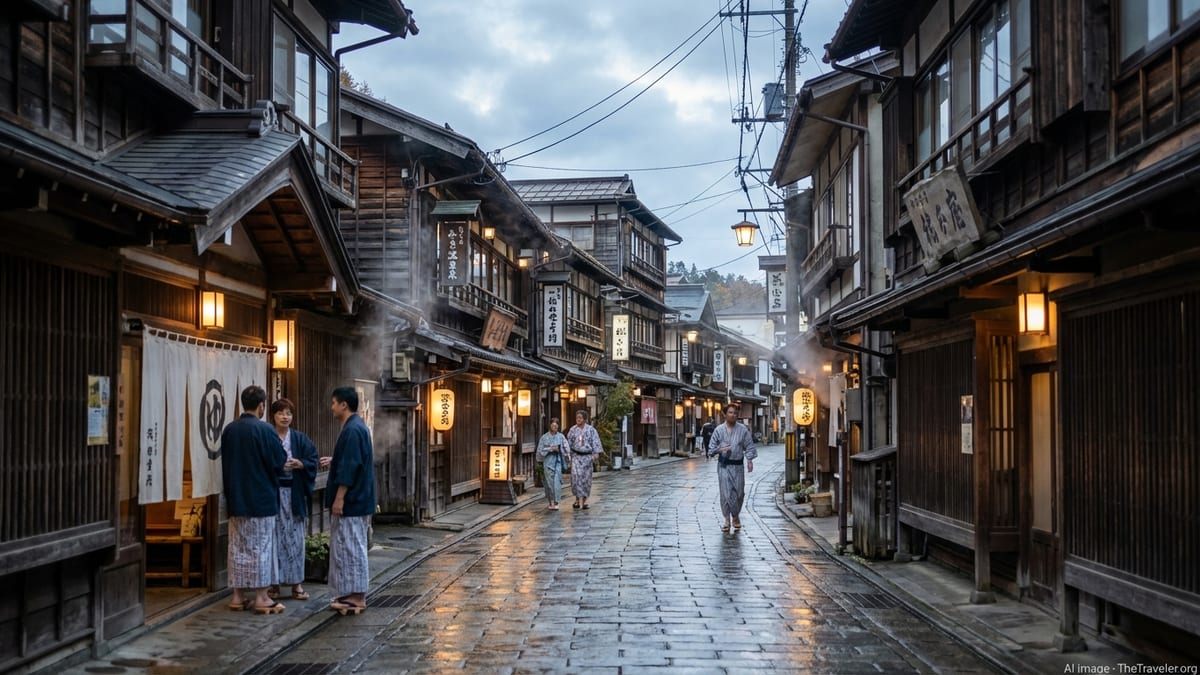
A short bus ride or walk upriver from Yudanaka brings travelers to Shibu Onsen, a tightly packed hot spring town lining a stone-paved street beside the Yokoyu River. The district’s wooden ryokan, some dating back generations, have become emblematic of Shinshu’s nostalgic appeal, with weathered facades, latticed balconies and glowing lanterns at dusk.
Tourism materials highlight Shibu’s network of nine communal bathhouses, each fed by its own spring source and offering slightly different mineral compositions and temperatures. Guests staying at local inns receive keys that grant them access to the full circuit, turning an evening or two into a layered bathing pilgrimage that complements the spiritual journey begun at Zenkoji.
Scenes of visitors walking the narrow street in cotton yukata and wooden geta sandals have become a familiar image in domestic travel magazines and social media posts. Yet away from peak holiday periods, Shibu retains the feel of a lived-in town, with local residents visiting bathhouses for their daily soak and small eateries catering as much to neighbors as to overnight guests.
As international travel resumes, business owners in Shibu Onsen say they are balancing visibility with preservation. Many ryokan have added basic multilingual support and online booking while keeping interiors traditional, emphasizing tatami rooms, seasonal kaiseki meals and baths where rules are explained patiently rather than altered.
Beyond the Classics: Kakuma Onsen and Quieter Corners of Shinshu
While Yudanaka and Shibu Onsen attract most of the headlines, Shinshu’s slow-rail narrative increasingly includes smaller, less publicized hot spring settlements such as Kakuma Onsen. Located in the broader Nagano region and typically reached by a combination of train and local bus or taxi, Kakuma offers a more understated experience that appeals to repeat visitors and those seeking time away from crowds.
Facilities in these outlying onsens tend to be modest, with one or two inns anchoring clusters of houses and farms. What draws travelers is not grand architecture but the rhythm of rural life: fields just beyond the baths, local produce at dinner and night skies largely free of city light. For planners designing longer Shinshu itineraries, these communities add depth, showing how hot springs function as everyday infrastructure rather than tourist-only attractions.
Regional tourism offices have quietly begun promoting such places under themes of “deep Shinshu” and “satoyama stays,” encouraging visitors who have already seen the more famous onsen towns to spend a night in locations where conversations with innkeepers and neighbors may be the main activity. Access information is being translated and included alongside more prominent destinations to make these smaller onsens feel less intimidating to first-time visitors.
In this way, Kakuma Onsen and similar hamlets are becoming part of a broader experiment in dispersing tourism across Nagano Prefecture, lightening pressure on marquee spots while bringing economic activity to communities that have struggled with depopulation.
Redefining Japan Travel Through Slow, Connected Journeys
The emerging route through Nagano, Zenkoji Temple, Yudanaka, Shibu Onsen and quieter hot spring enclaves like Kakuma Onsen reflects wider changes in how people want to experience Japan. Rail passes and social media may still drive initial interest, but once on the ground, many visitors are choosing to move less, stay longer and link experiences that share a sense of place rather than a checklist of icons.
Local stakeholders in Shinshu point out that this approach also aligns with sustainability goals. Encouraging visitors to arrive by shinkansen, continue on a regional private railway and walk or use short bus hops between compact districts reduces dependence on private cars and spreads spending across multiple towns. It also gives travelers more opportunities to adjust plans in response to weather, seasonal events or local recommendations.
For Nagano, the challenge ahead lies in managing this growth without eroding the qualities that make the region attractive: the quiet of Zenkoji at dawn, the sight of steam rising between wooden eaves in Shibu Onsen and the unhurried conversations that happen in small station waiting rooms along the Nagano Dentetsu line. As more people discover Shinshu through slow rail, the success of this experiment will be measured as much in preserved atmospheres as in visitor numbers.
For now, the journey from Nagano’s underground platforms to the cobblestones of Shibu and the tucked-away baths of Kakuma Onsen offers a glimpse of what a different kind of Japan trip can look like, built not around speed but around a string of places that invite travelers to stop, soak and stay awhile.