

More news on this day
As South Africa’s tourism sector settles into a steadier post-pandemic recovery, the Great Karoo is emerging as a quiet counterpoint to big-city itineraries, inviting travellers to trade packed schedules for lingering in its vast, high-plains landscapes.
Get the latest news straight to your inbox!
Slow Travel Finds Its Moment in South Africa
Publicly available tourism data indicates that international arrivals to South Africa climbed to nearly 9 million in 2024, with further gains reported in 2025. Within that broader rebound, tourism analysts and regional strategies increasingly single out lesser-known, inland regions as places where sustainable, higher-value travel can grow. The Great Karoo, a semi-arid plateau stretching across the interior of the country, is among the landscapes benefiting from this shift.
National and provincial tourism documents describe the Karoo as an area of big skies, sparse settlements and layered cultural history, contrasting with South Africa’s coastal resorts and marquee safari parks. For travellers, that translates into long horizons, gravel roads and a markedly slower rhythm of life. It also aligns closely with global wellness and nature trends that emphasise unhurried stays, reflective experiences and light-impact exploration.
Recent industry commentary suggests that South Africa’s recovery is strongest where destinations encourage longer visits and deeper engagement rather than high-volume day trips. In that context, the Great Karoo’s remoteness, limited bed capacity and night skies free of heavy light pollution are being repositioned as assets rather than obstacles. The region’s draw is less about ticking off attractions and more about how it feels to simply be there.
Travel features and trade releases highlight that this changing mindset dovetails with a broader reassessment of how visitors move around the country. Road trips, rail journeys and multi-day loops through interior provinces are being promoted as alternatives to quick flights between major hubs. The Karoo sits at the heart of many of these slower routes, turning what was once considered an empty space between cities into the main event.
The Art of the Linger on Karoo Roads
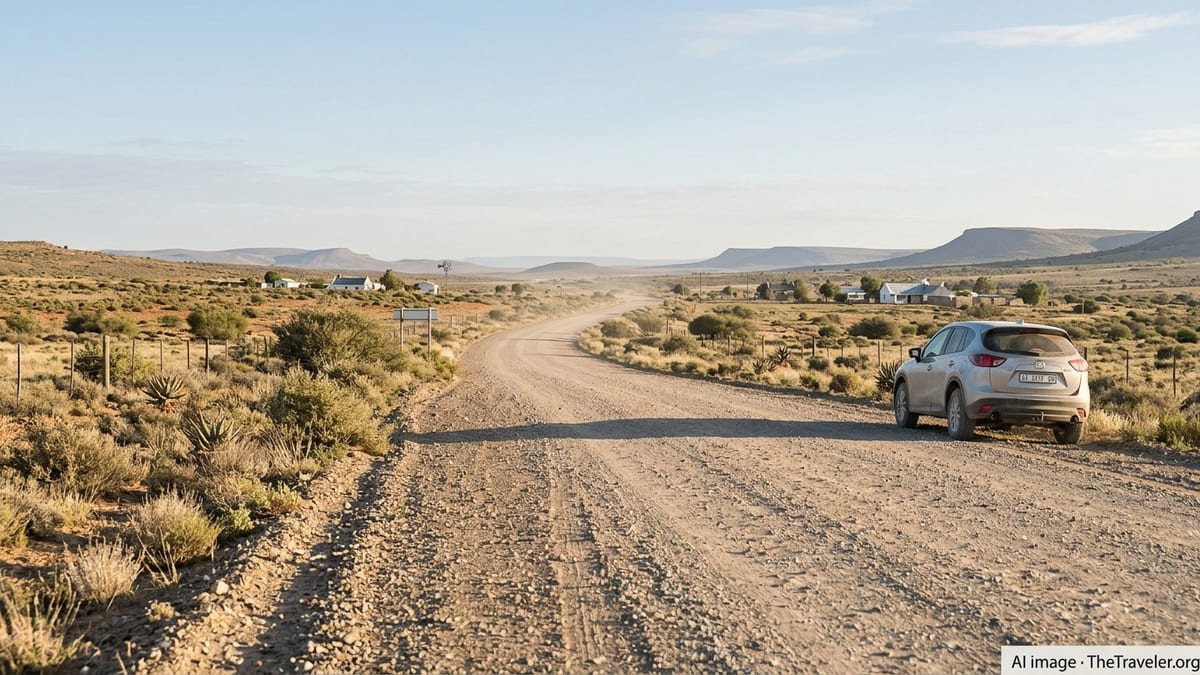
Slow travel in the Great Karoo often begins behind the wheel. The region is criss-crossed by national highways and quieter secondary roads that link Cape Town, the Garden Route, the Eastern Cape interior and the Northern Cape. Online trip reports and road-planning discussions increasingly frame the Karoo not as a stretch to be rushed through in a single day, but as a place where extra nights transform a transfer into a journey.
These accounts commonly describe modest daily distances, scenic detours and unscripted stops at farm stalls, padstals and view sites. Practical advice stresses that South Africa’s interior roads reward conservative speeds, generous rest breaks and flexible itineraries. Seen through a slow-travel lens, the long hours between towns become an opportunity to notice shifting geology, weather patterns and the sudden presence of wildlife on the verges.
Safety-conscious guidance still encourages travellers to plan fuel stops carefully, avoid night driving where possible and factor in gravel stretches that demand lower speeds. Within those boundaries, the Karoo’s emptiness is being reframed as part of its appeal. Tourism messaging and personal narratives alike emphasise that allowing extra time on the road turns potential fatigue into a meditative experience as the landscape gradually reveals its textures.
In many cases, slow itineraries link the Karoo with neighbouring regions, such as the Klein Karoo and the Garden Route. Regional strategies point to these multi-day routes as a way to spread visitor spending more evenly and relieve pressure on coastal hotspots. For travellers, that means more nights in small towns, local guesthouses and national park campsites, and fewer rushed photo stops from a moving car.
Small Towns and National Parks Rethink Their Role
The Great Karoo’s towns are central to this emerging narrative. Places such as Beaufort West, Graaff-Reinet and Nieu-Bethesda are increasingly featured in travel coverage as gateways to both natural and cultural heritage. Public information on Nieu-Bethesda, for example, notes its arts centres, fossil interpretation sites and the well-known Owl House as anchors of a modest but meaningful tourism economy.
Nearby, Camdeboo National Park protects the dramatic Valley of Desolation and high Karoo plains on the edge of Graaff-Reinet, while Karoo National Park near Beaufort West offers self-drive wildlife viewing in a semi-desert setting. National park information highlights loop roads, viewpoints and walking trails that lend themselves to slow exploration rather than quick drive-throughs, with visitors often encouraged to stay multiple nights in rest camps to experience changing light and weather.
Further north, protected areas such as Tankwa Karoo National Park and the newer Meerkat National Park showcase both the region’s biodiversity and its role in scientific research. Meerkat National Park, linked to South Africa’s radio astronomy projects, illustrates how conservation, astronomy and tourism intersect in a landscape prized for its quiet skies and low levels of radio interference. These parks illustrate how the Karoo is being positioned as a place to learn, observe and reflect at a slower pace.
Provincial tourism campaigns, particularly in the Northern Cape and Western Cape, increasingly package these parks and towns into themed routes. Marketing materials highlight stargazing, fossil heritage, birdwatching and farm stays as reasons to linger. Rather than promising constant activity, the emphasis is on the value of silence, dark nights and extended conversations with hosts, all of which resonate with visitors seeking restorative travel experiences.
Wellness, Dark Skies and Climate Awareness
The rise of slow travel in the Karoo also connects to changing attitudes around wellness and climate impact. A recent Africa-focused wellness trends report cited by industry media notes growing demand for nature immersion, digital disconnection and contemplative time in open landscapes. The Karoo’s clear air, wide horizons and relative lack of development fit this pattern, positioning it as an inland counterpart to more established coastal wellness retreats.
Stargazing has become a particular point of focus. Public information on South Africa’s astronomy infrastructure, including major telescopes on the fringes of the Karoo and legislative protection of dark-sky areas, has helped shape the region’s reputation among astro-tourism enthusiasts. Guest farms and lodges increasingly promote night-sky viewing, with simple offerings such as blankets and basic telescopes becoming part of the slow-travel experience.
At the same time, ongoing drought and heatwave reports from parts of southern Africa underscore the fragility of semi-arid ecosystems. Environmental assessments describe plant die-offs and desertification pressures that are already reshaping some Karoo landscapes. Destination managers and conservation bodies present slow, low-impact travel as one way to support local economies while limiting strain on water and infrastructure.
In practice, this can translate into longer stays in fewer places, off-peak travel, and choosing operators that emphasise resource efficiency. Visitors are encouraged through public-facing campaigns to respect water restrictions, stick to designated tracks and support local conservation initiatives. For many travellers, engaging with these realities becomes part of the depth that slow travel promises, fostering a more nuanced appreciation of the Karoo’s resilience.
What the Karoo Reveals When You Stay Longer
For South Africa, promoting the Great Karoo as a slow-travel destination also has economic and social dimensions. Policy papers and tourism analyses stress the importance of dispersing visitor spending beyond established hubs, pointing out that smaller towns often see outsized benefits when travellers stay multiple nights, buy local produce and book community-based activities.
Reports on domestic tourism patterns suggest that South Africans themselves are rediscovering interior road trips, with the Karoo featuring prominently in narratives of family holidays and cross-country drives. As international visitors return, these established domestic habits provide a template for slower, more grounded itineraries that mix iconic sites with quieter detours.
For visitors who accept the invitation to linger, the Great Karoo offers a layered experience that goes beyond its first impression of empty space. Fossil beds hint at deep time, frontier-era churches and graveyards speak to complex settlement histories, and contemporary art centres and festivals show how local communities continue to reinterpret the landscape. None of this reveals itself at highway speed.
As global tourism wrestles with questions of sustainability and meaning, the Great Karoo’s emerging profile suggests that there is room in South Africa’s visitor economy for destinations where stillness, slowness and open horizons are the main attractions. For those willing to adjust their pace, the art of the linger is turning the country’s vast interior into one of its most compelling journeys.