

More news on this day
As visitor numbers climb across Finnish Lapland’s best known resorts, travelers seeking silence, space and star‑filled skies are turning their attention to Pallas‑Yllästunturi National Park, a high‑fell wilderness where the pace of travel is set by weather, seasons and the crunch of boots on tundra.
Get the latest news straight to your inbox!
A Less Crowded Lapland, Still Within Reach
Pallas‑Yllästunturi National Park stretches across western Lapland between the villages of Hetta in the north and Ylläsjärvi and Äkäslompolo in the south. Publicly available information shows it is Finland’s most visited national park, yet its size and dispersed trail network mean visitors can walk for hours without meeting another party outside the busiest fell crossings.
Recent statistics from Finland’s state land manager Metsähallitus indicate that the park records well over half a million visits a year, placing it among the country’s top nature destinations by volume. At the same time, coverage of Lapland’s tourism boom highlights that the most intensive development is clustered around gateway towns such as Rovaniemi and Levi, leaving the park’s interior fells comparatively undeveloped and quiet.
Travel industry reporting suggests that this combination of accessibility and relative seclusion is drawing a new wave of visitors who are less interested in amusement‑park style winter experiences and more focused on self‑guided hiking, skiing and berry‑picking. For many, the national park represents a chance to experience Lapland’s Arctic scenery and deep winter darkness while stepping away from crowds and organized excursions.
Classic Trails and Gentle Day Walks at Your Own Pace
Pallas‑Yllästunturi has a trail network that caters to both seasoned trekkers and travelers looking for shorter, low‑stress outings. According to route descriptions published by Finnish outdoor organizations, the 55‑kilometer Hetta–Pallas route remains the park’s classic multi‑day hike, following a chain of fells across open tundra ridges and birch forests. The route has been in use since the 1930s and is widely described as one of Finland’s most scenic marked trails.
For those preferring day hikes, local tourism boards highlight shorter loops such as the Varkaankuru and Vatikuru nature trails near the Pallastunturi visitor hub, along with easily reached paths beginning close to the Ylläs ski villages. These routes typically combine maintained forest paths, duckboard sections and low fell summits, offering expansive views without requiring technical skills or long days on the trail.
Outdoor guides and recent trip reports note that the park encourages unhurried travel, with open wilderness huts, reservable cabins and basic lean‑tos spaced along many routes. This infrastructure allows hikers to break journeys into shorter segments, pause for weather changes or simply linger on a summit to watch shifting light without rushing to reach the next overnight stop.
Four Seasons of Slow Adventure
In summer and early autumn, the park’s high fells and surrounding mires turn into a corridor for long‑distance hikers, trail runners and bikepackers. Public information from Nationalparks.fi describes dozens of marked routes of varying length, from family‑friendly lakeside walks to multi‑day itineraries that traverse some of Finland’s highest fells. The long northern daylight allows visitors to set their own timetable, walking late into the evening or pausing for extended breaks without worrying about darkness.
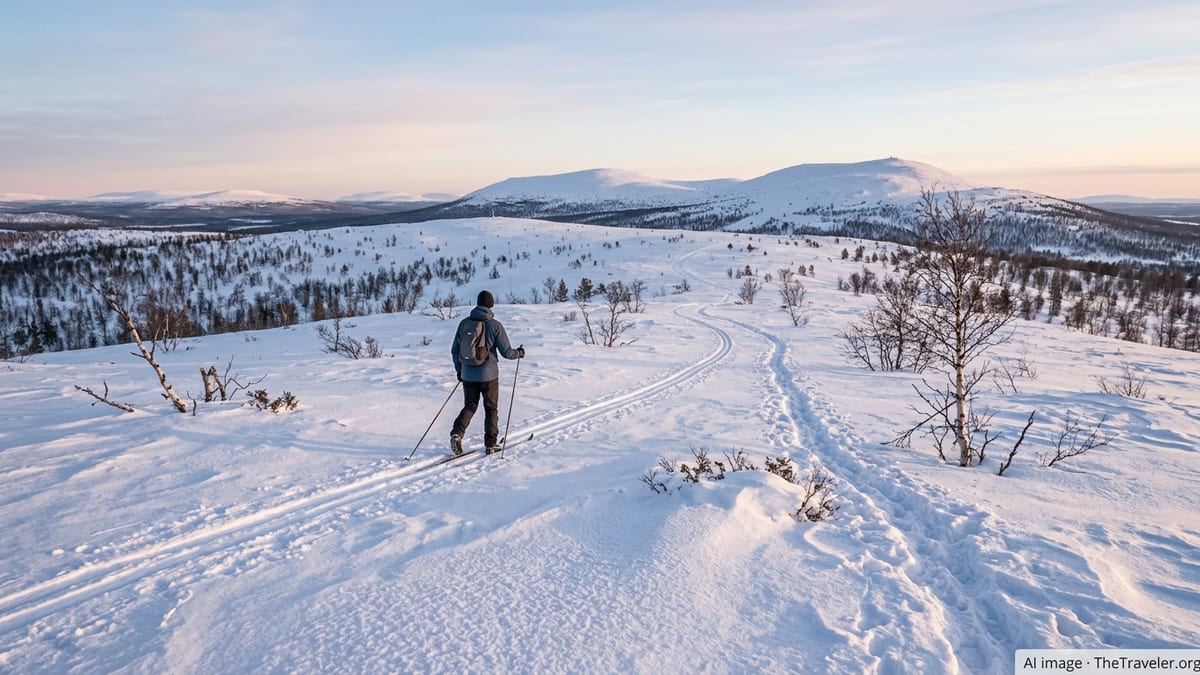
Winter transforms the landscape into what regional tourism bodies describe as one of Europe’s most extensive cross‑country skiing areas, with around 500 kilometers of maintained ski tracks across the broader Pallas‑Ylläs fell system. Many of these tracks run through or alongside the national park, connecting villages, wilderness cafés and open shelters. For travelers more interested in gentle movement than sport performance, the network makes it possible to choose short out‑and‑back routes or relaxed point‑to‑point journeys between trailheads.
Snowshoeing and backcountry tours are also growing in profile, with Finnish outfitters marketing multi‑day hut‑to‑hut trips that stay within the park’s quieter zones. These itineraries often emphasize navigation skills, safety and respect for changing Arctic conditions, encouraging participants to travel slowly, read the terrain and adapt plans to wind and visibility rather than chase fixed daily distances.
Stargazing, Northern Lights and the Sound of Silence
Unlike some of Lapland’s more intensively lit resort areas, much of Pallas‑Yllästunturi remains free of artificial light pollution, particularly away from village centers and main roads. Night sky researchers and tourism analyses note that this darkness improves opportunities for viewing the aurora borealis, which is active throughout the winter season when skies are clear.
Several fell summits inside the park are recognized as vantage points for both northern lights and wide Arctic panoramas. Visitor information highlights Pallas, Taivaskero and nearby ridges as locations where, in stable weather, travelers can watch shifting curtains of light while surrounded by snowfields and near‑complete silence. In summer, the emphasis shifts toward experiencing the midnight sun and soft pastel light that lingers on the horizon for hours.
Reports from recent visitors suggest that this quiet, combined with the absence of large entertainment complexes inside the park boundaries, is a key part of the appeal for travelers seeking to “reset” their internal clocks. Many itineraries now marketed to international guests frame time in the park as a counterbalance to urban noise, with activities built around slow walks, campfire evenings and unhurried mornings in simple cabins.
Balancing Popularity with Protection
The rising profile of Pallas‑Yllästunturi comes at a moment when wider coverage of tourism in Finnish Lapland is focusing on habitat loss, infrastructure pressure and tensions over land use. Environmental analyses have documented rapid growth in construction around some Arctic resorts, along with concerns about the cumulative impact of new roads, holiday villages and motorized excursions on sensitive northern ecosystems.
Within Pallas‑Yllästunturi, Metsähallitus has publicly emphasized sustainable trail design and visitor management, pointing to upgrades such as reinforced paths and improved waymarking on heavily used sections. Economic impact assessments published in recent years indicate that national parks across Finland, including this one, generate significant local income while also providing health and wellbeing benefits that reduce public costs.
Travel advisories increasingly encourage visitors to support these goals by staying on marked routes, choosing non‑motorized activities, using existing accommodation rather than building new informal structures and traveling in shoulder seasons when pressure on popular sites is lower. For international guests, these recommendations align closely with the growing trend toward slow travel, in which fewer flights and longer stays are favoured over short, intensive holiday packages.
As more travelers look beyond Lapland’s headline resorts, Pallas‑Yllästunturi National Park is being framed as a test case for whether high visitor numbers can coexist with genuine wildness. For now, its rolling fells, dark skies and understated infrastructure continue to offer a rare opportunity to reconnect with nature at an unhurried, human pace.