

More news on this day
As visitor numbers surge across the Everest region, a growing share of trekkers are turning to slower, quieter routes inside Sagarmatha National Park, seeking mountain solitude, cultural encounters and lower impact journeys in the shadow of the world’s highest peak.
Get the latest news straight to your inbox!
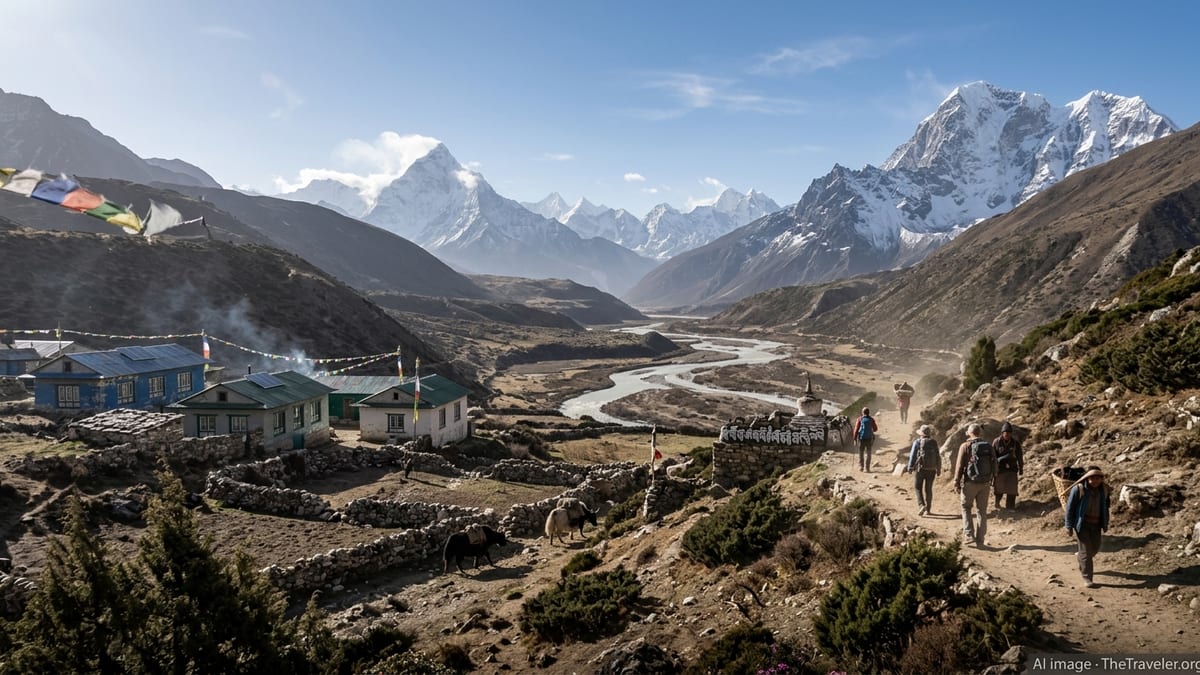
A World Heritage Landscape Under Growing Pressure
Sagarmatha National Park in eastern Nepal covers more than 124,000 hectares of high Himalayan terrain, including the summit of Mount Everest and a dramatic sweep of glaciers, valleys and Sherpa villages. UNESCO documentation describes a landscape where around 69 percent of the park lies above 5,000 metres as bare rock, ice and snow, with only a small fraction forested, underscoring how fragile the ecosystem is at trekking altitudes.
Tourism statistics from Nepal’s government show Sagarmatha among the country’s most visited protected areas, with close to 50,000 foreign visitors recorded in a recent year, even before counting domestic trekkers. In peak spring months, separate reports indicate that daily arrivals in the region can approach 700 visitors, and monthly totals into the park have exceeded 12,000, illustrating how concentrated the flow of people has become along the best known routes.
Conservation assessments describe benefits for local livelihoods, including income for lodges, guides and porters, alongside infrastructure improvements in health and education. At the same time, research by conservation groups highlights mounting challenges ranging from trail erosion and pressure on water supplies to waste management in remote settlements, as overall visitation has more than tripled since the late 1990s.
This combination of exceptional natural value and rapid tourism growth is driving renewed attention to “slow travel” models that shift focus from high‑speed itineraries and single icons to longer stays, lesser‑known villages and a more measured pace on the trails.
Choosing Quieter Trails Beyond Everest Base Camp
The classic Everest Base Camp trek remains the region’s headline attraction, drawing thousands of trekkers each season to a route that passes through Namche Bazaar, Tengboche and Gorak Shep before reaching the glacier‑side outpost below the Khumbu Icefall. Commercial operators and local observers increasingly describe crowding at narrow sections of this corridor, particularly near suspension bridges and popular viewpoints where queues can form during peak hours.
In response, trekking companies and independent hikers have been paying more attention to alternative routes that remain within Sagarmatha National Park but move away from the busiest stretches. The Gokyo Valley is frequently highlighted as a quieter option, with its chain of high lakes and the summit of Gokyo Ri offering commanding views of Everest, Lhotse and Cho Oyu. Guides describe this route as less congested than the direct base camp trail, despite offering comparable altitude and scenery.
Other slow‑paced itineraries focus on side valleys and lower‑elevation spurs. Treks toward Chukhung and the Imja Valley, routes to Ama Dablam Base Camp, and short panoramic circuits that turn back around Khumjung or Phortse are being promoted as suitable for visitors who prefer more time in individual villages rather than pushing to the highest possible overnight stops.
These options are helping to disperse visitors across a broader network of paths. While the overall number of trekkers in Sagarmatha continues to climb, the availability of less trafficked trails is allowing slow‑travel enthusiasts to spend days at a time without encountering the largest groups bound for base camp.
Slow Travel Principles on High Himalayan Paths
Slow travel in Sagarmatha is emerging less as a formal program and more as a set of practices adopted by guiding companies and independent trekkers. Common recommendations include adding extra acclimatization days, limiting daily elevation gain, and planning at least two nights in villages such as Namche Bazaar, Khumjung or Phortse to explore side paths, monasteries and local markets on foot.
Travel features and operator briefings suggest that visitors who spend longer in each settlement tend to distribute their spending across smaller, family‑run lodges and tea houses, rather than concentrating expenditure in just a few large establishments. This pattern is viewed by local development groups as helpful for spreading tourism income more evenly along the trails.
Slow travel advocates in the region also draw attention to low‑carbon choices. Trekkers are encouraged to walk into side valleys instead of booking additional helicopter sightseeing flights, to carry refillable water bottles and purification systems rather than buying single‑use plastic, and to plan itineraries that avoid the tight time pressures which can lead to unnecessary flights or rushed decisions at altitude.
For many visitors, the appeal lies in exchanging a checklist approach for deeper familiarity with Sherpa culture and the rhythms of high‑mountain life. Staying several nights in one place allows participation in morning prayer at monasteries, observation of farming routines where conditions allow, and opportunities to visit local schools or community halls that are part of the park’s lived landscape rather than its postcard views.
Permits, Seasons and Practical Considerations
All visitors to Sagarmatha National Park require an entry ticket, which can be purchased at designated checkpoints and government offices in Nepal. Publicly available information from park and tourism authorities indicates that foreign nationals typically pay higher fees than nationals of South Asian regional countries, with Nepali citizens charged a nominal rate. In parallel, separate local permits are required to enter the Khumbu Pasang Lhamu rural municipality, which covers the main gateway villages used by trekkers.
The main trekking seasons are spring, from around March to May, and autumn, from late September through November. During these windows, weather patterns generally provide clearer mountain views and more stable conditions underfoot, although late‑season snow or early storms can still disrupt routes. Recent coverage on mountain tourism notes that spring in particular has seen strong rebounds in visitor numbers, which is sharpening interest in shoulder‑season travel for those seeking quieter paths.
Travel advisories recommend that trekkers planning slow‑paced journeys still follow standard high‑altitude precautions, including staged ascents, rest days above 3,000 metres and awareness of acute mountain sickness symptoms. Insurance that covers emergency evacuation is widely advised, as even slow itineraries can traverse remote terrain with limited road access.
Operators also encourage visitors to build flexibility into their plans, allowing weather‑related delays on flights between Kathmandu and the airstrip at Lukla, as well as time for trail adjustments if passes are temporarily closed or conditions deteriorate.
Balancing Solitude, Culture and Conservation
As Sagarmatha National Park navigates the dual priorities of conservation and economic opportunity, slow travel is being framed by commentators as one way to reduce pressure on iconic viewpoints while strengthening local engagement. Longer stays in fewer places tend to reduce the number of internal flights and vehicle transfers per trip, while giving visitors more time to learn about environmental issues through local museums, visitor centres and guide briefings.
Non‑profit initiatives such as waste management programs and community‑led conservation projects are increasingly visible in the Khumbu region, with volunteer clean‑up efforts and awareness campaigns targeting popular rest stops and viewpoints. Travel articles suggest that slow‑travel guests are more likely to participate in or financially support these schemes, as their itineraries leave room for half‑day activities not centered on moving to the next lodge.
At the same time, research on mountain tourism in Nepal points to the need for coordinated management so that alternative routes do not simply repeat the overcrowding patterns seen on the main base camp trail. Observers emphasize the value of monitoring visitor numbers in side valleys, maintaining clear guidelines on waste disposal and water use, and reinforcing trail maintenance budgets as less frequented paths gain popularity.
For now, Sagarmatha National Park continues to offer both high‑profile expeditions to Everest and the possibility of quiet days on lesser‑known paths. As global interest in the Himalayas grows, the success of slow travel models in the region is likely to shape how future visitors experience one of the world’s most celebrated mountain landscapes.