

More news on this day
John F. Kennedy International Airport’s multibillion-dollar redevelopment is moving further into the digital era, with the under-construction Terminal 6 and the New Terminal One set to feature advanced signage, biometrics and smart systems aimed at reshaping how travelers navigate one of the United States’ busiest gateways.
Get the latest news straight to your inbox!
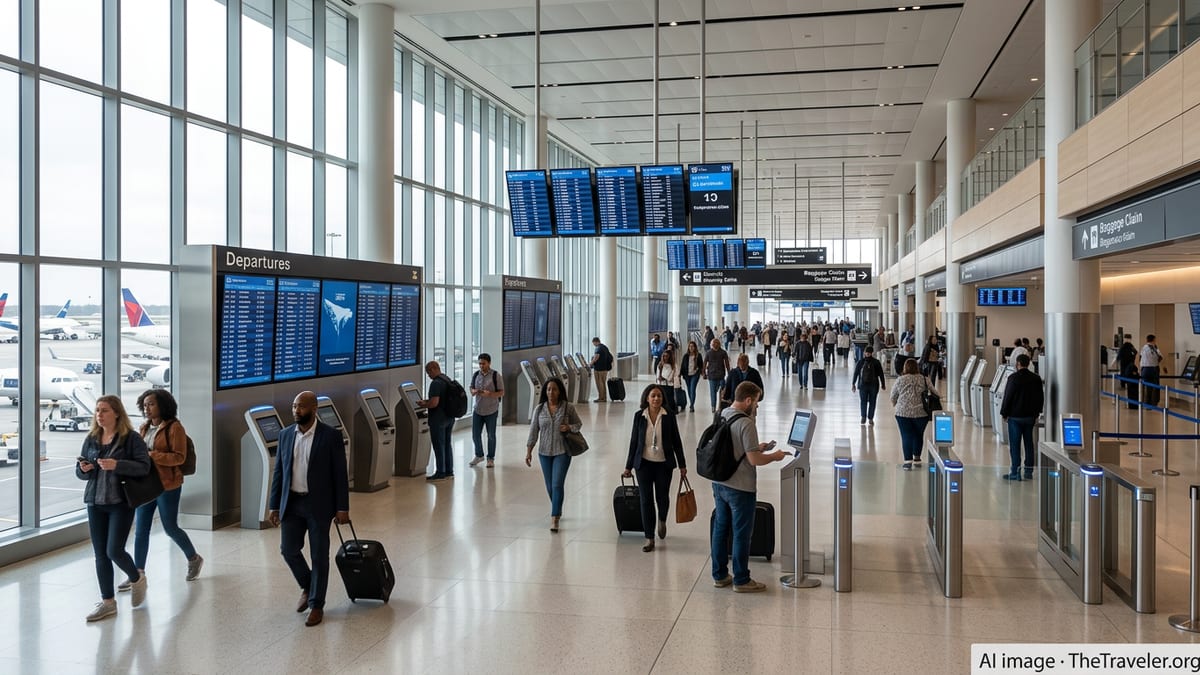
Digital-First Vision for JFK’s Next-Generation Terminals
The Port Authority of New York and New Jersey’s wider 19 billion dollar transformation program at JFK is centered on building two major new terminals while modernizing existing facilities, with technology positioned as a core differentiator. Publicly available information shows that both the New Terminal One and the new Terminal 6 are being designed from the ground up as digital-first environments where information is delivered primarily through networked screens, sensors and mobile integrations rather than static signage. ([aviationpros.com](https://www.aviationpros.com/airport-business/airport-infrastructure-operations/article/55297516/how-jfks-new-terminal-one-reimagines-the-passenger-experience?utm_source=openai))
At the New Terminal One, a 9.5 billion dollar complex being developed on the sites of the current Terminal 1, Terminal 2 and the former Terminal 3, design briefs emphasize a seamless experience from curb to gate. Reports indicate that this includes comprehensive digital wayfinding, flexible content zones, and an infrastructure that allows rapid updates to passenger information across the building. ([aviationpros.com](https://www.aviationpros.com/airport-business/airport-infrastructure-operations/article/55297516/how-jfks-new-terminal-one-reimagines-the-passenger-experience?utm_source=openai))
Terminal 6, a separate 4.2 billion dollar project located on the airport’s north side, is being led by JFK Millennium Partners with Vantage Airport Group as the operating partner. Coverage of the program highlights a strategy that prioritizes digital channels for customer relationship management, navigation and retail discovery, with the goal of driving both satisfaction and commercial performance. ([trbusiness.com](https://www.trbusiness.com/regional-news/the-americas/digital-first-solutions-will-drive-penetration-at-jfk-terminal-6/244529?utm_source=openai))
Advanced Digital Signage and Immersive Displays
Digital signage is expected to be a defining visual feature of both new terminals. In Terminal 6, Vantage Airport Group has described a plan to deploy a coordinated network of large-format screens and targeted displays that can shift in real time between flight information, commercial content and service messaging, shaped by passenger flows and dwell times. This “digital-first” approach is intended to move beyond traditional static advertising toward a dynamic environment that responds to operating conditions and traveler needs. ([trbusiness.com](https://www.trbusiness.com/regional-news/the-americas/digital-first-solutions-will-drive-penetration-at-jfk-terminal-6/244529?utm_source=openai))
At the New Terminal One, design overviews published in aviation and infrastructure outlets point to extensive use of media walls and integrated digital art canvases that double as wayfinding and information points. These displays are planned to carry gate changes, security updates and connection information alongside curated cultural content that reflects New York’s neighborhoods, allowing the terminal’s visual landscape to change throughout the day. ([aviationpros.com](https://www.aviationpros.com/airport-business/airport-infrastructure-operations/article/55297516/how-jfks-new-terminal-one-reimagines-the-passenger-experience?utm_source=openai))
Behind the scenes, both terminals are being fitted with centralized content management systems so that messages can be updated instantly across hundreds of endpoints. This is particularly significant during irregular operations, when coordinated digital signage can help redirect passengers, communicate delays or re-route them to alternative security lanes more efficiently than static signage allows. ([aviationpros.com](https://www.aviationpros.com/airport-business/airport-infrastructure-operations/article/55297516/how-jfks-new-terminal-one-reimagines-the-passenger-experience?utm_source=openai))
Biometrics, Smart Processing and Real-Time Operations
The New Terminal One is being positioned as a testbed for end-to-end biometric processing, from check-in to boarding. According to recent coverage, the facility’s technology stack is built to integrate facial recognition and other biometric identifiers into check-in, security and boarding controls, in line with broader U.S. Customs and Border Protection initiatives for international travel. Enhanced Passenger Processing, a next-generation biometric arrivals platform, has already been announced as a key component for international passengers. ([futuretravelexperience.com](https://www.futuretravelexperience.com/2026/02/the-new-terminal-one-at-jfk-partners-with-u-s-cbp-to-transform-international-arrivals-experience/?utm_source=openai))
Operationally, the New Terminal One will also use a virtual control room model and advanced visual docking guidance systems that draw in data from cameras and sensors around the airfield. Published reports describe multiple camera positions, machine-learning tools for object tracking, and integrated controller workstations that offer an airport-wide view to help manage stand allocation, pushback and turnaround times. ([aviationweek.com](https://aviationweek.com/air-transport/gallery-cutting-edge-technology-jfk-airports-new-terminal-one?utm_source=openai))
Terminal 6, meanwhile, is investing heavily in airside smart tech of its own. JFK Millennium Partners has selected an advanced virtual ramp control system, pairing panoramic video feeds with an augmented reality software layer to provide controllers with an overlay of live aircraft and vehicle movements. The system is designed to support more efficient gate use and reduce congestion on the apron, while feeding status updates to terminal-side displays and gate agents. ([reddit.com](https://www.reddit.com/r/augmentedreality/comments/1bngxq3?utm_source=openai))
Wayfinding, Accessibility and Personalized Passenger Journeys
Accessibility has emerged as a prominent theme in the New Terminal One’s technology planning. Public commentary from project leaders and specialist media highlights that biometric touchpoints will be paired with clearly separated flows for passengers requiring additional assistance, supported by digital prompts and staff guided by handheld devices. The terminal’s digital wayfinding tools are being designed to accommodate multiple languages and accessibility needs, including visual contrast considerations and audio support in key areas. ([runwaygirlnetwork.com](https://runwaygirlnetwork.com/2025/07/new-terminal-one-at-jfk-bakes-in-accessibility-as-it-readies-for-debut/?utm_source=openai))
Digital signage in both terminals is expected to link closely with mobile services. Industry coverage suggests that passengers will be able to receive gate changes, boarding calls and routing suggestions directly on their devices, synchronized with physical screens in the building. This approach is intended to reduce confusion in peak periods and to allow passengers to spend more time in retail and dining areas without losing track of key milestones such as boarding and security wait times. ([trbusiness.com](https://www.trbusiness.com/regional-news/the-americas/digital-first-solutions-will-drive-penetration-at-jfk-terminal-6/244529?utm_source=openai))
In Terminal 6, operators are seeking partners that can use data from beacons, Wi-Fi and flight information to shape personalized offers and guidance, such as recommended walking routes based on time to departure or notifications about nearby concessions. Reports indicate that such tools are expected to be layered onto a robust digital backbone, so that new applications can be introduced as passenger behavior and technology standards evolve. ([trbusiness.com](https://www.trbusiness.com/regional-news/the-americas/digital-first-solutions-will-drive-penetration-at-jfk-terminal-6/244529?utm_source=openai))
Commercial Opportunities and Future-Proofed Infrastructure
The focus on advanced digital signage and smart technology is closely tied to the commercial strategies for both developments. Vantage Airport Group has indicated that at Terminal 6, digital channels will play a central role in directing footfall to concession partners, including targeted offers on large-format displays and contextual promotions triggered by flight schedules and occupancy trends. The aim is to use data to balance passenger convenience with higher spending per visit. ([trbusiness.com](https://www.trbusiness.com/regional-news/the-americas/digital-first-solutions-will-drive-penetration-at-jfk-terminal-6/244529?utm_source=openai))
For the New Terminal One, technology infrastructure is being framed as a way to keep the terminal competitive over its multi-decade life cycle. Published analyses note that systems are being specified with open architectures and capacity for future sensor networks, allowing the operator to add new layers such as advanced queue analytics, indoor positioning and next-generation security screening as they mature. ([aviationpros.com](https://www.aviationpros.com/airport-business/airport-infrastructure-operations/article/55297516/how-jfks-new-terminal-one-reimagines-the-passenger-experience?utm_source=openai))
With key phases of the New Terminal One scheduled to open from 2026 and work on Terminal 6 progressing in parallel, JFK’s new generation of terminals is expected to become a showcase for how digital signage and smart systems can be woven into the fabric of airport design. As these projects move toward completion, travelers are likely to see a shift from static, one-size-fits-all information toward environments that update continuously around them, guided by data and responsive technology.