

More news on this day
As major U.S. hubs grapple with construction bottlenecks and chronic congestion, Harrisburg International Airport is quietly building a reputation as one of the easiest places to start a trip in 2026, combining record passenger growth with the kind of fast, predictable experience many larger airports struggle to deliver.
Get the latest news straight to your inbox!
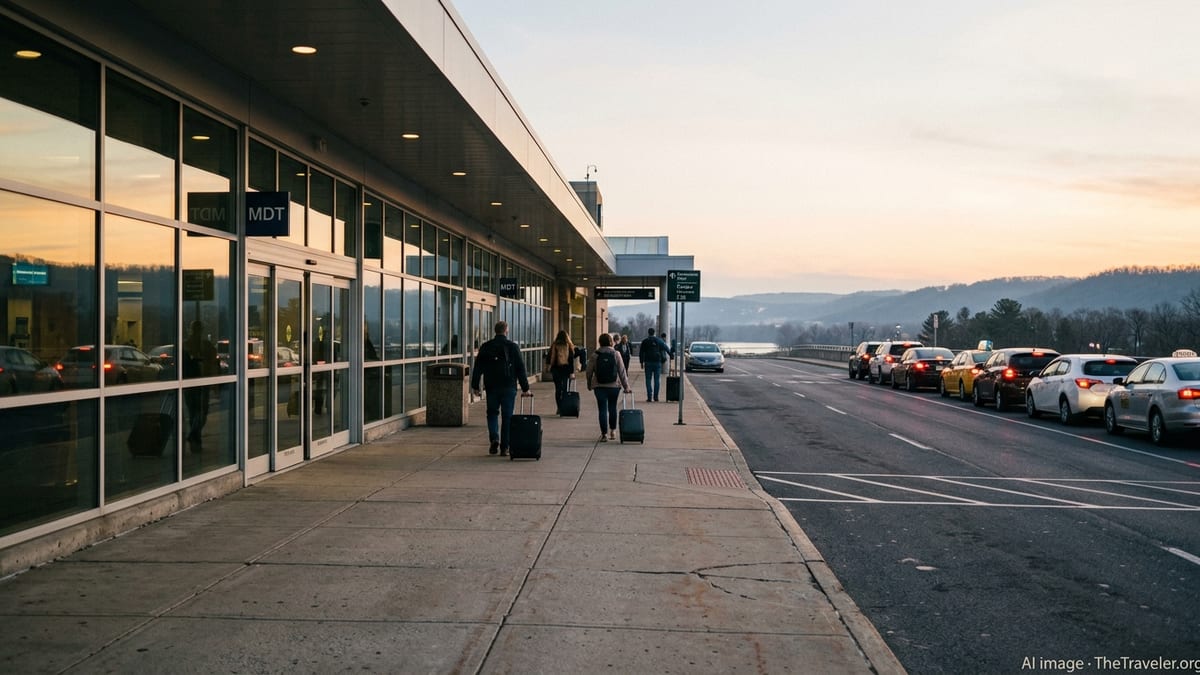
Record Passenger Growth Without the Gridlock
Harrisburg International Airport, known by its code MDT, is entering 2026 on the back of its strongest traffic performance on record. Publicly available data from the Susquehanna Area Regional Airport Authority shows that the airport handled more than 1.6 million passengers in 2025, surpassing its previous peak set in 2019 and marking double-digit growth over 2024. For a regional facility serving Pennsylvania’s capital and surrounding communities, that trajectory signals a robust rebound in demand.
Despite the surge, reports indicate that MDT has avoided the gridlock that often accompanies growth at larger hubs. The airport’s own operational summaries highlight consistent gains in passenger numbers alongside stable aircraft operations, suggesting that capacity has expanded in step with demand rather than lagging behind it. The result is a terminal that feels noticeably busier than it did a few years ago, yet remains manageable at peak times.
Industry statistics add useful context. Federal transportation data shows that MDT’s on-time performance and completion rates remain competitive with similar-sized airports, a key factor for travelers prioritizing reliability. While Harrisburg does not appear in headline national rankings dominated by mega-hubs, its steady metrics indicate an airport that is scaling up without sacrificing its core strengths.
For airlines, the growth story has translated into fuller flights and, in some cases, additional capacity. Published schedules for 2025 and early 2026 show a thicker roster of departures on legacy carriers and low-cost airlines, especially on core routes to major East Coast and Midwest hubs. For travelers, that means more options from a compact airport that still feels accessible and familiar.
Small Airport, Big-Time Convenience
What is winning over many travelers in 2026 is not just where MDT flies, but how easy it is to use. Unlike sprawling hub facilities, Harrisburg’s single-terminal layout keeps check-in counters, security, gates and baggage claim within a short walk of each other. Publicly available accounts from recent travelers describe a curb-to-gate journey measured in minutes rather than hours, even during busy morning and evening banks.
Security screening is a particular bright spot. The Transportation Security Administration noted ahead of the 2025 spring and summer travel seasons that it expected sustained high volumes at Harrisburg but did not forecast significant disruptions. The airport’s compact checkpoint footprint, combined with the uptake of programs such as TSA PreCheck, has helped keep lines comparatively short. Anecdotal reports posted in March 2026 describe travelers moving from the parking garage through security to their gate in roughly 15 minutes, underscoring the advantage of MDT’s scale.
Parking and access also contribute to the airport’s appeal. Harrisburg International sits directly off a major regional highway and maintains on-site parking within walking distance of the terminal, which reduces the guesswork around shuttle times and off-airport lots that travelers often face at larger facilities. For residents of the Harrisburg, Lancaster and York areas, the ability to arrive closer to departure time without risking major delays is becoming a deciding factor in choosing MDT over more distant alternatives.
Once airside, the modest size of the concourse means fewer long walks and easier wayfinding. Gate areas remain relatively close together, which is particularly valuable for families, older passengers and those making tight connections on multi-stop itineraries. In an era when many airports are expanding upward and outward, Harrisburg’s compact design is emerging as a competitive advantage.
Improving Amenities While Keeping Things Manageable
MDT’s leadership has been gradually refreshing the passenger experience as traffic has grown, aiming to add services without overwhelming the terminal. Publicly available information from the airport’s communications channels details a series of incremental upgrades, including modernized seating areas, updated wayfinding and expanded concessions. Nearby commercial development, such as new fast-food outlets and convenience options just outside the airport entrance, is giving travelers more pre- and post-flight choices.
Inside the terminal, the focus has been on practical amenities rather than headline-grabbing projects. Travelers are seeing more charging stations, updated restrooms and improved lighting in key circulation areas, all of which play directly into how comfortable an airport feels during delays or layovers. These relatively low-profile changes can significantly improve satisfaction compared with large, disruptive construction programs that dominate many bigger airports.
Retail and food offerings remain more limited than at major hubs, but recent additions have focused on staples that matter to time-pressed travelers: better coffee, grab-and-go meals and small-format shops for last-minute essentials. According to regional business coverage, the airport continues to evaluate further concessions as passenger numbers climb, with an eye on maintaining short walking distances between gates and services.
The balance MDT is trying to strike is clear. Rather than chasing the extensive shopping malls and destination dining seen at mega-airports, Harrisburg is leaning into a profile that emphasizes speed, clarity and comfort. For many travelers in 2026, that trade-off is an attractive one.
Regional Competition and Changing Traveler Choices
Harrisburg International operates in the shadow of much larger East Coast gateways, including Philadelphia and Baltimore, both of which offer far more nonstop destinations and international links. However, as national passenger volumes have climbed and congestion at major hubs has persisted, regional airports like MDT have grown more appealing for certain itineraries.
Recent coverage of airport satisfaction studies from firms such as J.D. Power highlights what matters most to travelers: ease of navigating the terminal, confidence in operations, and the overall comfort of the departure and arrival experience. While most published rankings focus on larger facilities, the criteria they emphasize closely align with MDT’s strengths. Shorter queues, simpler layouts and calmer gate areas are increasingly valued alongside route choice.
Price remains an important consideration, and some Harrisburg-area travelers still drive to larger airports in search of lower fares or more nonstop options. Yet the cost of time lost in traffic, longer security waits and parking complexity is shifting the equation. As more carriers adjust their schedules to reflect strong load factors at MDT, fare gaps on key routes have narrowed, making the convenience premium easier to justify.
In this environment, Harrisburg’s role as the primary commercial airport for south-central Pennsylvania looks more secure. The airport’s record-setting 2025 and its confident outlook for 2026 reflect not just a rebound from the pandemic era, but a broader realignment in traveler behavior toward smaller, more manageable gateways.
What 2026 Could Bring for Harrisburg Travelers
Looking ahead through 2026, available planning documents and public statements point to continued investment in maintaining Harrisburg’s smooth operation as volumes grow. The airport authority has signaled an ongoing focus on airfield efficiency, terminal upkeep and incremental technology upgrades, rather than headline-grabbing expansion projects that could disrupt day-to-day operations.
On the airline side, schedule filings suggest that MDT will continue to see strong service to major hubs such as Charlotte, Atlanta, Chicago and Washington, as well as to leisure destinations in Florida and the Southeast. As aircraft gauge and frequency continue to adjust to demand, travelers from the region are likely to see more seats available at peak travel periods, which can ease pressure on fares and reduce the risk of last-minute sellouts.
Nationally, air travel volume is expected to remain high in 2026, and that context matters for MDT’s trajectory. If the broader system experiences periods of strain, smaller airports with efficient layouts and reliable operations may stand out even more in traveler surveys and informal word of mouth. Harrisburg’s consistent performance through past peak seasons suggests that it is positioned to capture additional loyalty from both business and leisure passengers.
For now, Harrisburg International Airport is illustrating how a mid-sized facility can thrive in a crowded air travel landscape by focusing on fundamentals. With record traffic, measured improvements and a reputation for quick, low-stress journeys, MDT is emerging as a model for the kind of airport many travelers increasingly prefer in 2026.