

More news on this day
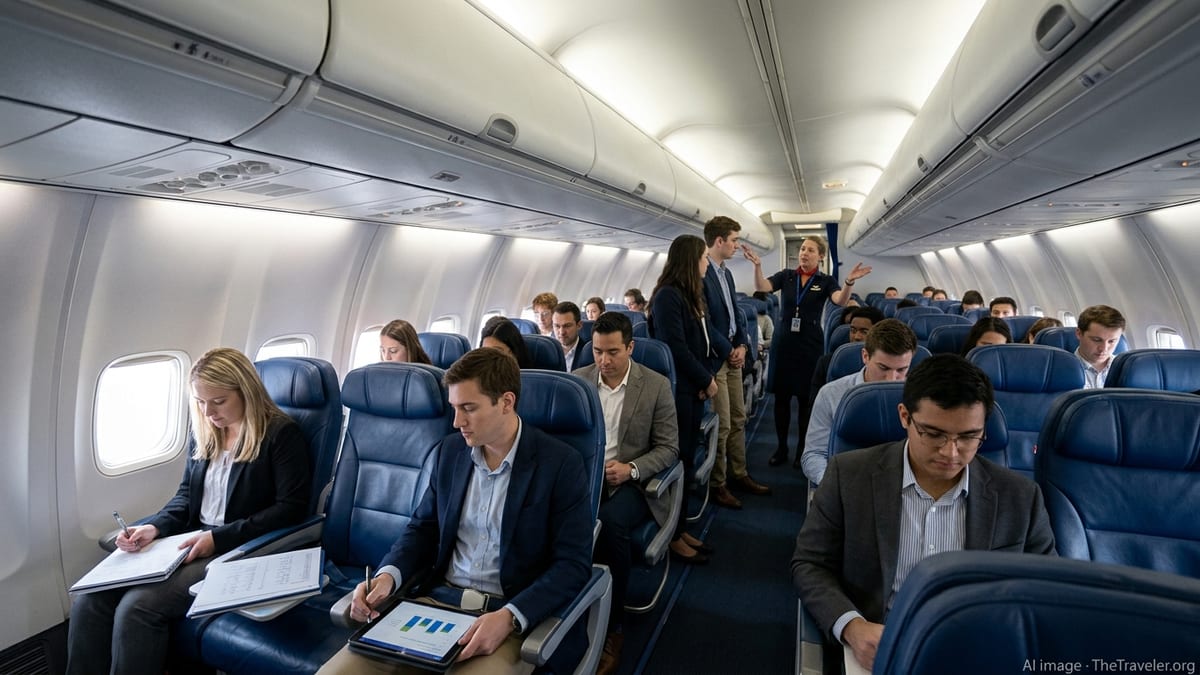
A recent class trip by Southern Methodist University’s Cox School of Business turned a routine Southwest Airlines flight into a high-altitude classroom, giving business students a rare, close-up look at how an airline operates in real time.
Get the latest news straight to your inbox!
An Immersive Lesson in Aviation and Service
The flight, organized as part of SMU Cox’s broader emphasis on experiential learning, invited students to step beyond textbooks and spreadsheets to observe a complex service operation in motion. Publicly available program materials from the school describe experiential learning as a core pillar of the Cox Advantage, with simulations, consulting projects, and immersion trips used to connect theory with practice. The Southwest journey fit squarely into that model, transforming typical in-flight moments into case material.
From the moment students arrived at Dallas Love Field, the airline’s hometown base, they were encouraged to view each stage of travel as a business process. Check-in procedures, boarding flow, gate communications, and turnaround timing all became data points for analyzing efficiency and customer experience. For many participants, it was the first time seeing familiar travel routines through a manager’s lens rather than a passenger’s.
Once in the air, the class observed how the airline’s single-fleet strategy, point-to-point network, and emphasis on a friendly service culture show up in everyday operations. Cabin announcements, the coordination between flight attendants, and the visible elements of safety and hospitality offered a live complement to earlier coursework on operations management and service design.
Because Southwest Airlines is headquartered in Dallas and frequently appears as a teaching example in local business programs, the collaboration also underscored the value of proximity. For SMU Cox students, experiencing a major employer and case-study company in its home market provided a tangible link between classroom frameworks and regional industry realities.
SMU Cox’s Experiential Learning Strategy at Cruising Altitude
SMU Cox has spent recent years expanding immersion-style learning across its undergraduate and graduate offerings, including online, professional, and full-time MBA programs. School materials highlight immersion trips, simulations, and real-life business cases as recurring features that place students in ambiguous, unstructured environments where outcomes depend on real-world decisions. Positioning an airline flight as a mobile classroom reflects that same philosophy at 30,000 feet.
In this setting, students were encouraged to connect what they have studied about capacity management, pricing, and route strategy with observable touchpoints. The tight turnaround window between flights, the rapid cleaning and restocking process, and the sequencing of passengers during boarding all mirrored concepts from operations courses that emphasize throughput and bottleneck management.
The trip also intersected with SMU Cox coursework in marketing and customer engagement. Onboard interactions, loyalty program messaging, and the overall tone of the brand experience offered a living case in how service companies differentiate in a crowded market. For students familiar with local course guides that often cite Southwest as an example of customer-centric strategy, seeing those principles in action provided a more vivid understanding than any slide deck could deliver.
Faculty involved in experiential initiatives at the school often frame these activities as a way to give students decision-making confidence and career readiness. By positioning students as observers and informal analysts rather than traditional tourists, the Southwest flight made the airline’s operational and cultural choices part of a broader leadership and management narrative.
Inside a Working Airline: Operations Meet Classroom Theory
The experience gave participants a structured way to analyze one of the most logistically demanding sectors of the travel industry. Prior to departure, students reviewed basic airline economics and operational models, which helped frame the flight as an integrated system rather than a series of isolated steps.
As the aircraft pushed back and taxied, attention shifted to scheduling discipline, gate utilization, and on-time performance, themes that regularly appear in airline case studies. The familiar open-seating boarding approach, which Southwest has used for years, became an opportunity to discuss trade-offs between speed, customer perception, and revenue optimization.
In the cabin, students observed how the crew balanced safety protocols with a relaxed, personable style associated with the airline’s brand. The way inflight teams coordinated snack service, addressed passenger requests, and handled announcements served as examples of front-line empowerment and service recovery principles that are central to many Cox leadership and management courses.
By the time the aircraft began its descent, students had compiled a mental checklist of process observations and service moments to debrief later on campus. The routine steps of disembarkation, bag claim, and aircraft turnaround closed the loop on a full operational cycle that most travelers rarely scrutinize in detail.
Strengthening Campus-to-Corporate Connections in Dallas
The Southwest Airlines trip also highlighted the growing links between SMU Cox and major employers in the Dallas region. Public materials from the business school describe a steady expansion of partnerships that bring corporate perspectives into the classroom through simulations, speaker series, leadership seminars, and case-based collaborations.
For students, participating in a class that literally flies with a prominent local airline reinforces the sense that Dallas serves as a real-time business laboratory. With companies in aviation, finance, technology, and logistics clustered around the region, Cox programs increasingly encourage students to move fluidly between academic analysis and firsthand observation.
Reports on SMU Cox experiential initiatives note that alumni and employer feedback often emphasize the practical value of such field-based learning. By giving students structured exposure to the operational side of travel, the class flight with Southwest aligned with that feedback and offered a concrete example of how education and industry can reinforce one another.
As experiential learning continues to grow as a hallmark of business education, the SMU Cox flight experience suggests that traditional site visits are evolving. Instead of only touring offices or hearing presentations in conference rooms, students are increasingly stepping into the very environments that shape the customer journey, whether that means a theme park resort, a manufacturing line, or a fully booked commercial jet.
Future Travel-Classroom Hybrids on the Horizon
The success of the Southwest flight experience has encouraged discussion within the SMU Cox community about where travel-based learning might go next. Program descriptions already point to domestic and international immersions, consulting engagements, and high-intensity simulations such as the school’s War Games strategy labs, suggesting that mobile and location-based teaching will remain a priority.
For the students who participated, the key takeaway was less about the novelty of holding class on a plane and more about learning to see ordinary environments as systems that can be studied and improved. From gate signage to cabin layout, every detail contributed to a service blueprint that could be mapped, critiqued, and reimagined.
In the competitive landscape of business schools, initiatives like the Southwest flight help distinguish SMU Cox as a program willing to push beyond conventional classroom boundaries. By treating the journey itself as the laboratory, the school signaled that tomorrow’s travel and aviation leaders will be expected to understand both the numbers on the page and the lived experience in the aisle.
As airlines and universities alike look for new ways to engage the next generation of managers, the image of a business class quietly taking notes during final approach may become more common. For now, SMU Cox’s high-flying lesson with Southwest stands as a vivid example of how the skies can double as a classroom for the travel industry’s future decision-makers.