

More news on this day
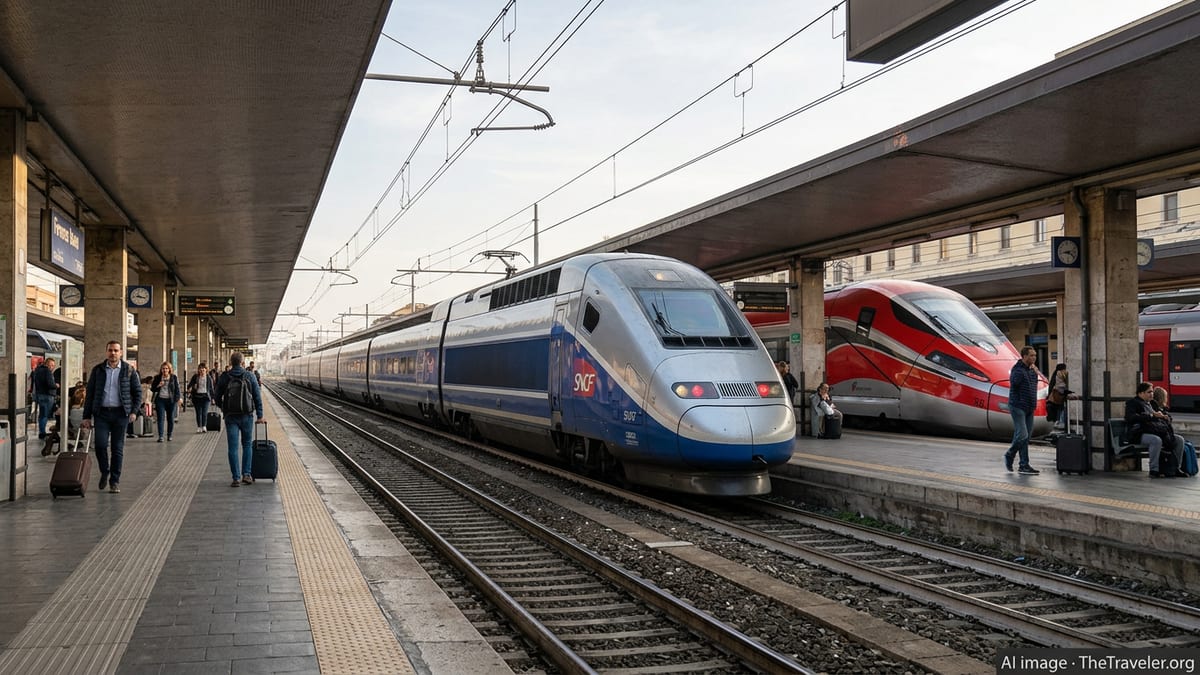
France’s state railway operator SNCF has secured regulatory approval to enter Italy’s domestic high-speed rail market, paving the way for new TGV services that will directly challenge incumbent operators Trenitalia and Italo on some of the country’s busiest north–south routes.
Get the latest news straight to your inbox!
Regulators Clear Path for Third High-Speed Operator
The move follows a decision by the Italian Competition Authority and infrastructure manager Rete Ferroviaria Italiana to revise how train paths are allocated on the national high-speed network, opening capacity for a third operator alongside Trenitalia and private competitor Italo. The changes are intended to address long-standing concerns that access rules and slot distribution made it difficult for new entrants to secure commercially viable timetables.
SNCF, through its subsidiary SNCF Voyageurs Italia, had applied for high-speed paths in 2024 for a significant domestic operation, including multiple daily Turin to Venice and Turin to Naples services starting in 2026. With the revised framework now in place and technical approvals progressing on new rolling stock, the French group is poised to move from cross-border services into full open-access competition on Italian soil for the first time.
The Italian authority has framed the opening as a milestone for passengers, arguing that greater competition on the high-speed network should translate into more frequencies, sharper pricing and improved service quality. For Italy, already regarded as one of Europe’s most advanced high-speed markets, the entry of SNCF is being closely watched as a test case for deeper cross-border liberalisation in European rail.
Planned TGV Routes Target Italy’s Busiest Corridors
SNCF’s plans focus on the core high-speed spine linking the industrial north with Rome and southern hubs, as well as the east–west axis across the Po Valley. The company has outlined intentions to operate several daily return services between Turin and Venice and between Turin and Naples from 2026, using Italy’s existing high-speed infrastructure between Turin, Milan, Bologna, Florence, Rome and Naples.
Industry sources indicate that future services could also extend to cities such as Florence and possibly other intermediate stops, positioning SNCF trains alongside Trenitalia’s Frecciarossa and Italo’s AGV and Pendolino fleets on some of Europe’s most competitive high-speed corridors. The French operator has not yet published final timetables or branding for the Italian services, but has signalled a mix of business and leisure-focused offerings designed to capture market share from both incumbent rail operators and domestic air routes.
The new services would complement SNCF’s existing international TGV operations to northern Italy, which today connect France to Turin and Milan. By securing domestic paths within Italy, SNCF gains the flexibility to run through-services and purely Italian itineraries, tightening the competitive screws on rivals that have already been battling each other for over a decade.
New TGV Fleet Navigates Technical and Approval Hurdles
To operate in Italy, SNCF is relying on a new generation of multi-system high-speed trains capable of meeting Italian signalling, power and safety requirements. Fifteen four-system TGV trainsets ordered from Alstom for Italy have been undergoing testing, including dynamic trials at the Bologna San Donato test centre, as part of a broader TGV Inoui and TGV-M modernisation programme.
The trains must obtain full authorisation for use on Italian tracks, including the country’s dedicated high-speed lines and their European Train Control System equipment. Engineers have been working to harmonise French and Italian technical standards, from onboard signalling to braking performance, in order to allow seamless operation at speeds up to 300 kilometres per hour on the Turin to Naples and Turin to Venice corridors.
While no firm launch date has been announced, the combination of regulatory clearance and the advanced stage of certification for the new TGV fleet suggests that trial runs and pre-commercial services could begin ahead of the planned 2026 start. Any delay in rolling stock approvals, however, could compress SNCF’s timetable and give incumbents more time to adjust pricing and capacity in anticipation of the newcomer.
Competitive Shock for Trenitalia and Italo
The arrival of SNCF in Italy’s domestic high-speed arena marks the latest chapter in an increasingly crowded European market, where former national monopolies are turning into aggressive cross-border challengers. Italian state operator Trenitalia is already a visible rival to SNCF in France through its Frecciarossa services between Paris, Lyon, Marseille and Milan, while private operator Italo has spent years chipping away at Trenitalia’s dominance inside Italy.
Analysts expect SNCF’s Italian move to trigger a new round of fare promotions, loyalty-programme tweaks and service upgrades as the three operators vie for passengers on flagship routes. Trenitalia has been investing in a refreshed Frecciarossa 1000 fleet and expanded international reach, while Italo has focused on flexible pricing and frequencies. SNCF, entering as a third player, is likely to exploit its experience with low-cost brands such as Ouigo and its dense French network to craft competitive offers tailored to Italian travellers.
Airlines operating on domestic Italian routes could also feel the impact. High-speed rail has already captured a dominant share of traffic between cities such as Rome and Milan, and additional train capacity with attractive fares may further erode short-haul air demand, particularly as environmental concerns and airport congestion push passengers toward rail alternatives.
What SNCF’s Move Means for European Rail Travelers
For passengers, SNCF’s entry promises not only more choice in Italy but also smoother cross-border journeys across western Europe. With high-speed operators now competing on both sides of the Alps, travellers can increasingly piece together itineraries that link France, Italy and neighbouring countries by rail rather than air, often at competitive journey times once airport transfers and security are factored in.
Travel industry observers note that the Italian decision reinforces a broader trend across the European Union, where liberalisation and technical interoperability are slowly turning a patchwork of national systems into a more integrated high-speed network. As regulators continue to open markets and infrastructure managers adapt capacity-allocation rules, more operators may follow SNCF’s lead in seeking opportunities beyond their home borders.
For tourism destinations along Italy’s high-speed corridors, the potential arrival of additional TGV services could mean greater visibility and easier access for international visitors. Cities such as Turin, Milan, Florence, Rome, Naples and Venice stand to benefit from increased rail connectivity, higher frequencies and potentially more granular stopping patterns, all of which support short breaks and multi-city itineraries that are increasingly popular with leisure travelers.