

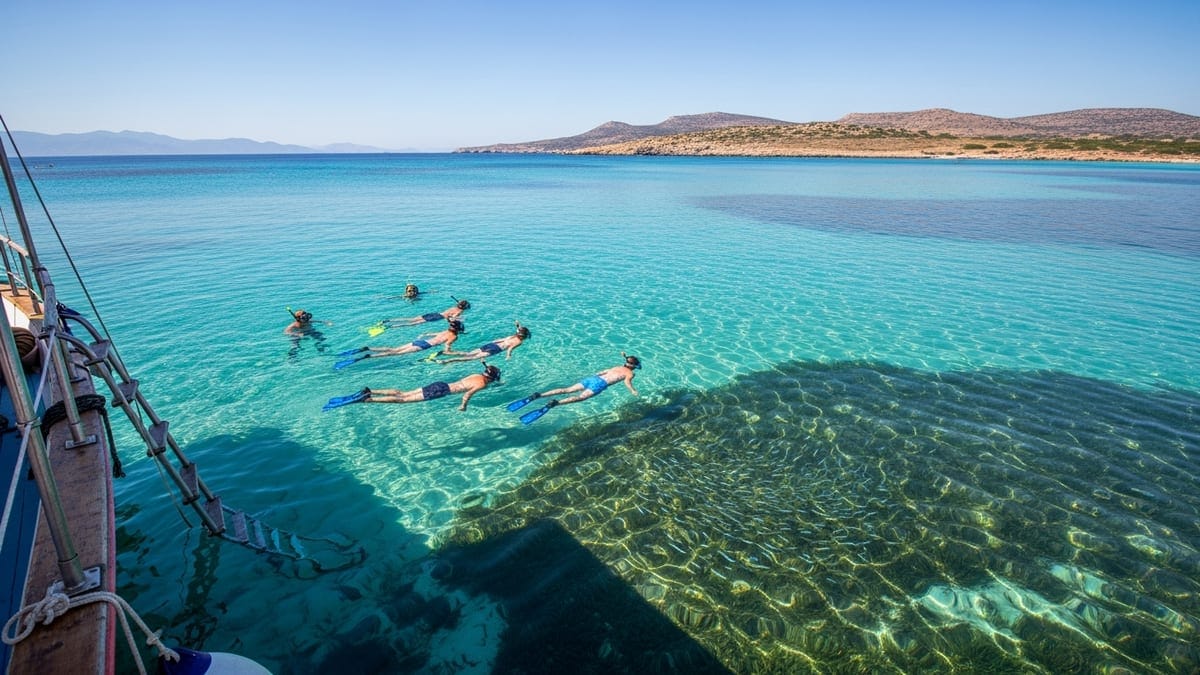
On the quiet northern side of Kos, where the Dodecanese islands taper off into open Aegean, boat trips from the island sail into a pocket of water that locals simply call the Blue Lagoon. Here, sandbars and reefs break up a shallow bay so clear that from the deck of the boat you can already see the seabed, seagrass meadows and flashes of silver fish.
For snorkelers, it is one of the most accessible marine playgrounds around Kos, combining calm, bathtub-warm water with rocky outcrops that shelter more life than first meets the eye.
This guide walks you through how to get there, what you will see, and how to prepare, so you can make the most of a Blue Lagoon snorkeling day from Kos.
Where Exactly Is the “Blue Lagoon” of Kos?
The Blue Lagoon that most visitors to Kos mean lies between Kos and the tiny island of Pserimos, a short sail from Kos Town and the resort of Kardamena. Boat tours generally market it as “Blue Lagoon” or “Blue Lagoon near Pserimos,” and often combine it with stops on Pserimos or nearby islets such as Plati. Operators highlight the shallow, turquoise water and a natural basin of sand and rock that offers sheltered swimming and snorkeling, even when the Meltemi wind ruffles the open Aegean in summer.
Blue Lagoon is not a developed port or village but a mooring area used by excursion boats. You reach it exclusively by sea. Half-day cruises typically depart from Kos Harbor or Kardamena, then cruise past the low, arid coastline of Kos before swinging into the calmer waters around Pserimos. Many boats anchor in a broad, turquoise pool fringed by low rocks and pale sand, where depths range from less than a meter near shore to around 6 or 7 meters under the hull.
Because the Blue Lagoon is a generic name used across the Mediterranean, it can cause confusion with famous spots in Cyprus or the Ionian. When booking in Kos, you are looking for excursions that specifically mention departure from Kos and a stop at Pserimos or “Blue Lagoon Pserimos.” This is the area whose sheltered, clear conditions lend themselves best to relaxed snorkeling, and it is the spot this guide focuses on.
Getting There: Boat Trips and Best Seasons
Public access to the Blue Lagoon is through organized boat trips. In Kos Town and Kardamena you will find a dense line of excursion agencies and boats advertising three-island cruises, Pserimos and Blue Lagoon trips, and pirate-style or family-focused cruises.
A common option is a half-day escape that sails at midday, spends about an hour on Pserimos, includes a simple lunch on board, then anchors at Blue Lagoon for swimming and snorkeling before returning to Kos in the late afternoon. Other cruises add a third stop at Plati or Kalymnos.
Departures cluster in the high season from late May through September. July and August are the busiest months, with daily sailings and larger crowds. Shoulder months like late May, June and late September can be ideal for snorkelers: sea temperatures are generally comfortable, the water is still very clear, and you share the lagoon with fewer boats. Some operators keep running into October, weather permitting, but schedules are more limited and should be checked locally just before your trip.
Sea conditions are usually gentle inside the lagoon, but wind patterns matter. The Meltemi, a strong northerly wind that peaks in July and August, can make the outbound crossing a little choppy, especially if your boat is small and open. Once the captain tucks into the lee of Pserimos, however, you will notice calmer water and better visibility. If you are prone to seasickness, choose a morning or midday departure on a larger, more stable vessel and bring seasickness tablets recommended by your doctor.
Snorkeling Conditions: Visibility, Depth and Safety
Visibility around the Blue Lagoon is one of its main draws. On a typical summer day you can expect 15 to 25 meters of horizontal visibility, thanks to the low nutrient levels of the Aegean and a mostly sandy bottom that does not cloud easily. The color that gives the lagoon its name comes from this combination of pale sand, shallow depth and intense sunlight reflecting off the seabed.
Depths shift gradually from ankle-deep water near small coves or pebble beaches to around 3 or 4 meters over sandy patches, and up to approximately 7 meters where the excursion boats anchor. For novice snorkelers, this gentle gradient is ideal: you can start in water shallow enough to stand, then fin slowly out toward the boat, staying within your comfort zone. More confident swimmers can work along the rocky edges where fissures and overhangs attract fish.
Currents within the lagoon are usually weak, but there can be a light drift depending on the wind and tide. Skippers generally keep an eye on swimmers and set clear boundaries for where you can go. Many boats provide pool noodles or life jackets for weaker swimmers. If you are visiting with children, and particularly if they are not strong swimmers, stay between the boat and the nearest shore, within clearly signposted limits set by the crew.
Reefs and Underwater Landscapes
Do not expect coral reefs in the tropical sense. The Aegean is a temperate sea, and the Blue Lagoon’s underwater scenery is dominated by rocky ledges, boulders, seagrass meadows and sandy channels rather than branching coral gardens. That said, the interplay of rock, sand and plant life creates a varied landscape with plenty of micro-habitats to explore.
Close to the rockier edges of the lagoon you will find ledges and small vertical faces covered in algae and sponges. Cracks serve as hiding spots for small fish, crabs and occasionally octopus. In some spots, low rock terraces form steps descending from about a meter deep to three or four meters, making it easy to follow the contours and peer into each level.
Further out, broad patches of Posidonia seagrass sway in the gentle swell. These meadows are ecologically important, providing nursery grounds for juvenile fish and stabilizing sediments. From above, they appear as darker, velvety patches against the pale sand. Between them run sandy “highways” where you can often spot bottom-dwelling species and watch light ripple across the seabed in mesmerizing patterns.
On especially calm days, the clarity can make it feel as if you are suspended in air rather than water, gliding above this patchwork of rock, grass and sand. The relative simplicity of the habitat also means you can easily orient yourself using the shape of the bottom, reducing the risk of drifting away from your boat or exit point.
Marine Life You Are Likely to See
While the Blue Lagoon is not a big-animal hotspot, it offers a rewarding cross-section of eastern Mediterranean marine life that suits beginner to intermediate snorkelers. The most common sight will be shoals of small, silver fish flickering in the shallows. These are often bogue and picarel, which twist and turn in tight groups, creating quicksilver clouds whenever they are startled.
Among the rocks, look for wrasse in greens and blues, such as ornate and rainbow wrasse, that flit between crevices picking at invertebrates. Striped seabream and saddled seabream patrol just above the sand, sometimes approaching curiously if you remain still. Over the seagrass, you may see salema, whose yellow stripes catch the light as they move in loose schools. Near the hulls of boats, damselfish often gather in small, dark swarms.
More patient or observant snorkelers might spot camouflaged creatures. Octopus are present throughout the region, usually tucked into a rocky hole with just their eyes and part of a tentacle visible. Hermit crabs and small true crabs scuttle along the rocks, while sea stars occasionally cling to shaded surfaces. In sandy areas keep an eye out for flounder and other flatfish that lie partially buried, revealing themselves only when they dart away.
Larger animals are possible but less predictable. On some trips, visitors have reported glimpses of loggerhead turtles passing through or rising to breathe near the boats, especially in late spring and early summer when turtles are more active around Greek islands. Such encounters should be treated as lucky bonuses rather than expectations. If you do see a turtle or any larger marine life, maintain a respectful distance, avoid chasing, and simply observe quietly.
What to Bring: Snorkeling Gear and Practical Extras
Most excursion boats from Kos provide basic snorkeling equipment, typically a mask, snorkel and sometimes simple fins. The quality and fit can vary, especially during peak season when equipment is heavily used. If snorkeling is a highlight of your trip, it is worth bringing your own well-fitting mask and snorkel from home. A mask that seals comfortably to your face and a snorkel with a purge valve will make a greater difference to your enjoyment than almost any other purchase.
Fins are helpful but not strictly essential in the lagoon’s calm, shallow water. Strong swimmers can manage with just mask and snorkel, especially if they stay close to the boat. If you like to explore the further edges or follow the rocks where light currents can be felt, short travel fins provide extra propulsion without being cumbersome on the boat. Many families opt to share one or two pairs among those most eager to roam further.
Water temperatures around Kos in summer are generally comfortable, often in the mid-20s Celsius. Most adults will not need a wetsuit for the relatively short snorkeling stops offered by day cruises. Children or those who get cold easily might appreciate a thin neoprene top or shorty suit, especially from late May to mid-June and again from late September onward. A lightweight rash guard also protects against both sun and minor scrapes if you drift close to rocks.
Non-gear essentials include high-factor reef-friendly sunscreen, applied well before you enter the water so it has time to absorb, and a secure way to keep valuables dry on board, such as a dry bag. A microfiber towel, a wide-brimmed hat and a long-sleeved cover-up help you avoid overexposure on the upper deck, where sun and reflected glare from the sea can be intense for several hours.
Technique Tips for Enjoying the Blue Lagoon
Because the lagoon’s conditions are forgiving, it is an ideal place to refine basic snorkeling technique. Before you leave the boat, adjust your mask strap so it sits snugly around the widest part of your head, not across your ears. Press the mask gently to your face and inhale slightly through your nose to check the seal. If it holds without you needing to keep inhaling, you have a good fit. Once in the water, avoid overtightening the strap, which can cause discomfort and leaks.
Enter the water slowly, usually via a ladder or by stepping down from a platform at the stern. Take a few moments at the surface to float and get used to breathing through the snorkel. Keep your body horizontal and your legs relaxed. Slow, steady kicks from the hips, with only a slight bend in the knees, are more efficient and less disruptive to the water than frantic splashing from the knees down.
If water enters your snorkel, you can clear it with a sharp exhalation, blowing forcefully through the tube to expel water out the top or through a purge valve near the mouthpiece. To clear your mask, surface briefly, lift one side of the lower skirt away from your face, and blow out through your nose while tipping your head back so water drains out. Practice these moves near the boat so they feel routine rather than stressful.
To see more marine life, slow down and adopt a patient, observant approach. Fish quickly adjust to your presence if you move smoothly and avoid sudden lunges. Spend a few minutes hovering over one patch of rock or seagrass instead of constantly swimming in search of something spectacular. In the simple, clear environment of the Blue Lagoon, small behaviors and interactions become much more visible once you give your eyes and brain time to tune in.
Responsible Snorkeling and Local Regulations
The Blue Lagoon and the surrounding waters form part of a fragile marine environment that is under increasing pressure from rising visitor numbers each summer. Simple choices from each snorkeler add up to a real impact. The first rule is to avoid touching or standing on any rocks that host visible plant or animal life. Even a light brush of a fin or hand can damage slow-growing algae, sponges or invertebrates, and can also expose you to stings or cuts.
Equally important is not feeding fish. While some excursion boats may have historically encouraged throwing bits of bread into the water, altering the diet and behavior of marine life disrupts natural balances and can contribute to poor water quality. Observing fish in their normal routines is both more authentic and more sustainable than coaxing them with food. You should also refrain from collecting shells, stones or any living organisms. Taking home souvenirs from the seabed might seem harmless, but when multiplied across thousands of visitors, it erodes the character and health of shallow habitats.
Most reputable Kos operators now follow basic safety and environmental guidelines. Many conduct short briefings before you enter the water, covering swimming zones, prohibited areas and behavior toward marine life. Listen carefully and follow the indicated boundaries. If the crew asks you not to go beyond a particular rock or buoy, it is typically for both your safety and to protect sensitive areas. Where life jackets or buoyancy aids are offered, they are a good option for less confident swimmers and also reduce the likelihood of people accidentally standing on the bottom.
On board, dispose of rubbish properly and consider bringing a reusable water bottle rather than relying on multiple single-use plastic bottles. Even small items like cigarette butts or drink lids can easily end up in the sea on a moving boat. By leaving no trace on deck and in the water, you help keep the Blue Lagoon as pristine as the brochures promise for the next wave of snorkelers.
The Takeaway
Snorkeling the Blue Lagoon from Kos is less about extremes and more about effortless pleasure. It offers a combination that is increasingly rare in the Mediterranean: clear, shallow water, gentle conditions suited to beginners and families, and enough marine life and varied seabed to keep more experienced swimmers happily occupied for a couple of hours.
With the right expectations and a little preparation, it becomes a highlight that punctuates days of sunbathing and exploring ruins with a vivid, saltwater memory.
Planning ahead means choosing your season carefully, selecting a reputable boat operator, and packing a few pieces of personal gear that dramatically improve comfort.
Once you are there, a calm, observant approach in the water will reveal the lagoon’s quieter charms, from the way light dances over seagrass to the sudden appearance of a wrasse or an octopus emerging from its den. Treat the place with respect, tread lightly and float more than you kick, and you will leave with both the satisfaction of a good swim and the sense of having spent time in one of Kos’s most luminous corners.
FAQ
Q1. Do I need to be an experienced swimmer to snorkel in the Blue Lagoon near Kos?
Basic swimming ability is recommended, but you do not need to be an expert. The water is generally calm and shallow near the edges, and many boats provide life jackets or flotation aids. If you are nervous in open water, let the crew know, stay close to the boat or shore, and consider wearing a buoyancy vest while you snorkel.
Q2. What is the best time of year to snorkel the Blue Lagoon from Kos?
The main snorkeling season runs from late May through September, when sea temperatures are most comfortable and visibility is consistently good. June and September often strike the best balance between warm water and lighter crowds. Trips may run in October depending on weather, but conditions can be more variable and cooler.
Q3. How long do you usually get to snorkel during a Blue Lagoon boat trip?
On standard half-day excursions, the boat typically stops at the Blue Lagoon for around 45 minutes to 1 hour. This is enough time for a relaxed swim, some exploratory snorkeling along the rocks and a few breaks back at the ladder to rest. Full-day cruises that include the lagoon may divide time between several stops, so your snorkeling window will be similar at each.
Q4. Is the snorkeling suitable for children?
Yes, many families bring children to snorkel in the Blue Lagoon. The clear, shallow water and easy access from the boat ladder make it an inviting environment. For safety, young children should use life jackets or swim vests, stay within arm’s reach of an adult, and remain in the area designated by the crew. A simple mask and snorkel sized for their faces will help them enjoy the experience more.
Q5. Are there jellyfish or other hazards I should worry about?
Jellyfish can appear in the Aegean at certain times, but significant blooms are not an everyday feature of the Blue Lagoon. Skippers are usually aware of local conditions and may adjust stops if jellyfish are present in numbers. As with any rocky coastal area, the main hazards are slipping on wet rocks or brushing against sharp surfaces, so wearing fins or sturdy water shoes and keeping a respectful distance from rocks can minimize risk.
Q6. Can I rent snorkeling gear on the boat, or should I bring my own?
Most excursion boats provide basic snorkeling sets, and in some cases the use of this gear is included in the ticket price. However, the fit and condition can vary. Bringing your own well-fitting mask and snorkel is the best way to ensure comfort and hygiene. If you prefer to travel light, you can use boat gear but check it carefully and ask to swap if something does not fit properly.
Q7. Will I see turtles or dolphins while snorkeling there?
It is possible but not guaranteed. Loggerhead turtles do inhabit Greek waters and sometimes pass through areas around Kos, and dolphins may occasionally be spotted from the boat during the journey. These sightings are considered lucky rather than routine. For realistic expectations, plan to enjoy smaller fish and the clear underwater scenery, and treat any encounters with larger animals as an unexpected bonus.
Q8. Do I need a wetsuit for snorkeling in the Blue Lagoon?
In the height of summer, most people are comfortable snorkeling without a wetsuit, as the water temperature is typically warm enough for extended swimming. In late spring or early autumn, or if you are particularly sensitive to the cold, a shorty wetsuit or a thin neoprene top can make the experience more pleasant. Children often benefit from an extra layer even when adults do not feel the chill.
Q9. How can I be a responsible snorkeler while visiting the Blue Lagoon?
Responsible snorkeling means not touching or standing on rocks that support marine life, avoiding any contact with animals, and never feeding fish. You should also refrain from collecting shells or stones, use reef-friendly sunscreen applied in advance, and ensure that no rubbish from the boat or your bag ends up in the sea. Following crew instructions about swimming areas also protects sensitive habitats and keeps everyone safe.
Q10. Are there any medical or fitness considerations before snorkeling?
If you have heart, lung or ear conditions, or any medical issue that affects your ability to exert yourself in water, it is wise to consult a doctor before your trip. Once on board, inform the crew of any relevant conditions so they can advise you appropriately. Even for healthy visitors, staying hydrated, avoiding excessive alcohol before swimming, and easing slowly into activity will help ensure a safe and enjoyable snorkeling session.