

More news on this day
Heavy snowfall and renewed disruption in French aviation have triggered the cancellation of more than 145 flights at Paris Charles de Gaulle, Paris Orly and Nantes Atlantique airports, stranding passengers, stretching airline operations and reviving questions over how resilient Europe’s busiest air corridors really are.
Weather Woes and Operational Strain Hit Key French Hubs
France’s civil aviation authority recently instructed airlines to trim operations at the capital’s main airports after snow and ice swept across the Paris region, forcing reductions in takeoffs and landings at Charles de Gaulle and Orly. Carriers were told to cut schedules by around 15 percent during peak afternoon and evening periods, choosing themselves which services to cancel in order to keep runways safe and de-icing operations manageable.
The ripple effects of those cuts, combined with existing winter timetable pressures and previous days of disruption, translated into more than 145 cancellations across Charles de Gaulle, Orly and Nantes Atlantique. While the percentage reduction in flights at each airport may appear modest, concentrated cancellations on specific routes and time bands quickly left departure boards showing swathes of red and passengers with few immediate alternatives.
At Charles de Gaulle, one of Europe’s busiest hubs, the reduced capacity coincided with a heavy long-haul and transfer schedule. Travellers connecting onward to North America, Africa and Asia found themselves stuck in limbo as a single cancelled leg broke carefully choreographed itineraries. At Orly and Nantes, where operations are more point to point, leisure and short-haul business travellers saw city breaks, meetings and family visits scrapped or severely curtailed.
Ground staff at all three airports reported a sharp spike in rebooking requests and baggage handling complications as aircraft, crews and luggage ended up in the wrong places. With stands and taxiways already slowed by snow and ice, the effort to reset schedules for the following day became a race against time.
Scenes of Confusion as Travellers Scramble for Answers
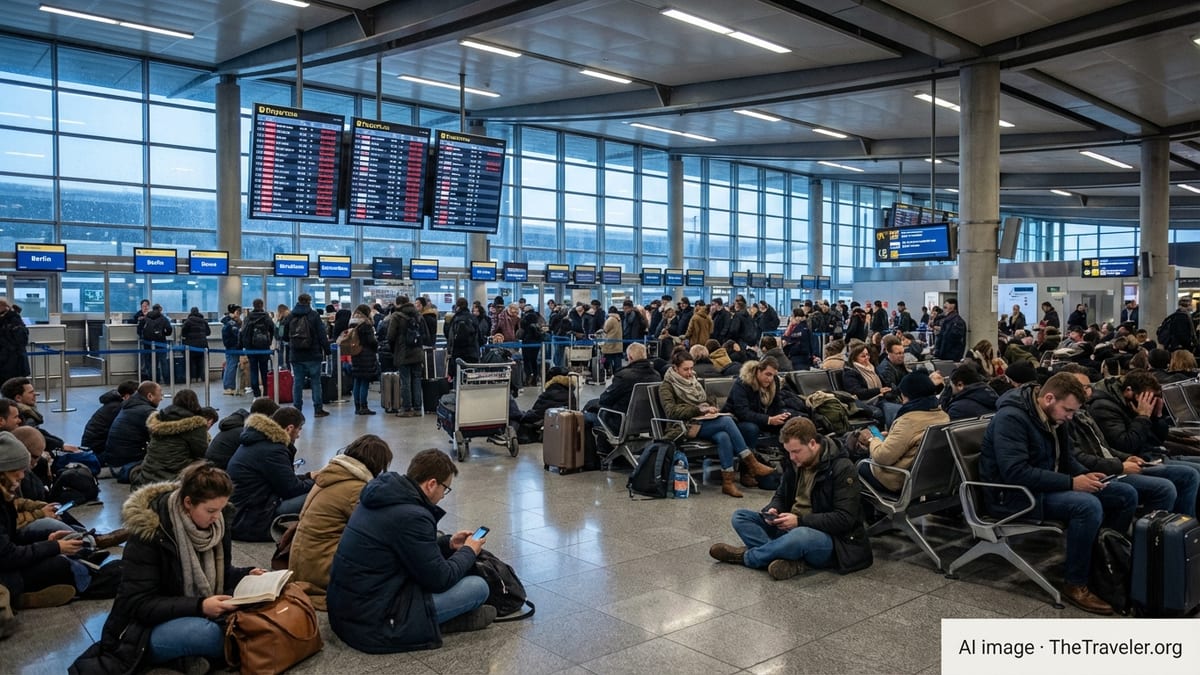
Inside terminal buildings, passengers described confused queues, packed departure lounges and frustrated crowds clustering around information screens. Many arrivals only learned of cancellations when they reached the airport, despite repeated calls from French transport officials for travellers to verify flight status before leaving home and to use public transport instead of driving.
At Charles de Gaulle, long lines formed at airline service desks as travellers sought rerouting options on remaining flights to major hubs such as Amsterdam, Frankfurt and London. With winter storms also affecting other parts of northwestern Europe, those alternatives were quickly overwhelmed, leaving some passengers told that the first available seats would be a day or more away.
Families with young children and elderly travellers were particularly affected, with some forced to spend the night on camp beds or seats in the public areas of the terminals when nearby hotels sold out. Volunteers from airport support teams and local authorities worked alongside airline staff to provide blankets, water and basic refreshments, but reports from the terminals indicated that supplies and seating were stretched.
In Nantes, where the scale of the terminal is smaller, even a limited wave of cancellations created a crowding effect in security and check-in halls. Travellers arriving on regional rail and coach services found departure boards already listing multiple flights as cancelled or “retimed,” and some opted to abandon their trips altogether and return home.
Airlines Juggle Crews, Slots and Passenger Rights
For airlines, the disruption presented a complex operational puzzle. When authorities order capacity reductions for safety reasons, carriers must decide in hours which services to sacrifice, balancing legal obligations to passengers with the need to protect key routes and high-load long-haul flights. The result is often a patchwork of cancellations that can appear arbitrary to travellers on the ground.
Crews and aircraft based in Paris and western France were among the most affected. Snow and de-icing requirements lengthened turnaround times, causing knock-on delays even for flights that did operate. In some cases, aircraft due to operate evening departures were still waiting for inbound arrivals blocked earlier in the day, forcing last-minute schedule changes and additional cancellations.
Passenger-rights rules in Europe mean that travellers on cancelled services are entitled to rerouting or refunds, and in many cases care in the form of meals and accommodation. But when entire city pairs are heavily disrupted, finding hotel rooms and spare seats becomes a challenge. Some airlines encouraged customers to postpone non-essential trips, waiving change fees and fare differences to reduce congestion at the airports.
Industry analysts note that these winter cancellations come on top of a difficult few years for French and European aviation, marked by intermittent strikes by air traffic controllers and airline staff, as well as ongoing staffing constraints in ground handling and security. Each fresh episode of disruption adds cost pressures for airlines and tests passenger patience with the reliability of the network.
Knock-on Impact Across Europe’s Skyways
The problems at Charles de Gaulle, Orly and Nantes Atlantique did not remain confined to French airspace. As aircraft and crews were delayed or grounded in France, schedules as far afield as the United Kingdom, Spain, Italy and Scandinavia were forced to adjust. Connecting passengers missed onward flights, while aircraft that should have rotated through Paris to operate later services elsewhere simply did not arrive.
Hub carriers and low cost airlines alike experienced difficulties. Services into Paris from other major European gateways ran late or with substituted aircraft, while departures from France left with empty seats where transfer passengers had failed to make tight connections. The fragile choreography of Europe’s slot-coordinated airports meant that even relatively short-lived restrictions in Paris created a backlog that took days to clear fully.
Travel data firms tracking the period reported several hundred cancellations and many more delays across the continent, with French airports among the worst affected. While some of those interruptions were directly tied to the weather-related capacity cuts at Paris, others were the delayed consequence of earlier disruption linked to industrial action and staffing shortages, illustrating how quickly local issues can propagate through the wider network.
For travellers planning upcoming trips, experts advise building greater flexibility into itineraries that touch French hubs in winter, including longer connection windows and, where possible, the option to rebook without penalty. Tour operators and corporate travel managers are also reviewing contingency plans, from alternative routings to rail substitutions on shorter intra-European legs.
What Passengers Can Do Next Time Disruption Hits
The latest wave of cancellations has renewed scrutiny of how both authorities and airlines communicate with passengers before and during major disruptions. While many travellers received notifications via apps and email, inconsistencies in timing and detail meant that others set off for the airport unaware that their flights had already been scrubbed from the schedule.
Consumer advocates recommend that passengers proactively monitor their booking through airline apps and departure boards, not just third-party booking sites. Signing up for real-time alerts and checking airport social media feeds can provide early warning when authorities order capacity reductions, giving travellers more time to adjust ground transport or seek alternative flights.
Where journeys are essential, experts suggest favouring early-day departures, which tend to have more recovery options if something goes wrong, and avoiding tight self-made connections on separate tickets. Travellers should also familiarize themselves with their rights under European passenger-protection rules, including entitlement to assistance during long delays and cancellations that are not caused by extraordinary circumstances.
At the same time, aviation officials in France face mounting pressure to invest further in winter resilience, staffing and communication systems so that future weather events and operational strains do not once again leave thousands of passengers stuck on the wrong side of airport departure gates, staring at cancelled flights and uncertain onward plans.