

More news on this day
Thousands of passengers were left stranded in Austria on Friday as a powerful winter storm crippled Vienna International Airport, triggering 238 flight delays and 80 cancellations that rippled across European hubs from Barcelona and Istanbul to Brussels, Krakow and Manchester.
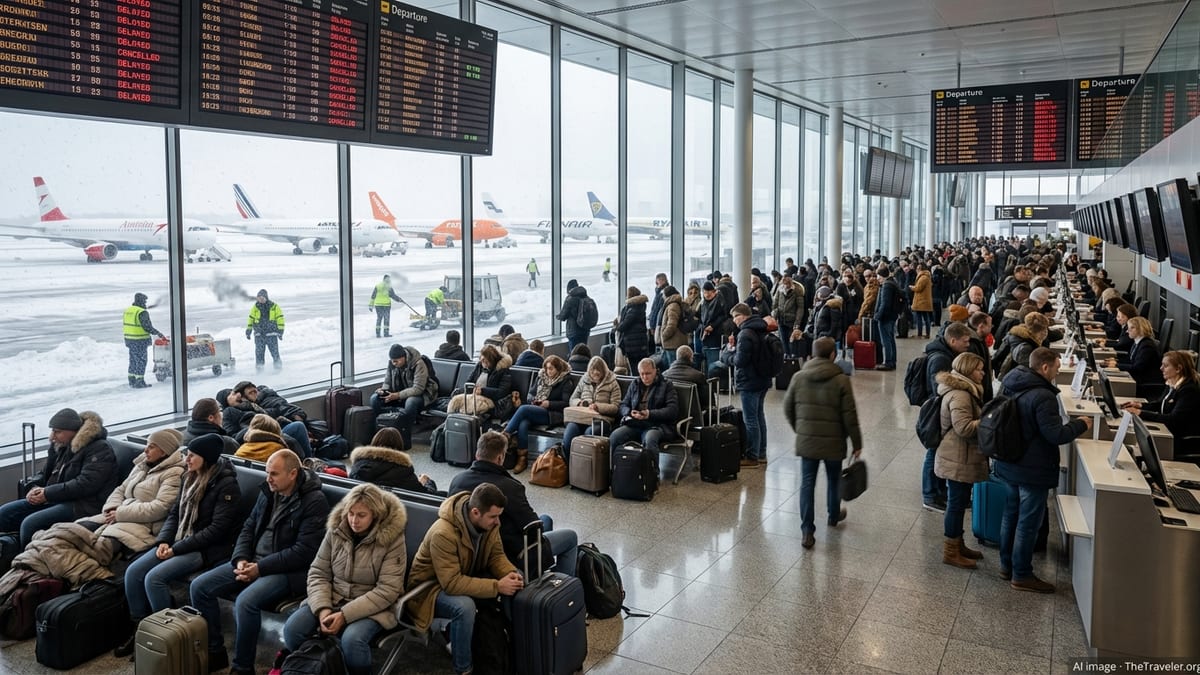
Historic Snowfall Paralyzes a Key European Hub
The disruption began in the early hours of February 20, 2026, when heavy, wet snow swept across eastern Austria, dumping around 20 centimeters on the capital region and blanketing runways, taxiways and access roads at Vienna International Airport. Airport operator Flughafen Wien AG temporarily suspended all departures and arrivals, citing unsafe runway conditions, poor visibility and the need to keep ground staff out of hazardous conditions while plows and deicing teams worked continuously.
By late morning, operations had only partially resumed, with officials warning that the airport would operate on severely reduced capacity for the rest of the day and into the weekend. Aviation data compiled on Friday showed 238 delayed flights and 80 outright cancellations connected to Vienna, affecting a mix of short- and medium-haul services across the continent. Long queues quickly formed in the terminal as departure boards filled with red notices and passengers scrambled for information.
Meteorologists in Austria described the system as one of the most disruptive February snow events in more than two decades for the Vienna region. The rapid accumulation caught both road and air networks under intense pressure, with airport winter service crews reportedly clearing thousands of truckloads of snow in an effort to keep at least one runway marginally usable for limited operations.
Authorities emphasized that safety remained the overriding priority, with aircraft deicing, braking performance and visibility all constrained by the continuing snowfall. Even as some flights were allowed to depart around midday, incoming services faced diversions to alternate airports including Munich, adding to the cascading operational complexity for airlines and crews.
Network Shock for Air France, easyJet, Finnair, Austrian and Ryanair
The paralysis at Vienna quickly translated into a network shock for airlines heavily reliant on Central Europe as both a destination and a connecting point. Flag carrier Austrian Airlines, the airport’s largest tenant, bore the brunt of the collapse in capacity, cancelling and delaying a large portion of its morning bank of flights that normally connect eastern and western Europe through Vienna.
Air France, easyJet, Finnair and Ryanair were among the international carriers hardest hit. Aircraft and crews scheduled to operate rotations between Vienna and key cities such as Barcelona, Istanbul, Brussels, Krakow and Manchester were left out of position, forcing last-minute adjustments. In several cases, flights that did depart from foreign bases could not return as planned, resulting in aircraft stranded away from home hubs and additional cancellations later in the day.
Low cost giant Ryanair and budget rival easyJet, which both operate dense networks linking Central and Western Europe, reported clusters of delays that extended far beyond Vienna itself. Turnaround times lengthened as aircraft waited for new slots, deicing or crew clearances, while missed connections forced rebookings and overnight accommodation in secondary cities that were never meant to be more than a brief stopover.
Finnair, operating northbound routes through Vienna into Scandinavia and beyond, also saw its schedules disrupted, with knock-on effects expected into the weekend as aircraft cycles and crew duty times were pushed to their legal limits. Airlines warned that even after the snow eased, it could take more than 24 hours to fully realign schedules, especially on multi-leg routes that depend on precise aircraft positioning.
Barcelona, Istanbul, Brussels, Krakow and Manchester Feel the Ripple Effects
While the storm’s epicenter was Austria, the consequences were felt in departure halls far away from Vienna. At Barcelona’s main airport, screens showed a cluster of delayed and cancelled services to and from Austria, forcing holidaymakers and business travelers alike to crowd customer service desks in search of alternatives. With school holidays underway in parts of Europe, several Vienna-bound flights were reportedly carrying high numbers of families, amplifying pressure on rebooking options to popular winter and city-break destinations.
In Istanbul, a key east–west gateway linking Europe, the Middle East and Asia, the Vienna disruption created headaches for passengers who had planned onward journeys to Central Europe. Airlines flying the Istanbul to Vienna corridor, including partner carriers feeding into alliance networks, were forced to hold aircraft on the ground or reroute passengers via alternate hubs such as Munich or Zurich, increasing travel times and stretching available seats to capacity.
Brussels, Krakow and Manchester also experienced noticeable ripples in their local operations. Departures bound for Vienna sat on the tarmac awaiting updated slot information, while arriving passengers learned mid-journey that their return services had been cancelled or re-timed. In some cases, aircraft that did make it into Austria were unable to depart again on schedule, creating gaps in rotations that left city pairs temporarily disconnected.
Airport authorities in these secondary hubs urged passengers with Vienna in their itineraries to contact airlines before travelling to the airport, warning that same-day rebooking options were limited. With winter weather also complicating operations at Munich and other nearby airports, the usual safety valves in Europe’s dense aviation network were under significant strain.
Inside the Terminal: Long Queues, Thin Information and Growing Frustration
Scenes inside Vienna International Airport on Friday captured the human cost of the disruption. Lines at airline service counters stretched across concourses as travelers waited to secure rebookings, meal vouchers or hotel accommodation. Many passengers reported difficulty reaching call centers as phone lines became jammed, leaving the terminal as the only realistic place to manage their disrupted journeys.
Families with young children tried to occupy hours in crowded departure areas as charging points, seating and quiet corners quickly became scarce commodities. Some passengers resorted to lying on jackets and luggage on the floor, expecting to spend the night in the terminal after being told there were no immediate hotel rooms available nearby. Airport staff distributed basic refreshments in some areas, while airlines worked to hand out meal vouchers where required by European passenger rights rules.
Travelers described a mixture of frustration and resignation. Many acknowledged the severity of the weather but expressed concern about limited real-time information and the pace of communication as delay estimates repeatedly shifted. Large digital displays were updated frequently, yet changes in gate assignments and departure times often came with little advance warning, prompting crowds to move en masse from one part of the terminal to another.
Despite the tension, airport officials highlighted the efforts of ground staff, from snowplow operators and deicing crews to security officers and cleaners, who were working extended shifts in challenging conditions. Local emergency services remained on high alert around the airport perimeter in case of incidents on icy access roads and nearby highways, which themselves saw multiple accidents and closures during the peak of the storm.
Broader Transport Disruption Across Austria
The chaos at Vienna Airport was part of a wider transport crisis across Austria as the snowstorm swept through the country. Rail operator OBB warned passengers of significant delays and cancellations on key intercity and regional lines, particularly in Styria and Lower Austria, where heavy snow and fallen trees obstructed tracks and limited the use of overhead power lines. Some services were shortened or replaced by buses, which in turn struggled with poor road conditions.
On major highways around the capital, including sections of the Westautobahn, trucks and private vehicles became stuck on snow-covered lanes, leading to temporary closures and long tailbacks. Road maintenance services deployed fleets of plows and gritters, but authorities cautioned that visibility and the sheer volume of snowfall meant it would take time before normal traffic flows could be restored.
Power outages were reported in several regions, leaving tens of thousands of households without electricity at the height of the storm. Local utilities worked throughout the day to repair lines weighed down or damaged by the heavy, wet snow. In some rural areas, residents were advised to limit travel and prepare for potential interruptions to services as forecasters warned of an elevated avalanche risk in Alpine regions following the fresh accumulation.
The combination of air, rail and road disruption underscored how a single intense weather system can stress an interconnected transport network. For travelers attempting multimodal journeys that included flights via Vienna, the breakdown in one segment often cascaded into missed trains and buses at the far end, further complicating rebooking efforts.
Weather, Infrastructure and the Limits of Winter Preparedness
The Vienna shutdown has also revived questions about how well European airports are prepared to handle increasingly erratic winter weather. Vienna, like many Central European hubs, is accustomed to snow and maintains robust winter service procedures, including fleets of plows, deicing equipment and trained staff. Yet the intensity and speed of this storm appeared to push those systems close to their limits, leaving little margin when snowfall coincided with peak morning operations.
Experts noted that while northern hubs such as Helsinki or Oslo routinely operate in harsher winter conditions, they are built around infrastructure and staffing models fully optimized for frequent snow and ice. Airports further south, including those in Central Europe, often face a trade-off between the cost of maintaining rarely used heavy-weather capacity and the risk of occasional large-scale disruptions when extreme events do occur.
The storm hit at a time when European aviation is already juggling other pressures, from chronic staffing shortages to congested airspace and tight turnaround schedules. Even small deviations from the plan can quickly magnify into large-scale disruptions when aircraft and crew rotations span multiple countries and hubs. The Vienna incident, layered on top of a broader pattern of winter-weather disruptions across the continent in recent weeks, has fueled calls for renewed investment in resilience measures.
These could include expanded deicing capacity, improved runway drainage and snow storage, more flexible crew basing arrangements and upgraded digital tools for real-time passenger notifications. For travelers, however, the immediate concern remained far simpler: when they would finally be able to leave the terminal and reach their intended destinations.
What Stranded Passengers Can Expect Under EU Rights
With thousands of passengers stuck in terminals across Europe, attention turned to what support they are entitled to under European Union air passenger rights rules. Regulation EC 261/2004 provides for assistance such as meals, refreshments and hotel accommodation when delays or cancellations leave travelers waiting for extended periods, depending on the length of the delay and the distance of the flight.
Because the Vienna disruption was triggered by severe weather, airlines are generally not required to pay lump-sum financial compensation for cancelled flights, as such events fall under the category of extraordinary circumstances outside their control. However, carriers still have a duty of care, which means they must offer re-routing at the earliest opportunity or a refund if the journey no longer serves its original purpose, along with reasonable care such as food and, if necessary, overnight accommodation.
Consumer advocates reminded passengers to keep receipts for any additional expenses that might be reclaimable and to document the details of their disruption, including flight numbers and timestamps. They also urged travelers to use airline apps and digital channels wherever possible to avoid spending hours in queues, although patchy connectivity and overwhelmed call centers meant that, for many, dealing with staff at the airport remained the most practical option.
Looking ahead, regulators and passenger groups are likely to scrutinize how airlines and airports handled the episode, from the timeliness of cancellations and rebooking offers to the clarity of information given to affected travelers. The answers may shape future guidance on how European aviation manages weather-driven crises at key hubs like Vienna, and how well the system protects passengers when nature brings operations to a standstill.