

More news on this day
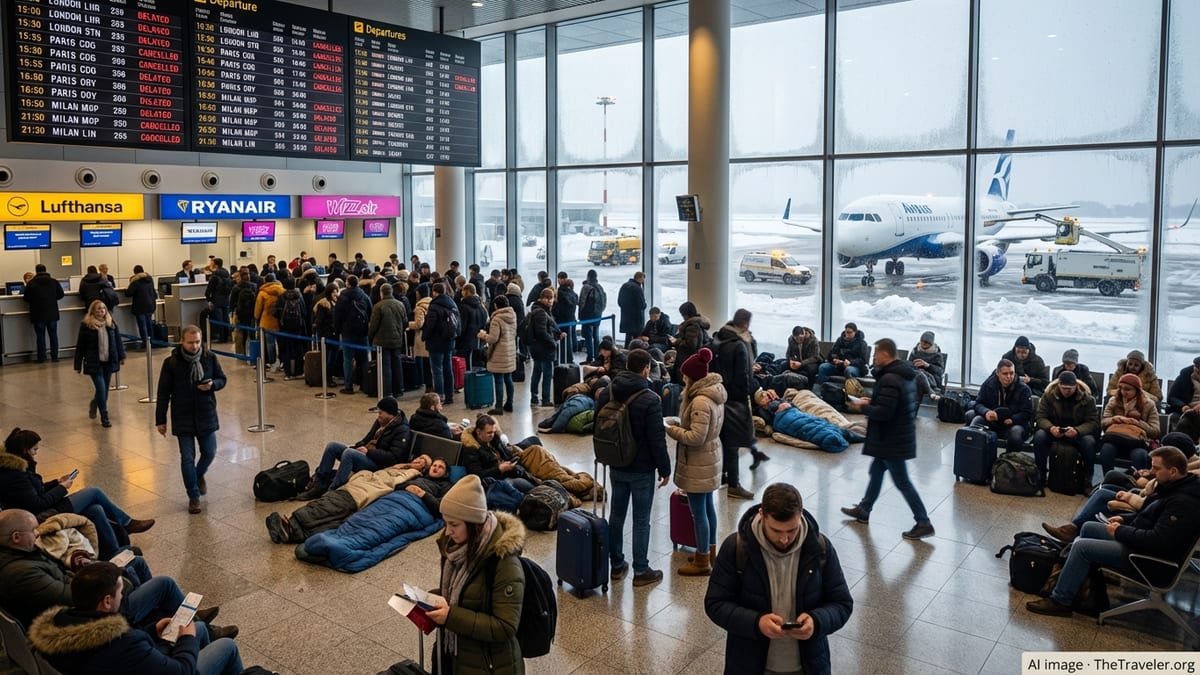
Passengers at Bucharest Henri Coandă International Airport faced hours of uncertainty and mounting frustration this week as a powerful snowstorm swept across southern Romania, triggering 68 flight delays and at least one cancellation on services operated by major European carriers including Lufthansa, Ryanair and Wizz Air, and disrupting key routes to cities such as London, Paris and Milan.
Heavy Snowfall Paralyzes Romania’s Busiest Airport
Air traffic in and out of Bucharest was severely disrupted on 18 February after an intense winter storm blanketed the capital and surrounding Ilfov County in deep snow. Authorities issued a red-code warning for blizzard conditions during the early morning hours, followed by an orange alert that remained in effect until late afternoon, as winds and heavy snowfall continued to batter the region.
At Henri Coandă International Airport, Romania’s main aviation gateway, airside operations struggled to keep pace with the weather. Runway and taxiway clearing required continuous use of snow-removal equipment, while aircraft de-icing dramatically slowed departures. As the day progressed, delays rippled through the schedule, ultimately affecting 68 flights and forcing at least one outright cancellation.
Airport officials reported that the worst of the disruption was concentrated in the morning peak, when visibility dropped and crosswinds made takeoffs and landings hazardous. Although the red alert was lifted midmorning, residual operational constraints, ground handling backlogs and ongoing de-icing requirements meant that delays extended well into the afternoon and evening.
The disruption coincided with wider transport challenges across Bucharest. Local authorities struggled to keep major roads clear, and public transport services were also impacted, complicating journeys for passengers trying to reach or leave the airport.
Flights to London, Paris and Milan Hit by Rolling Delays
The knock-on effect of the storm was felt most acutely on international routes linking Bucharest to western Europe’s main business and leisure hubs. Flights to London, Paris and Milan, all of them heavily trafficked city pairs for both business travelers and tourists, were among those hit by rolling delays that stretched from one departure bank to the next.
Contacted passengers reported waiting in departure lounges for several hours as departure times were repeatedly revised, in some cases moving in 30 to 60 minute increments as aircraft awaited de-icing or inbound connections. For travelers heading to or connecting through London’s major airports, including Heathrow, Gatwick and Stansted, the disruption threatened to unravel tightly planned itineraries across the UK and Ireland.
Similar scenes played out among passengers booked on flights to Paris, particularly Charles de Gaulle and Orly, where even minor delays can create a cascade of missed connections throughout continental Europe and long-haul networks. Travelers heading to Milan’s Malpensa and Linate airports also faced extended waits, with many concerned about missing meetings, trade fairs and onward rail links to northern Italian cities.
Airline operations teams attempted to regroup throughout the day by consolidating loads, reassigning aircraft and negotiating new slots with air traffic control. However, with conditions in Bucharest affecting both arrivals and departures, many services left hours behind schedule, and arrivals into western Europe’s busiest hubs were pushed into already congested evening waves.
Lufthansa, Ryanair and Wizz Air Among Carriers Affected
The disruption at Bucharest Henri Coandă spread across a wide range of airlines, from full-service flag carriers to low-cost operators. Lufthansa, Ryanair and Wizz Air were among those particularly affected, reflecting the importance of Bucharest in each airline’s regional network.
Lufthansa, which feeds passengers from Bucharest into its Frankfurt and Munich hubs for onward connections worldwide, was forced to slow operations as ground crews prioritized de-icing and safety checks. Even modest initial delays in departing Romania quickly translated into misaligned connection windows in Germany, raising the stakes for travelers relying on tight transit times to North America, Asia and other European destinations.
Ryanair, one of Europe’s largest low-cost airlines by traffic, also saw its Bucharest services disrupted. With a point-to-point model that typically relies on rapid aircraft turnarounds, winter weather complications can have an outsized impact on the carrier’s daily schedule. Delays in Bucharest reverberated across shorter-haul routes to Italy, Spain and the United Kingdom, affecting not just passengers in Romania but also those waiting at downline airports for inbound aircraft.
Wizz Air, which operates an extensive network of routes from Bucharest into central and western Europe, faced similar challenges. Ground operations teams were forced to juggle de-icing queues, late-arriving aircraft and crew duty time limits, all while managing large volumes of passengers and luggage during one of the most intense winter weather events of the season.
Scenes of Frustration as Passengers Sleep in Terminals
Inside the terminal, the cumulative strain of delays manifested in long lines at check-in counters, security checkpoints and airline service desks. As afternoon turned to evening, dozens of passengers were seen resting on benches and floors, using coats and carry-on bags as makeshift pillows after hours of uncertainty.
Families with young children were particularly hard hit. Parents described struggling to keep children occupied in crowded departure halls while waiting for updated information on their flights. Some passengers reported receiving frequent push notifications via their airline apps, while others complained of sparse or inconsistent communication, especially when gate changes were made at short notice.
Food and beverage outlets inside the terminal reported brisk business as stranded travelers sought hot meals and drinks. However, as lines lengthened and seating filled up, the atmosphere grew more tense. Travelers with early-morning departures the following day opted to remain overnight in the public areas of the airport rather than risk navigating snow-covered roads again in the pre-dawn hours.
Despite the frustration, there were also isolated reports of cooperation and camaraderie among passengers, with strangers keeping watch over each other’s luggage, sharing device chargers and helping interpret announcements for those who did not speak Romanian or English.
Airport and Airline Responses Focused on Safety
Airport authorities emphasized that safety remained the overriding priority as they sought to maintain operations in deteriorating weather. Crews deployed dozens of specialized vehicles to clear runways, taxiways and aircraft parking stands, while de-icing rigs worked continuously to remove ice accumulation from wings and fuselages before departure.
Airport management noted that while 68 delays and a cancellation were disruptive, the decision to slow the pace of operations was necessary given the red and orange weather alerts in force throughout the day. Airlines were instructed to strictly adhere to de-icing protocols and to coordinate closely with air traffic control to ensure that aircraft were not held on taxiways longer than necessary.
Lufthansa, Ryanair and Wizz Air all pointed to the extraordinary weather conditions as the primary cause of disruption and highlighted their obligations under European air passenger protection regulations. While compensation for weather-related events is generally limited, carriers indicated that affected passengers would be offered rerouting, refunds where applicable and, in cases of overnight delays, assistance with hotel accommodation and meals.
Ground handling companies at Henri Coandă also came under pressure, with teams forced to operate at maximum capacity across extended shifts. Industry observers noted that even well-resourced airports can struggle when heavy snowfall persists for many hours, particularly during peak travel periods.
Travelers Scramble to Rebook and Reroute
As the scale of the disruption became clear, many passengers turned to airline apps, websites and travel agents in a bid to salvage their plans. Those traveling on flexible tickets or with status in frequent flyer programs sometimes secured rebookings on alternative flights via secondary hubs, such as Vienna, Zurich or Warsaw, to bypass the worst of the congestion.
Others, particularly those on low-cost carriers, found options more limited. With many flights across Europe experiencing weather-related delays and some airports facing their own backlogs, routing alternatives quickly filled up. Passengers heading from Bucharest to London, Paris and Milan reported that same-day alternatives were scarce and often significantly more expensive than their original bookings.
Travel agents in Bucharest and other Romanian cities described a flurry of last-minute requests from customers seeking rail or coach options as backup. For some, especially those traveling shorter distances within the region, overland journeys via Hungary or Bulgaria offered a more predictable, if longer, way home than waiting for disrupted flight schedules to normalize.
In the terminal, mobile charging stations and seating near power outlets remained in constant demand as travelers tried to stay connected with family, employers and accommodation providers while their plans shifted.
Know Your Rights When Weather Disrupts Your Flight
The events in Bucharest have once again drawn attention to European air passenger rights, particularly under the EC 261 framework, which applies to flights departing from EU and EEA airports. While compensation for delays and cancellations caused by severe weather is typically not available, airlines still have specific obligations to care for passengers during extended disruptions.
When a flight is significantly delayed, carriers must usually provide meals and refreshments proportionate to the waiting time, as well as access to communication. If an overnight stay becomes necessary and passengers are away from their home city, airlines are expected to arrange hotel accommodation and transport between the airport and the hotel. Travelers are advised to keep receipts for any expenses they incur independently in case they later seek reimbursement.
In the event of a cancellation, passengers are generally entitled to choose between a refund of the unused portion of their ticket or re-routing to their final destination at the earliest opportunity, subject to available seats. For those whose plans are flexible, accepting travel on a later date may provide better options and less stressful connections once conditions improve and schedules stabilize.
Consumer advocates recommend that travelers carefully document their experience during disruption, including screenshots of delay notices and correspondence with airlines, and to follow up in writing if they believe their rights have not been fully respected.
More Winter Weather Possible as Travelers Seek Normality
By the day after the storm, operations at Bucharest Henri Coandă showed signs of stabilizing as crews cleared remaining snow and temperatures began to inch upward. However, minor schedule adjustments continued as airlines repositioned aircraft and crews that had been displaced by the storm.
Meteorologists warned that further episodes of winter weather could not be ruled out in the coming days, although none were expected to match the intensity of the system that struck on 18 February. Airlines urged passengers with upcoming flights to monitor their bookings closely, allow extra time to reach the airport, and be prepared for last-minute gate or schedule changes.
For those stranded during the worst of the disruption, the experience served as a stark reminder of how quickly winter weather can upend even the most carefully laid travel plans. As long queues slowly dissipated and information boards returned to a more familiar pattern, many travelers finally boarded their delayed flights with a mix of relief and lingering fatigue.
With snowbanks still lining airport access roads and de-icing rigs parked at the ready, Bucharest’s main gateway is bracing for the remainder of the winter season, hoping that the next major storm waits until airlines and passengers have fully recovered from this week’s upheaval.