

More news on this day
Hundreds of Lufthansa passengers were forced to spend the night on grounded aircraft at Munich Airport after a sudden snowstorm, night-flight curfew rules and a shortage of buses left around 500 people unable to return to the terminal, triggering criticism of both the airline and airport authorities.
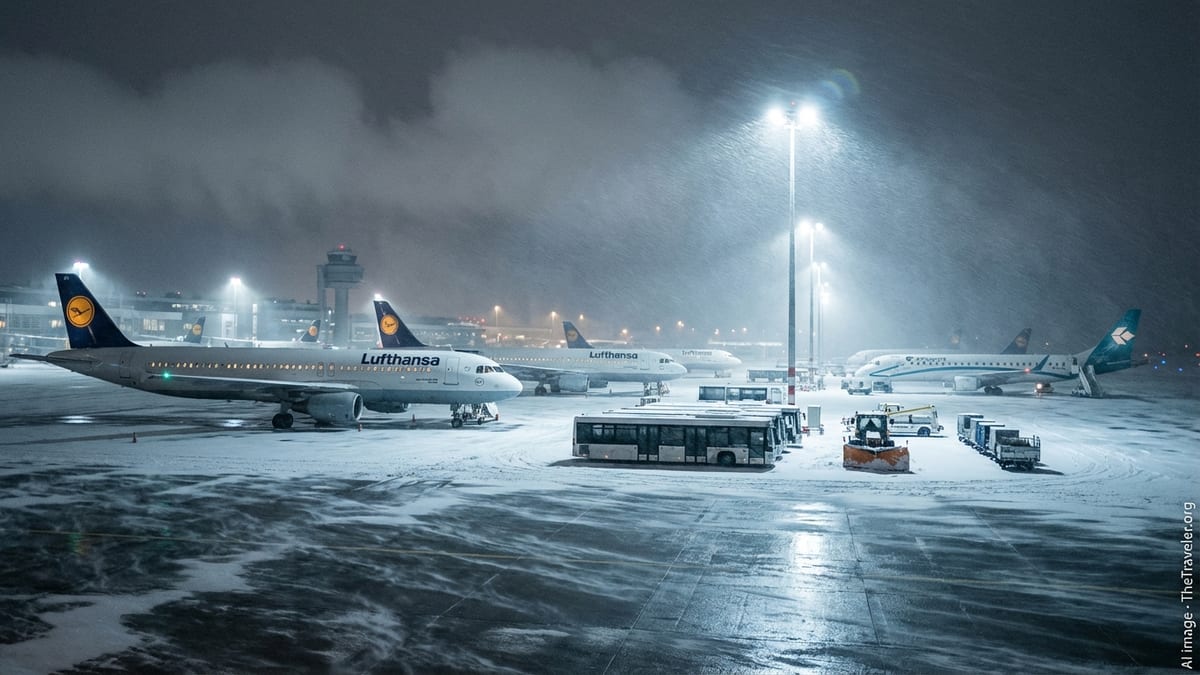
Sudden Winter Storm Paralyzes a Key European Hub
The disruption unfolded on the night of February 19 to 20, when heavy, wet snow swept across southern Germany and quickly overwhelmed operations at Munich Airport, one of Lufthansa’s primary hubs. Throughout the day, airport crews struggled to keep runways clear and to complete de-icing as the snowfall intensified, forcing repeated delays and, eventually, widespread cancellations.
By late evening, roughly 100 flights had been canceled, according to airport and media reports, as conditions on the runways and aprons deteriorated. Some late departures were granted special permission to operate slightly beyond Munich’s usual night curfew, but the worsening weather nullified those exemptions. Several aircraft that had already boarded passengers and pushed back for departure were unable to take off before the extended deadline expired.
What began as an all-too-familiar winter delay soon turned into an extraordinary ordeal for travelers on a cluster of Lufthansa Group services, whose aircraft were left parked in remote stands away from the terminal. As snow piled up, terminal-adjacent stands remained full and the airport’s fleet of apron buses was stretched thin, leaving no practical way to bring passengers back indoors once their flights were finally canceled.
Munich Airport officials later described the night as “very tense,” citing a combination of runway closures, gridlocked aircraft stands and constrained ground staff as the storm peaked. For several hundred passengers already on board, the consequences of those constraints would become painfully clear over the next several hours.
Five Lufthansa Group Flights, One Long Night on the Tarmac
In total, around 500 passengers were left to spend the night inside aircraft cabins on the apron, spread across five Lufthansa Group flights that never left the ground. Media reports and statements from the companies involved indicate that the affected services included three Lufthansa flights to Singapore, Copenhagen and Gdansk, along with two regional flights operated by Air Dolomiti to Graz and Venice.
The scale of the disruption was unusual even for a major European hub accustomed to winter weather. Aviation outlets and German news agencies reported that at least six aircraft were at one point stuck with passengers on board, while the airport later referenced approximately 600 affected travelers as investigations and passenger counts continued. The majority, however, were on Lufthansa-branded operations or those of its regional affiliate.
On each of these flights, the pattern was similar. Passengers boarded in the evening, expecting late departures after de-icing or runway delays. As the night-flight curfew approached, crews and ground operations teams hoped to clear aircraft for takeoff. The snow would not cooperate. One by one, the flights were canceled close to or just after midnight, by which time most terminal gates were occupied by aircraft that had already been taken out of service for the night.
With parking positions near the terminal full, the stranded jets remained at remote stands, accessible only by apron buses and stair trucks. Airport authorities later said that both buses and staff were in short supply in the early hours of the morning, leaving no approved way to disembark passengers or escort them safely across the dark, snow-covered tarmac.
Lufthansa Flight LH2446 Becomes a Symbol of Passenger Frustration
The experience on Lufthansa flight LH2446 from Munich to Copenhagen quickly emerged as the most prominent example of the night’s chaos, as outraged passengers shared accounts and images on social media and with regional news outlets. The Airbus A320neo was scheduled to depart at 9:30 p.m. with 123 passengers on board for what should have been a routine 90-minute hop to Denmark.
After several rounds of delays, passengers finally boarded via stairs at a remote stand and prepared for departure. As de-icing queues lengthened and runway conditions worsened, departure times slipped from late evening to just before midnight. Shortly before the clock struck twelve, the flight was canceled altogether. According to passenger accounts, there were initial expectations that buses would soon arrive to return travelers to the terminal.
Instead, hours passed with little practical progress. Around 2 a.m., several passengers reported being told by crew that the airport was essentially closed for the night under its strict core curfew between midnight and 5 a.m., and that no further buses or ground personnel were available. For safety reasons, passengers were not permitted to walk across the snow-covered apron.
Families with young children, older travelers and business passengers all found themselves confined to short-haul economy seats through the night. With only the standard catering supplies for a brief European flight, food and drink options quickly ran short. While the cabin remained lit and heated and toilets were available, passengers described the atmosphere as increasingly tense and uncomfortable as fatigue and uncertainty took hold.
Inside the Cabin: Long Hours, Limited Information
Across the affected flights, travelers described a long, uncomfortable night in conditions that, while safe, felt far removed from what they considered acceptable. Passengers on LH2446 and other flights told European media they received sporadic announcements, but rarely any firm timeline for when they might be allowed off the plane.
With cabin crews constrained by regulations and dependent on instructions from airport control, updates often amounted to variations on the same message: buses were not available, the airport was under night restrictions and passengers would have to remain on board until operations resumed. Some travelers recounted being told that many ground workers had already gone off duty as the snowstorm worsened and flights were progressively canceled.
For many, the practical hardships were straightforward but wearing. There were limited snacks and bottled water for a full cabin. Blankets and pillows were either scarce or unavailable on some short-haul aircraft, leaving passengers to doze in upright seats wearing coats and scarves for warmth. Parents tried to settle children in cramped rows while keeping them quiet through the early hours, and elderly passengers struggled with stiffness and lack of proper rest.
Several passengers emphasized that cabin crews remained professional and apologetic throughout the ordeal, attempting to serve what refreshments they could and to answer questions. But with no ability to open doors or release passengers onto the apron without ground support, crew members themselves appeared as frustrated as those they were trying to assist.
Airport Curfew, Bus Shortages and a Gridlocked Apron
Airport and airline statements in the days since the incident have painted a picture of a system pushed past its limits by a combination of weather, regulations and infrastructure constraints. Munich Airport operates under one of Germany’s strictest night-flight regimes, with a designated core period from midnight to 5 a.m. when takeoffs and landings are heavily restricted and require individual approvals.
On the night of the snowstorm, officials say they did obtain special exemptions to allow some late departures to operate until around 1 a.m., in an effort to clear the backlog and avoid precisely the kind of overnight stranding that occurred. However, as snowfall intensified and runway conditions deteriorated further, several exempted flights proved unable to depart within the extended window. Once the final deadlines passed, the curfew effectively froze aircraft movements that were not explicitly authorized for safety or emergency reasons.
At the same time, a separate bottleneck developed on the ground. Terminal stands, the gate positions that connect aircraft directly to the building, were largely filled with planes taken out of service earlier in the evening after their own cancellations. That forced late-running flights to park at remote stands, which can only be served by stair vehicles and buses. With the apron coated in snow and staffing resources stretched thin, the airport says bus capacity was “severely limited” overnight.
The result was a stalemate: passengers could not be allowed to walk to the terminal in icy conditions; buses were either unavailable or operating on reduced capacity; and moving aircraft themselves was constrained by curfew rules and occupied stands. By the time additional buses and staff could be mustered in the early morning hours, some passengers had been aboard their aircraft for the better part of eight hours without ever leaving the ground.
Lufthansa and Munich Airport Face Backlash
In the immediate aftermath, both Lufthansa and Munich Airport issued statements expressing regret for the events of the night and for what the airport described as “unacceptable” inconvenience to those affected. The airline acknowledged that several of its flights had remained parked at remote positions in accordance with airport regulations, and that disembarkation had been delayed by the lack of buses and parking positions near the terminal.
Lufthansa stressed that the aircraft had remained supplied with electricity and heat and that crews had “continuously informed” passengers and provided them “the best possible care” with the food and drinks available on board. The company has also begun reviewing compensation claims and indicated that eligible customers may be entitled to payouts or reimbursements, depending on the specific circumstances of their delay and rebooking.
Munich Airport, for its part, said it “deeply regrets” the situation and has apologized to passengers. Spokespeople cited the combination of heavy snowfall, runway closures, full terminal stands and limited bus availability, and emphasized that emergency plans are regularly reviewed and will now be reassessed in light of the incident. Officials suggested that the scale and timing of the storm, coinciding with the start of the night curfew, created a rare convergence of constraints.
Despite those explanations, reactions from travelers and aviation experts have been sharply critical. Commentators in German and international media questioned why no contingency measures were in place to guarantee basic passenger welfare, such as pre-positioned buses, mobile lounges or arrangements to deplane travelers into nearer facilities when it became clear that flights would not operate.
Passenger Anger and Questions Over Accountability
For the passengers who lived through the ordeal, apologies have done little to blunt anger over a night they say was avoidable. Many have described feeling abandoned between two responsible parties: the airline that boarded them and kept them on the aircraft, and the airport that controlled access to buses, stands and the terminal building.
Travelers on the Copenhagen and other affected flights have complained of inconsistent communication and a perception that passenger comfort was treated as secondary to operational constraints. Some passengers have already contacted consumer organizations and legal advisers to explore their rights under European air passenger regulations, while others have called for independent reviews of how such a scenario could unfold at a major hub.
Aviation analysts note that Lufthansa and Munich Airport share a complex relationship as dominant carrier and base hub, with ground-handling responsibilities and decision-making authority divided between airline, airport and contractors. That structure can make it difficult for travelers to know where to direct complaints when things go wrong, particularly in a fast-moving weather emergency.
The incident has also revived debate about the balance between strict night-noise protections for residents and flexibility for airports to resolve irregular operations in extreme conditions. While few are calling for an end to curfew rules, several experts have suggested that clearer exceptions for deplaning stranded passengers, even when aircraft cannot depart, may be warranted.
What Happens Next for Affected Travelers and for Munich
In the days since the snowstorm, Lufthansa has focused on rebooking passengers whose original flights were canceled or severely delayed and on processing compensation and refund claims. Many travelers from the overnight tarmac stays were accommodated on alternate services from Munich or other Lufthansa hubs, but some reported further delays as schedules remained disrupted by the weather and subsequent aircraft rotations.
Consumer advocates are urging affected passengers to document their experiences in detail, including boarding times, cancellation notices and the duration spent on board after departure was abandoned. Such information may prove vital for claims under European Union rules that govern compensation for cancellations and long delays, though airlines often argue that extreme weather constitutes an “extraordinary circumstance” that can limit their liability.
For Munich Airport, the incident is likely to prompt internal and regulatory scrutiny. Officials have already indicated that they will examine bus deployment strategies, stand allocation and communication protocols for nights when heavy weather coincides with curfew hours. Potential changes could include dedicating additional buses for emergency use, revising staffing models for late-night storms or creating more flexible options to bring passengers off aircraft even when terminal gates are unavailable.
For travelers, the episode serves as a stark reminder of how quickly even a well-equipped European hub can become gridlocked when severe weather collides with regulatory and operational limits. While aviation remains statistically safe and generally reliable, the events in Munich highlight the importance of robust contingency planning and transparent communication when things go wrong, especially for those left waiting in the dark on an aircraft that never leaves the ground.