

More news on this day
A powerful and unusually intense snowstorm has brought Vienna International Airport to a standstill, canceling or delaying hundreds of flights and rippling disruption across Austria’s transport network as the country grapples with some of its heaviest February snowfall in decades.
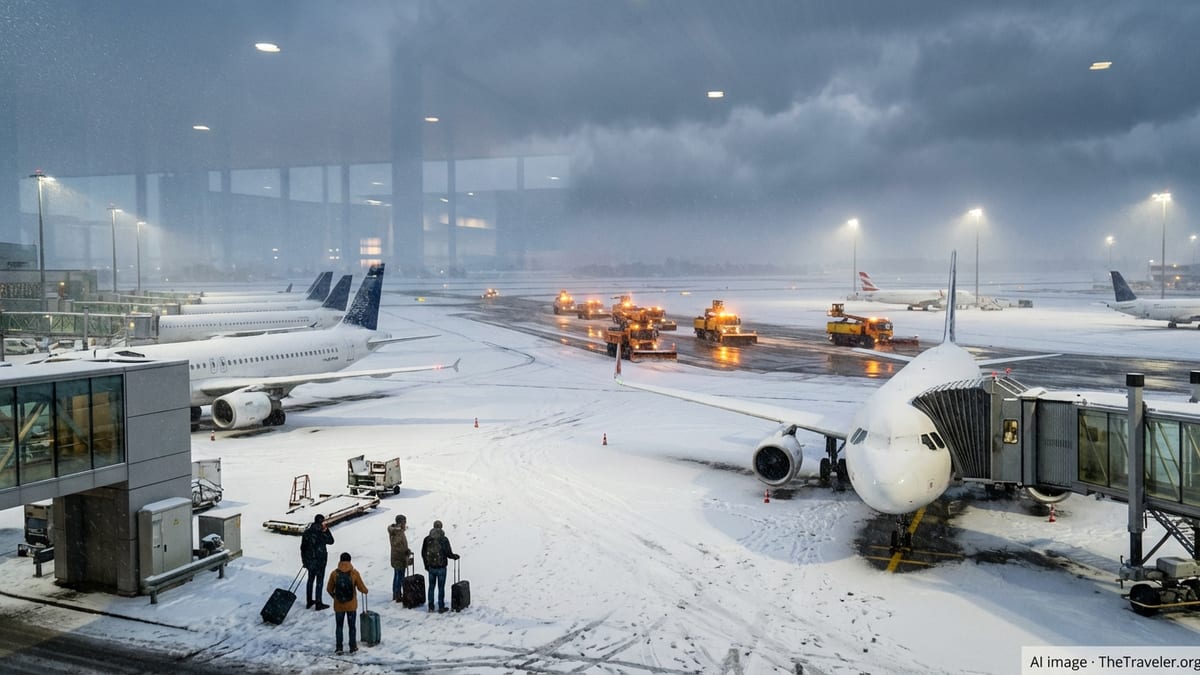
Flights Halted as Runways Disappear Under Snow
Vienna International Airport, one of Central Europe’s key aviation hubs, was forced to suspend all flights on Friday after heavy snow quickly overwhelmed runways, taxiways and de-icing capacity. Airport officials described an evolving emergency, with operations first paused in the early morning and the suspension then extended as conditions deteriorated faster than forecast.
By late morning, Austrian and international media reported that out of roughly 230 scheduled arrivals and departures through midday, around 150 flights had already been canceled, with many others severely delayed. Airport webcams showed rows of snow-covered aircraft standing idle and thick snow obscuring runway markings, while plows worked continuously to clear critical infrastructure.
In a statement, Vienna Airport urged travelers not to come to the terminals unless their flight was explicitly confirmed, warning that last-minute diversions and cancellations were likely as airlines and air traffic controllers scrambled to adapt. Passengers already on-site were advised to remain in close contact with their airlines and to expect extended waiting times for rebooking and ground services.
Airport spokespeople said that, weather permitting, limited takeoffs might gradually resume around midday, with landings following later in the afternoon. However, they cautioned that the backlog created by the morning shutdown would cause knock-on delays lasting well into the evening and potentially into the weekend.
Record Snowfall Turns a Winter Storm into a Historic Event
The storm system, which swept in from the west late Thursday, intensified overnight, dropping about 20 centimeters of snow on Vienna in just a few hours. Meteorologists described the event as highly unusual for late February, noting that the city has not seen such rapid accumulation in comparable conditions for more than two decades.
“We have not experienced anything like this in February in recent years,” one leading Austrian meteorologist told national broadcaster ZiB, pointing to a rare combination of moist air, low temperatures and sustained snowfall that converged directly over the capital and parts of Styria. The result was a fast-moving whiteout, with visibility collapsing and roads, rail lines and airport infrastructure quickly overwhelmed.
Across eastern Austria, the snow was accompanied by gusty winds, creating drifting that made clearing efforts significantly more difficult. Motorists reported suddenly encountering knee-deep snow in open stretches of highway, while rural routes vanished beneath wind-blown drifts that snowplows struggled to keep open.
Forecasters expect conditions to ease gradually from midday, but warn that the risk of avalanches in alpine regions remains elevated and that temperatures will stay below freezing in many areas, prolonging difficult travel conditions on untreated roads and exposed runways.
Passengers Stranded as Cancellations Mount
For travelers, the sudden shutdown translated into long, uncertain hours inside crowded terminal buildings. Departure boards at Vienna International Airport quickly filled with red cancellation notices, punctuated by a handful of delayed flights. Long queues formed at airline service desks as passengers attempted to secure alternative connections, compensation or overnight accommodation.
International connections were particularly affected, with long-haul passengers facing complex re-routing challenges. Aviation tracking sites showed a number of incoming flights holding near Vienna before being diverted to airports in neighboring countries when landing became impossible. Airport authorities confirmed that several services were rerouted, with Munich among the main alternative destinations.
An Etihad Airways flight from Abu Dhabi to Vienna was among those diverted, landing in Munich instead of the Austrian capital. The return leg to the United Arab Emirates was subsequently delayed, illustrating how a single weather disruption in Vienna can reverberate across global networks. Other carriers operating European and transcontinental routes into the city reported similar knock-on effects.
Inside the terminals, shops and cafes did brisk business as travelers sought warmth and distraction while awaiting updates. Many passengers, however, found themselves sleeping on benches or on the floor, using jackets and carry-on baggage as makeshift pillows. With hotels near the airport quickly filling, some airlines issued meal vouchers and limited accommodation support, but capacity was stretched by the sheer scale of the disruption.
National Rail, Roads and Power Networks Under Pressure
The impact extended far beyond the airport perimeter. Austria’s national railway operator warned of widespread delays and cancellations across multiple lines, particularly in regions hit hardest by the storm. Heavy snow and fallen branches affected overhead power lines, while points and switches required constant clearing to remain operational.
On key motorway routes, including sections of the Westautobahn and the main highway south of Vienna, traffic ground to a halt at times as trucks became stuck on slick inclines and visibility dropped dramatically. Road authorities reported multiple minor collisions and several serious accidents, including at least one fatal incident involving a snow-clearing vehicle in the city of Linz.
The province of Styria, especially its southern and eastern districts and the area around Graz, suffered significant power outages as snow-laden trees brought down lines. Local utilities estimated that about 30,000 households temporarily lost electricity on Friday morning, leaving residents without heating and light during some of the coldest hours of the day.
Emergency services and road maintenance crews were deployed around the clock, prioritizing main arteries, access to hospitals and critical infrastructure. Authorities urged residents to avoid non-essential travel, keep mobile phone batteries charged and check on vulnerable neighbors, particularly in rural areas where access could be cut off for hours at a time.
Airlines and Authorities Race to Restore Operations
As snowfall slowly weakened around midday, attention turned to the complex task of restarting operations at Vienna Airport and across Austria’s transport network. Airport management said clearing runways and taxiways was only the first step, with de-icing queues, crew availability, aircraft positioning and air traffic control slots all presenting additional hurdles.
Airlines began reviewing their afternoon and evening schedules, with some opting to consolidate flights or operate larger aircraft on fewer rotations to help move stranded passengers as efficiently as possible. Ground handling companies increased staffing, where feasible, to speed up baggage delivery and aircraft turnaround once operations restarted.
However, experts cautioned that even a short period of closure at a major hub can disrupt schedules for at least 24 to 48 hours. Delayed aircraft and displaced crews can cascade across route networks, leading to further cancellations the following day. Travelers with imminent departures to or from Vienna were advised to monitor their bookings closely and consider flexible rebooking options.
Austrian authorities signaled that they would review the handling of the event once immediate disruptions eased, examining whether forecasting, communication, and coordination between airport management, airlines and public agencies could be further improved to mitigate the impact of future extreme weather.
Tourism and Business Travel Plans Upended
The timing of the storm is particularly sensitive for Vienna and Austria’s broader tourism sector. Late February is typically a busy period, as winter sports travelers transit through the capital en route to alpine resorts and city-break visitors arrive to enjoy cultural attractions, museums and concerts before the onset of spring.
Tour operators reported clients missing transfers to ski destinations as flights failed to arrive, triggering a domino effect of lost hotel nights and rescheduled activities. Some groups were forced to delay the start of their holidays or cut trips short, while others diverted to airports in Germany or other neighboring countries to salvage itineraries.
Business travelers were similarly affected, with meetings, conferences and trade events postponed or moved online at short notice. Corporate travel managers scrambled to rearrange itineraries, while some multinational firms activated contingency plans for staff who could not return home on schedule.
Vienna’s hotels and hospitality venues, meanwhile, saw an unexpected mix of cancellations and new last-minute bookings from stranded travelers. While some properties benefited from additional overnight stays, industry representatives stressed that the short-term boost does not compensate for broader losses across the tourism value chain when a major transport hub is effectively frozen.
Questions Over Preparedness in an Era of Climate Extremes
The storm has also reignited debate over how well central European cities and transport hubs are prepared for increasingly volatile winter weather. Vienna, like many major airports in the region, has extensive snow-clearing equipment and protocols, but the scale and intensity of this event appeared to outpace available capacity during the most critical hours.
Climate scientists caution against attributing any single storm solely to climate change, yet many note that a warming atmosphere can contribute to more extreme and less predictable weather patterns. Central Europe has in recent years alternated between unusually mild winters with sparse snow and sudden, powerful cold snaps that deliver short but intense bursts of snowfall.
Transport experts say this volatility poses a challenge for infrastructure planning. Maintaining equipment and personnel capable of handling rare but severe storms is costly, particularly when years may pass without comparable events. Yet the economic impact of airport and network shutdowns, as seen in Austria this week, is also considerable, affecting airlines, logistics companies, tourism operators and travelers worldwide.
Officials indicated that an after-action review would consider whether additional investment in snow-clearing capacity, more flexible staffing models or enhanced early-warning systems could reduce the likelihood of similar paralysis in future winters, even as weather patterns become harder to predict.