

More news on this day
A powerful winter storm sweeping through the New York metropolitan area brought operations at Newark Liberty International Airport to a near standstill on Sunday, with at least 20 flights canceled and 77 delayed across United Airlines, Spirit Airlines and El Al, disrupting travel to London, Tel Aviv, Chicago, Los Angeles and major cities across the United States.
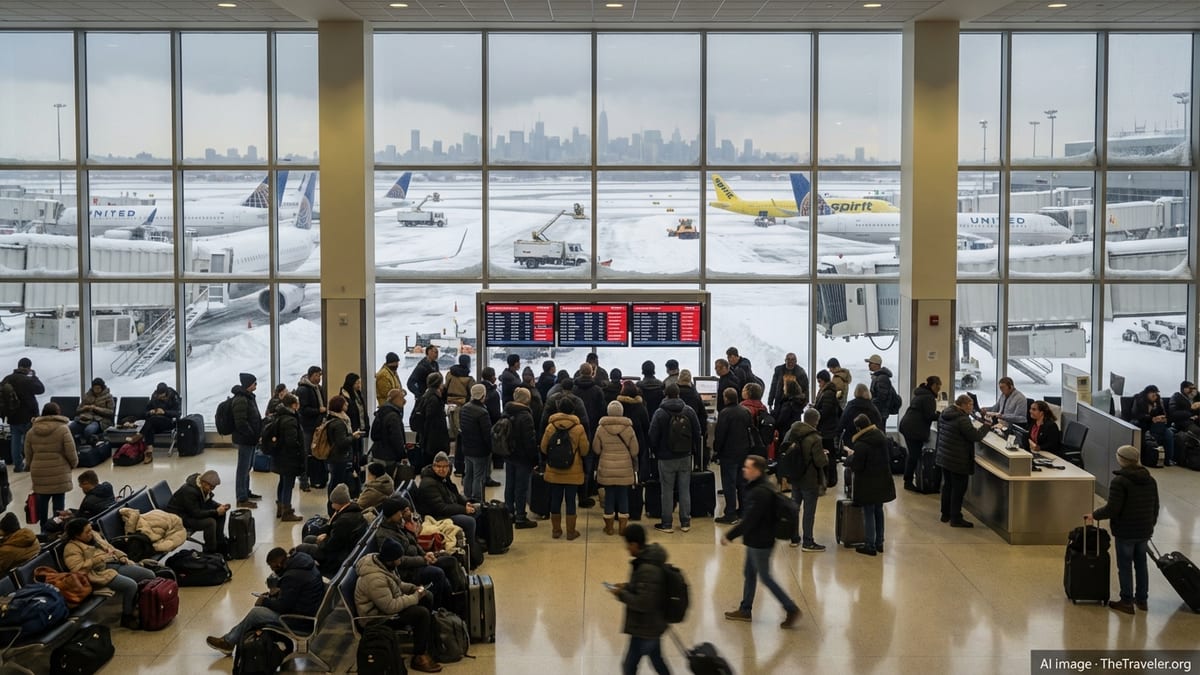
Severe Weather Forces Temporary Shutdown at Newark
Airport officials temporarily closed Newark Liberty to most arrivals on Sunday afternoon as heavy snow, gusting winds and poor visibility made operations unsafe, triggering a cascade of cancellations and delays. Flight information boards showed waves of inbound flights listed as canceled, with outbound departures pushed back repeatedly as crews and ground staff struggled to keep runways and taxiways clear.
The closure followed several days of intense winter weather across the Northeast, but conditions around Newark deteriorated rapidly, prompting authorities and the Federal Aviation Administration to suspend most landings. Airlines were ordered to hold or divert aircraft already en route, and to scale back their schedules through the evening peak.
While some departures continued to operate in gaps between heavier snow bands, the airport functioned at sharply reduced capacity. Travelers reported long queues at ticket counters and kiosks, as carriers attempted to rebook passengers whose flights had been canceled outright.
Forecasters warned that lingering snow showers and high winds could continue to affect operations into the overnight hours, raising the prospect of further disruption into Monday’s morning rush.
United, Spirit and El Al Bear Brunt of Cancellations
United Airlines, the dominant carrier at Newark Liberty, saw a significant portion of its schedule unravel over the course of the day. By late afternoon, the airline had canceled a cluster of domestic services to key hubs including Chicago and Houston, along with select transcontinental flights linking Newark with Los Angeles and other West Coast gateways.
Short-haul routes were hit particularly hard, as United trimmed frequencies to free up aircraft and crews for later recovery flights. Passengers on affected services were being offered rebooking options over the next several days, with some being rerouted via alternate hubs such as Washington and Dulles, depending on seat availability.
Low cost carrier Spirit Airlines, which has been expanding its presence at Newark, also reported multiple cancellations and rolling delays. Its point to point network meant disruptions rippled quickly through leisure focused routes, leaving travelers bound for Florida and other sun destinations scrambling to salvage vacation plans.
El Al, which links Newark with Tel Aviv, faced acute operational challenges as the snowstorm intersected with an already strained global network. One El Al flight bound for Newark was forced to return to Israel earlier in the week when the airport abruptly closed for snow, and Sunday’s renewed weather issues compounded the backlog of passengers waiting for a seat on the Israel United States corridor.
Ripple Effects for London, Tel Aviv and Transcontinental Routes
The timing of the disruption at Newark had outsized consequences for long haul services. Evening departures to Europe and the Middle East typically rely on tight connection windows from domestic feeder flights, many of which were delayed or grounded by the storm.
Flights linking Newark with London faced operational uncertainty as carriers weighed whether aircraft and crews could be positioned in time for safe departures. Some transatlantic passengers were shifted onto later overnight services from New York area airports, while others were offered routing via alternative hubs to keep them on schedule.
On the Tel Aviv route, the snowfall intersected with heightened volatility in Middle Eastern airspace, where airspace closures and reroutings in recent days have already led to extended flight times and schedule changes. For travelers between the New York region and Israel, the Newark disruption was just the latest in a series of hurdles complicating plans, from medical trips to family reunions and business travel.
Transcontinental operations between Newark and cities such as Los Angeles and San Francisco also suffered, with delayed morning flights cascading into the afternoon bank. Airlines prioritized keeping at least a skeletal schedule running to maintain aircraft rotations, but many travelers faced overnight stays or lengthy rebookings on already full flights in the days ahead.
Passengers Stranded as Rebooking Options Tighten
Inside Newark’s terminals, the human impact of the operational meltdown was immediately visible. Lines for customer service snaked down concourses as stranded passengers sought new itineraries, compensation and hotel vouchers. Families returning from school holidays, business travelers racing to Monday morning meetings and international visitors in transit all joined the crush.
With so many flights disrupted at once, rebooking options quickly became constrained. Many of United’s earliest available seats were several days out on popular routes, particularly on nonstop services to West Coast cities and on long haul departures to Europe and the Middle East. Passengers willing to accept connections or alternate airports, such as New York’s JFK or Philadelphia, had slightly better odds of securing an earlier departure.
Spirit and El Al customers faced similar bottlenecks, with limited spare capacity on overlapping routes and high demand driven by travelers who had already been delayed by earlier storms and international airspace issues. Some passengers chose to abandon air travel altogether, renting cars to reach nearby cities or rail hubs in an effort to keep critical commitments.
Airport staff urged travelers not to head to Newark without a confirmed rebooking, warning that security queues and terminal congestion were likely to remain heavy even as the flight schedule thinned out. Airlines advised customers to monitor mobile apps and text alerts closely, as departure times continued to shift in response to changing weather and operational constraints.
Airlines and Authorities Focus on Recovery and Safety
Despite growing frustration in the terminals, both airlines and airport officials emphasized that safety considerations would continue to drive operational decisions. Snow clearing crews worked continuously to treat runways, taxiways and gate areas, but the combination of accumulating snow, blowing wind and low visibility forced conservative spacing between aircraft and limited the number of movements Newark could safely handle.
Operational planners at United, Spirit and El Al spent the day revising schedules, repositioning aircraft and reallocating crews in an effort to stabilize their networks once conditions improved. Recovery flights were expected to operate late into the night and early Monday, although the sheer scale of the disruption meant that some knock on effects could persist for several days.
Travel experts urged passengers to build additional flexibility into upcoming itineraries involving the New York area, especially on routes that intersect with already fragile global corridors such as those to Tel Aviv and other Middle Eastern destinations. With winter weather still in play and international tensions reshaping flight paths, even minor local disruptions can escalate quickly into multi day travel headaches.
For now, travelers at Newark Liberty are left to navigate the immediate fallout of a storm that turned a busy Sunday travel day into a scene of cancellations, rolling delays and uncertainty, underscoring how vulnerable modern air travel remains to the combined forces of weather and geopolitics.