

More news on this day
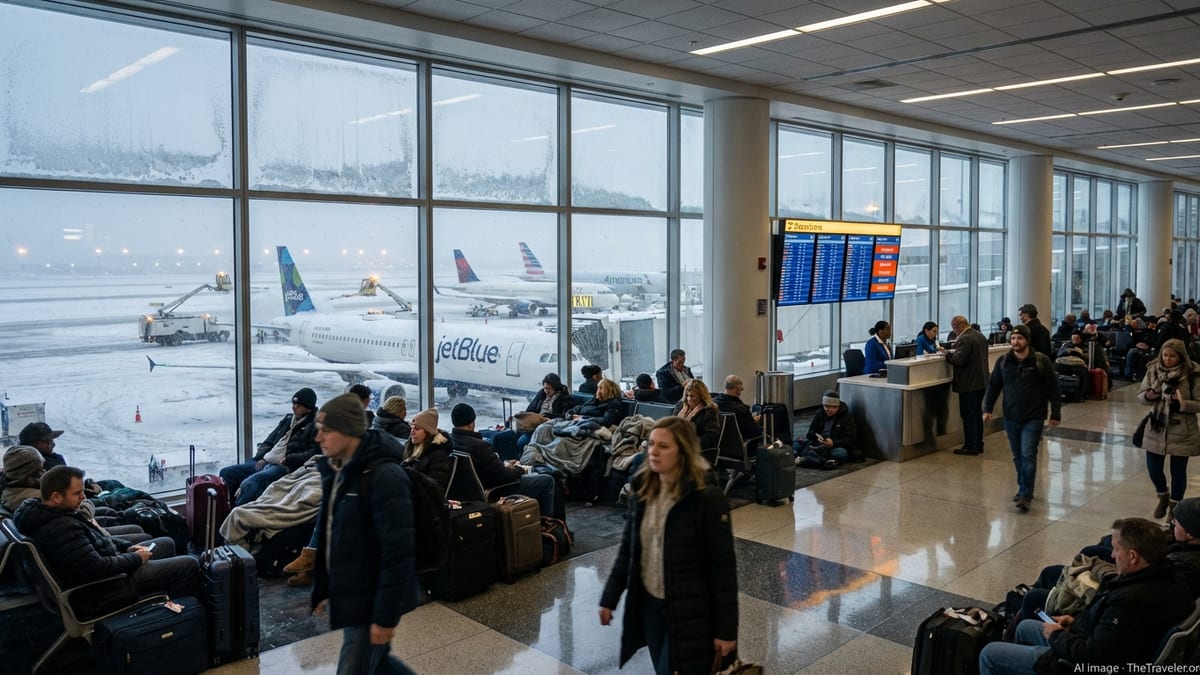
Snowstorms and sheets of ice sweeping across key regions of the United States have unleashed a fresh wave of air travel turmoil, with 2,760 flights canceled and another 499 postponed in a single day, leaving thousands of passengers stranded at airports from New York and Boston to Dallas, Los Angeles, and Miami as airlines including JetBlue, Delta, and American struggle to keep even skeleton schedules running.
Winter Weather Systems Collide With Peak Travel Demand
The latest disruption comes as a powerful series of winter systems pushes across the country, colliding with one of the busiest stretches of the winter travel season. Heavy, wet snow in the Northeast, bands of freezing rain across parts of the Mid-Atlantic and Texas, and pockets of ice and low visibility in California and Florida combined to create conditions that airlines describe as simply “unflyable” on many core routes.
Flight-tracking data shows the brunt of cancellations concentrated at major coastal and Sun Belt hubs, with New York area airports, Los Angeles, Dallas–Fort Worth, Houston, Orlando, Tampa, and Miami all reporting elevated disruption. In many cases, aircraft and crews that were supposed to position overnight from one region to another were unable to move, triggering a cascading effect that rippled throughout domestic networks.
Industry analysts note that while the raw number of cancellations is significant, the timing is equally painful for travelers. Many passengers are returning from long weekends or school breaks, amplifying the mismatch between demand and the capacity airlines can safely operate in adverse conditions. That imbalance has made same-day rebooking difficult and driven last-minute fare spikes on the limited flights still operating.
Meteorologists caution that even brief lulls in snowfall or rain are not enough to restore normal operations quickly. Airport runways, taxiways, and deicing facilities must be cleared and staffed, while airlines must rethread complex schedules that span multiple time zones. The result is that disruptions often linger for 24 to 48 hours after the worst of a storm has passed.
New York and the Northeast: Blizzard Conditions Bring Airports to a Standstill
In the Northeast, increasingly heavy snow and wind have hammered the New York aviation system, one of the most congested in the world. New York’s John F. Kennedy International, LaGuardia, and Newark Liberty International have all reported extensive cancellations, with some airlines suspending most or all departures during the heaviest bands of snow as visibility drops and crosswinds strengthen.
Blizzard-like conditions have also affected Boston and Philadelphia, further constraining the flow of traffic into and out of the region. Ground crews face whiteout bursts, icy ramp surfaces, and wind chills well below freezing, complicating deicing operations and extending the turnaround time needed to safely move aircraft. Even when runways are technically open, the rate at which planes can land and take off is significantly reduced.
Passengers at New York–area airports have described long lines at check-in and customer service counters, with many travelers sleeping in terminals overnight after missing scarce rebooking opportunities. Some airlines have encouraged customers based in the region to postpone nonessential trips, waiving change fees and fare differences for a limited time in order to reduce the pressure on already overloaded operations.
Rail and road options have provided only partial relief. Heavy snow and poor visibility have slowed interstate traffic across parts of New York, New Jersey, and New England, and rail services are also running on modified or delayed schedules. For many would-be fliers, the choice has been between a protracted airport stay or scrapping plans altogether.
Texas, California, and Florida Feel the Shockwaves
Although the most severe winter weather is centered farther north, major hubs in Texas, California, and Florida are feeling the consequences of a system that is tightly interconnected. In Texas, Dallas–Fort Worth and Houston have both seen cancellations tied less to local snow accumulation and more to aircraft and crew imbalances created in other parts of the network. When an aircraft cannot depart New York, Chicago, or Boston the previous evening, the next morning’s departure from Dallas or Houston often disappears as well.
In California, a combination of high winds, low clouds, and pockets of freezing conditions at higher elevations has limited operations at key airports and slowed the flow of transcontinental flights. Los Angeles and San Francisco, which serve as major gateways for both domestic and international traffic, have reported rolling delays that stretch across multiple banks of departures. Airlines are prioritizing long-haul and international flights where possible, sometimes at the expense of shorter-haul domestic routes.
Florida, normally a refuge for travelers seeking winter sun, is instead contending with the downstream impact of weather hundreds of miles away. Orlando, Tampa, Fort Lauderdale, and Miami have all recorded elevated cancellation and delay rates as connecting passengers fail to arrive and crews time out after extended duty days. Florida’s heavy reliance on inbound traffic from the Northeast and Midwest means that any severe storm in those regions is quickly felt along the state’s tourist corridor.
For travelers in these states, the uncertainty can be particularly frustrating. Local skies may look clear, but the aircraft they are waiting to board is still parked under heavy snow several time zones away. That disconnect underscores the national nature of airline scheduling and the speed with which a regional weather event can morph into a nationwide disruption.
JetBlue, Delta, and American Under Strain
Among the hardest-hit airlines in the current wave of disruptions are JetBlue, Delta Air Lines, and American Airlines, all of which maintain significant operations in the affected states. JetBlue, heavily concentrated in New York and Boston and with sizable presences in Florida and on transcontinental routes out of California, has canceled a large share of its schedule as it grapples with grounded aircraft and constrained deicing capacity.
Delta and American, which run sprawling hub-and-spoke networks centered on major airports such as New York, Atlanta, Dallas–Fort Worth, and Miami, are also facing complex operational puzzles. Their hub structures concentrate large numbers of flights in narrow time windows; when winter weather forces even a short ground stop or runway closure, the disruption reverberates through the rest of the day’s schedule, affecting flights that never go near snow or ice.
All three carriers have activated systemwide weather waivers, allowing customers booked to travel through affected cities to change their flights within a defined time window without incurring traditional change fees. However, limited spare capacity means passengers may find that the only available options are days later, or that alternate routings involve multiple connections instead of a nonstop trip.
Airline staff, from pilots and flight attendants to gate agents and call center employees, are also under enormous pressure. Crews must comply with strict federal duty-time rules, meaning that extended ground delays or diversions can quickly make them ineligible to operate additional legs. At the same time, front-line agents are dealing with long lines of frustrated travelers, many of whom have already been impacted by previous storms or operational issues over the past year.
Inside the Numbers: 2,760 Cancellations and 499 Delays
The headline numbers from the current disruption offer a stark snapshot of the fragility of the system. More than 2,700 canceled flights in a single day effectively represent the elimination of tens of thousands of seats, while nearly 500 additional delays add further strain as planes and crews fall out of position.
While these figures are significant on their own, experts point out that they also come on top of a broader pattern of weather- and infrastructure-related disruptions this winter. Earlier storms have already caused major interruptions in the Midwest and South, and each new round of cancellations complicates the task of resetting schedules, positioning aircraft, and balancing maintenance needs.
Another challenge is the uneven distribution of disruptions across airlines and airports. Some carriers, by virtue of their hub locations and route networks, are hit harder than others, leading to sharply different experiences for travelers depending on which airline they chose. An airport where one carrier has cut most departures for the day may still see a limited number of flights from other airlines, though spare seats on those services tend to sell out quickly.
For regulators and consumer advocates, the latest wave of cancellations adds fresh urgency to ongoing debates about passenger protections and airline accountability. Questions are being raised about how clearly airlines are communicating with customers, whether schedules have been trimmed sufficiently to reflect realistic winter operating conditions, and what obligations carriers should have when storms expose systemic vulnerabilities.
What Stranded Travelers Can Do Right Now
For travelers already caught in the disruption, timing and information are critical. Experts consistently recommend checking flight status early and often on official airline channels, as departure times can change multiple times in a matter of hours. Travelers should also ensure that the contact details in their booking profiles are up to date so that they receive text or email alerts about cancellations or schedule changes.
When a cancellation occurs, speed can make the difference between securing a reasonable alternative and being left with few options. Rebooking through an airline’s app or website is often faster than waiting in line at an airport counter or calling a customer service number, particularly during widespread disruptions when call volumes surge. In some cases, travelers have found success by proactively searching for alternate routings through secondary hubs rather than waiting for the airline’s automated system to suggest options.
Passengers who must travel urgently may want to consider nearby airports or even rail and bus connections as part of a patchwork solution. Larger metropolitan areas such as New York, Los Angeles, Dallas–Fort Worth, and South Florida offer multiple airports within driving distance; while availability is not guaranteed, checking surrounding airports can occasionally uncover seats that are not visible on the original routing.
At the same time, consumer advocates remind travelers to document all expenses related to disruptions, including hotels, meals, and ground transportation. While weather-related disruptions typically fall outside airlines’ legal obligation to provide compensation, some carriers offer goodwill vouchers or reimbursements on a discretionary basis, particularly for elite frequent fliers or those facing extreme hardship.
How to Plan Ahead if You Are Scheduled to Fly
For travelers with upcoming trips over the next several days, careful planning can significantly reduce the risk of being stranded. One of the simplest strategies is to opt for morning departures whenever possible. Early flights are less likely to be affected by the cumulative delays that build up over the course of a day, and they provide more backup options if a cancellation occurs.
Booking nonstop flights instead of connections, even if slightly more expensive, can also pay dividends during volatile weather patterns. Each additional connection introduces another point of potential failure, and passengers are more vulnerable to missed connections when storms disrupt tightly timed schedules. When connections are unavoidable, choosing hubs less likely to be hit by the current storm track may offer a small but meaningful buffer.
Travelers are also advised to travel with essentials in their carry-on rather than checked bags, including medications, chargers, basic toiletries, and a change of clothes. With cancellations and missed connections more common during severe weather, checked luggage can easily become separated from passengers for extended periods. Keeping the essentials close at hand can turn an unplanned overnight in an airport hotel from a crisis into an inconvenience.
Finally, experts suggest that passengers take advantage of flexible booking policies that have become more common since the pandemic. Many airlines now sell fares that can be changed without traditional penalties, especially for domestic travel. In the face of an approaching storm, voluntarily moving a trip by a day or two, or shifting to a different time of day, can often prevent far more serious disruption later.
Why US Air Travel Remains So Vulnerable to Weather Shocks
The scale of the current disruption has once again highlighted questions about why the US aviation system continues to be so vulnerable to weather shocks. Industry analysts point to a combination of aging infrastructure, tight staffing levels, and highly optimized schedules that leave little room for error when conditions deteriorate.
Many major airports operate near capacity during peak periods, with runways and taxiways already handling dense waves of traffic in normal weather. When a storm requires longer separation between takeoffs and landings, or forces temporary runway closures for plowing and deicing, the entire system quickly backs up. Even small reductions in capacity can translate into hundreds of delayed or canceled flights over the course of a day.
Airlines, for their part, have sought to rebuild schedules to capture strong travel demand after the pandemic era, but they continue to face shortages of pilots, maintenance technicians, and ground staff in some markets. That leaves less flexibility to recover after a disruptive event. When a major storm grounds aircraft in multiple regions at once, the recovery process can take several days even after skies clear.
Observers note that while no system can be fully weatherproof, incremental improvements are possible. Investments in modernizing air traffic control technology, expanding deicing capacity, bolstering staffing levels, and building more realistic seasonal buffers into schedules could all help reduce the scale and duration of future disruptions. For now, however, travelers are likely to face more episodes of widespread cancellations and delays as winter continues to test the system.