

More news on this day
Global air travelers are facing higher ticket prices and tighter capacity as jet fuel costs surge in tandem with the escalating Iran war and mounting disruption to key oil shipping routes, squeezing airline finances and reshaping flight patterns on major international corridors.
Get the latest news straight to your inbox!
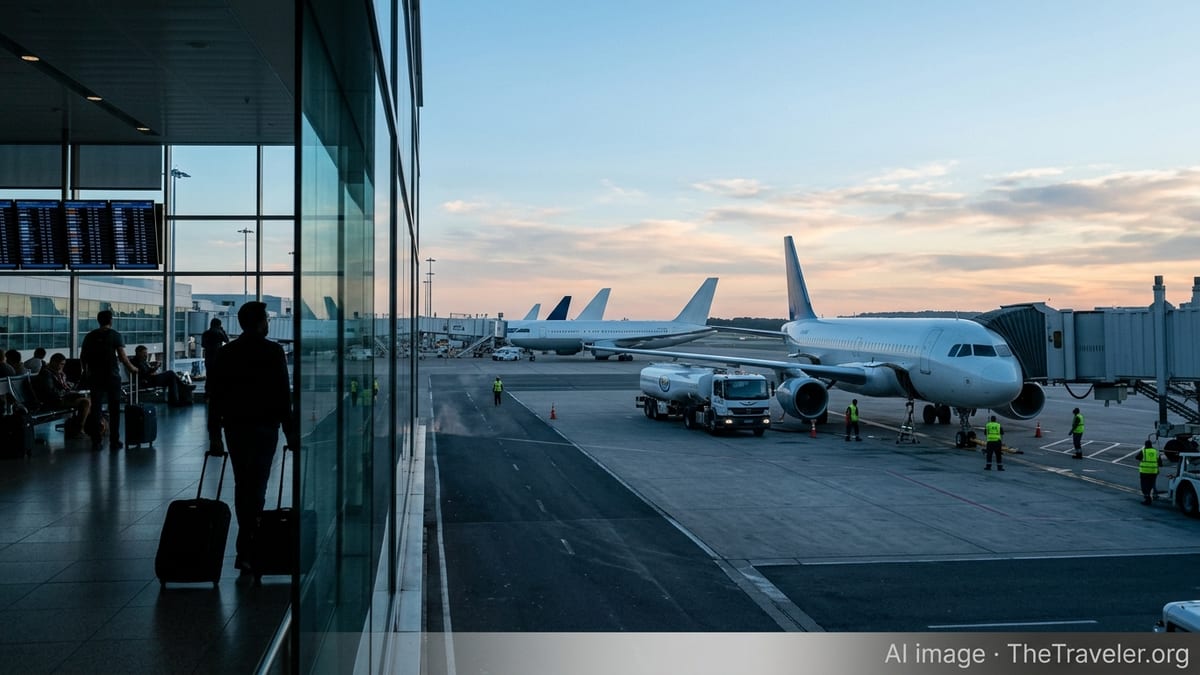
Jet Fuel Prices Spike As Conflict Squeezes Supply
Jet fuel, one of the airline industry’s largest operating expenses, has climbed sharply since late February 2026 as the Iran war intensified and key Gulf energy infrastructure came under attack. Publicly available data from industry trackers indicates that average jet fuel prices have almost doubled from early January levels, with some benchmarks rising more than 70 percent in Asia as refiners struggle to replace disrupted Middle Eastern supply.
The closure and intermittent disruption of the Strait of Hormuz, a vital choke point for global oil and refined products, has added to the pressure. Attacks on oil and gas facilities in Saudi Arabia, the United Arab Emirates, Qatar and Iran have taken capacity offline and increased risk premiums across oil markets. Tankers now face higher insurance costs and longer voyages, driving up the delivered cost of crude and aviation fuels used by airlines worldwide.
Analysts note that jet fuel prices often move in lockstep with crude oil but can spike more quickly when refinery operations and shipping lanes are directly affected. In this latest crisis, both factors are in play: damage to regional refineries and limits on tanker traffic are constraining supply just as airlines head into the busy spring and summer travel seasons, amplifying the cost shock for carriers and passengers.
Airlines Turn To Higher Fares, Surcharges And Rerouting
With fuel typically accounting for about a quarter of airline operating costs, carriers are moving quickly to pass at least part of the increase on to customers. Industry coverage shows that several airlines have introduced or expanded fuel surcharges on both domestic and international routes, while others have raised base fares on long-haul services that are particularly exposed to higher fuel burn and rerouting.
In India, low-cost giant IndiGo has announced a new fuel charge on tickets from mid-March, citing an increase of more than 80 percent in regional jet fuel prices compared with last year. In the Pacific, Air New Zealand has increased prices on domestic, short-haul and long-haul routes and signaled that further adjustments or schedule changes may follow if fuel costs continue to climb. Similar pricing actions are emerging across Asia, Europe and the Americas as airlines test how much extra cost consumers are willing to absorb.
At the same time, safety concerns and war-risk insurance conditions are prompting carriers to reroute flights away from sensitive Middle Eastern airspace. Long-haul services between Europe and Asia, as well as flights linking the Gulf to other regions, are in some cases adding hundreds of nautical miles to avoid conflict zones. These detours increase fuel burn, lengthen flight times and tie up aircraft and crew for longer rotations, compounding expense and reducing available capacity on popular routes.
Geopolitical Flashpoints Redraw Global Energy And Flight Maps
The surge in aviation fuel costs is tightly linked to a broader reconfiguration of global energy flows triggered by the Iran war and related tensions in the Red Sea and Gulf region. The effective closure of the Strait of Hormuz to most foreign shipping, combined with missile and drone strikes on refineries and export terminals, has disrupted a corridor that handles a significant share of the world’s oil and liquefied natural gas trade.
With tankers and container ships diverted away from high-risk waters, many voyages are being rerouted around Africa’s Cape of Good Hope, adding 10 to 14 days of sailing time on some Asia–Europe and Asia–US routes. Freight and tanker rates have reached record levels as a result, and higher marine fuel costs are feeding through into the refined products market, including jet fuel. Maritime and logistics advisories describe emergency surcharges and tight vessel availability as the new norm for shippers.
Meanwhile, countries heavily dependent on imported energy, particularly in Asia, are scrambling to secure alternative supplies and manage domestic fuel prices. Reports from the region highlight efforts to tap strategic reserves, adjust power generation mixes and negotiate new supply contracts. These shifts, however, take time, and the immediate effect is a more competitive scramble for cargoes that further inflates prices paid by refiners and, ultimately, airlines buying aviation fuel.
What Higher Fuel Costs Mean For Travelers
For passengers, the impact of this geopolitical and energy turmoil is already visible in airfares, especially on routes that rely heavily on long-haul aircraft or pass near affected regions. Published analyses of booking data suggest that ticket prices on some Europe–Asia and transpacific routes have risen faster than inflation in recent weeks, even as demand for leisure and business travel remains strong.
Travel industry briefings indicate that airlines are prioritizing routes with the strongest yields and highest demand, which can lead to reduced frequencies or aircraft downgrades on thinner routes. When capacity tightens, competition diminishes and fare flexibility shrinks, leaving travelers with fewer options for discounted seats. Some carriers are also trimming ancillary offers, such as fare sales and upgrade promotions, to preserve revenue as fuel bills escalate.
Consumer advocates and travel analysts recommend that passengers seeking international flights in the coming months plan further ahead than usual, particularly for peak summer departures. Flexible dates, alternative airports and willingness to connect rather than fly nonstop may help mitigate price increases, but the overall trend points to a more expensive environment for air travel while the energy shock persists.
Airline Strategies And The Outlook For Fares
Despite the cost pressures, airline financial guidance and recent earnings commentary show that strong post-pandemic demand is still supporting high load factors and robust revenue. Some large US and European carriers report record forward bookings for 2026, suggesting that many travelers are accepting higher prices rather than canceling trips. This demand backdrop gives airlines room to maintain fuel surcharges and higher base fares as long as jet fuel prices remain elevated.
Carriers are also accelerating measures to reduce long-term exposure to volatile fuel markets. Fleet renewal programs favoring newer, more fuel-efficient aircraft, expanded use of hedging in financial markets, and early-stage investments in sustainable aviation fuel are all being highlighted as ways to moderate future shocks. However, these strategies cannot fully offset the immediate hit from a sudden spike in conventional jet fuel costs tied to geopolitical conflict.
Looking ahead, the trajectory of airfares will be closely tied to developments in the Middle East and the reopening of key shipping lanes such as the Strait of Hormuz and Red Sea approaches. If tensions ease and energy infrastructure is restored, fuel prices could retreat from current highs, giving airlines scope to moderate surcharges. If the conflict drags on or widens, elevated fuel and insurance costs are likely to keep airline ticket prices higher for longer, reshaping travel budgets and route networks well into the year.