

More news on this day
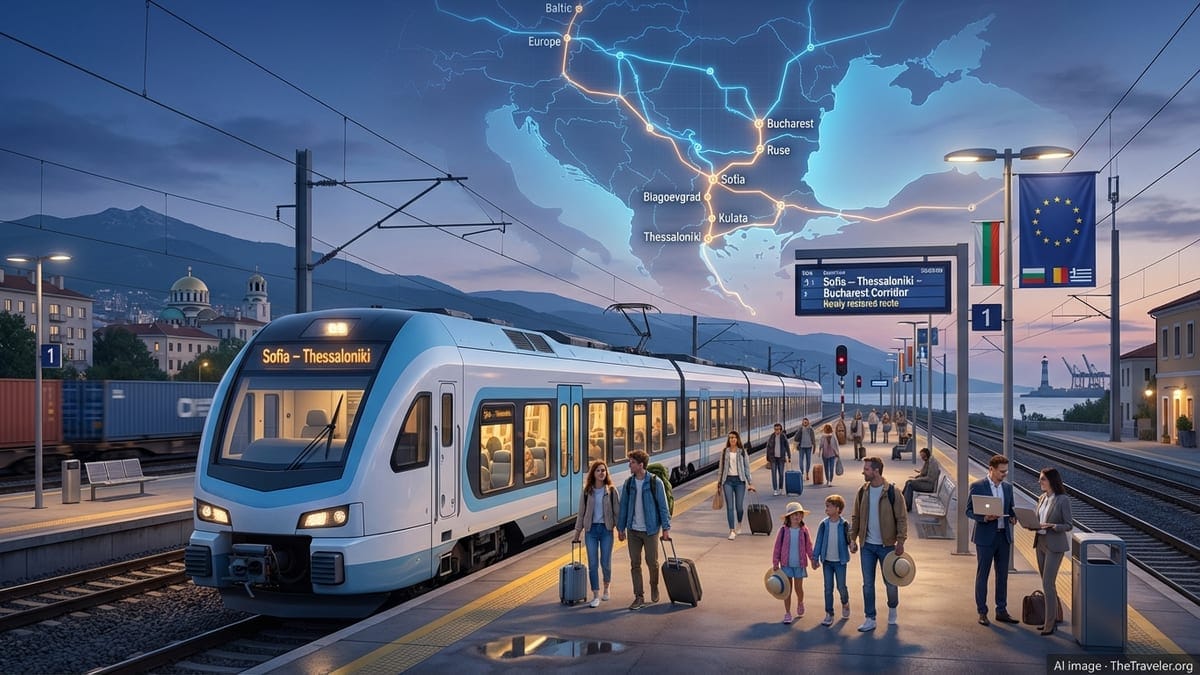
Regular passenger trains are set to return between Sofia and Thessaloniki for the first time in nearly a decade, as Bulgaria, Greece and Romania move from political declarations to concrete rail projects along a new Black Sea–Aegean Sea corridor.
For travelers, the revival of this north–south line promises faster, more comfortable journeys between the Balkans and the Aegean, and a new strategic spine that will ultimately stretch as far as Bucharest and beyond.
More News
- Winter Weather Triggers Widespread Flight Delays at Major European Hubs
- China Urges Citizens to Avoid Japan After Multi-Million Yen Pepper Spray Robberies
- UK Issues Nipah Virus Travel Alert for Holidaymakers Heading to South and Southeast Asia
A Rail Link Returns After Nearly a Decade
Direct passenger rail service between Sofia and Thessaloniki was suspended in 2017, cutting a traditional route used by holidaymakers heading for the Greek coast and Bulgarians and Greeks commuting or studying across the border. Now, Bulgaria’s outgoing transport minister Grozdan Karadzhov has confirmed that regular services will be restored next year, marking nine years without a direct link.
The announcement came on January 30, 2026, during the first working meeting in Sofia between Bulgaria, Greece, Romania and the European Commission focused on the new “Black Sea–Aegean Sea” transport corridor. Bulgarian public broadcaster reports that authorities are preparing to bring back daily passenger connections between the two cities, supported by infrastructure improvements on both sides of the border.
Greek Alternate Minister of Infrastructure and Transport Konstantinos Kyranakis said that high-quality passenger rail between Thessaloniki and Sofia is planned to be fully in place by 2027, with preparations and organizational work already underway. This timeline suggests an initial reopening of the service using existing or partially upgraded tracks, followed by a more modern, higher-standard service as works advance.
For passengers, this will mean a return to straightforward, border-crossing rail travel between Bulgaria’s capital and Greece’s northern metropolis, avoiding lengthy bus rides or multi-leg journeys through other hubs. It will also restore one of southeastern Europe’s few international train links, which had dwindled over the past decade.
The Strategic Black Sea–Aegean Corridor
The Sofia–Thessaloniki line is only one piece of a much bigger puzzle. In December 2025, Bulgaria, Greece and Romania signed a Memorandum of Understanding in Brussels establishing the Black Sea–Aegean Sea Corridor Platform, a new structure designed to coordinate investments in rail, road and inland waterway links between the three countries.
The platform is tasked with developing a north–south axis that connects the Aegean ports, notably Thessaloniki and Alexandroupolis, with the Black Sea coast and the Danube, via Bulgaria and Romania. The corridor is classified as part of the trans-European transport network, giving it access to EU funding instruments such as the Connecting Europe Facility.
Officials describe the project as both economically and geopolitically significant. It offers a land-based alternative to traditional east–west routes through the Bosphorus and central Europe, and is being designed to carry both civilian and military traffic. The European Commission has repeatedly highlighted the corridor’s role in strengthening supply chain resilience, regional security and connectivity with Ukraine and Moldova.
Within this framework, the Thessaloniki–Sofia–Bucharest rail axis is emerging as one of the flagship projects. The aim is to create a continuous, interoperable line, with coordinated timetables and standards, rather than a patchwork of national segments upgraded at different speeds.
What Will the New Sofia–Thessaloniki Service Look Like?
While detailed timetables and final rolling stock choices have not yet been published, officials have sketched out what travelers can expect from the reborn route. Kyranakis has spoken of “high-quality passenger rail transport,” suggesting modern, air-conditioned trains, upgraded tracks and signaling, and competitive end-to-end journey times.
On the Greek side, work is advancing on the electrification and modernization of the Piraeus–Athens–Thessaloniki double-track main line, already a backbone for domestic rail services. Modernization is also underway along the Thessaloniki–Kulata route toward the Bulgarian border, which forms the southern half of the international corridor.
In Bulgaria, the existing line running from Sofia through Blagoevgrad and Kulata to the Promachonas border crossing is being integrated into a broader modernization program that also targets connections northward to Plovdiv, Ruse and ultimately Bucharest. Officials in Sofia say the goal is to have a consistently upgraded route that can support higher speeds, more frequent trains and better reliability than the pre-2017 service.
At present, journey times between Sofia and Thessaloniki by rail are expected to remain in the medium range rather than match high-speed European services. However, renewed electrification, track renewals and cross-border signaling upgrades should bring a noticeable improvement over former services, which were hampered by speed restrictions, aging rolling stock and lengthy border formalities.
Connecting Bulgaria, Greece and Romania: Beyond a Single Line
The reopening of the Sofia–Thessaloniki rail link is being framed by all three governments as the first visible symbol of a much broader transformation in regional transport. Bulgaria’s transport ministry has emphasized that the same corridor will be extended north to Bucharest, while Romania has highlighted parallel plans for a Bucharest–Thessaloniki highway and rail axis.
In practical terms, this means that passengers will eventually be able to travel by train from the Romanian capital to the Aegean, changing in Sofia, on an integrated schedule. Freight operators are also watching closely, since a modernized line could offer an attractive route for containers and bulk goods moving between the Black Sea, the Balkans and Mediterranean ports.
The Black Sea–Aegean Sea Corridor is designed to intersect with other European corridors, including those linking to Central Europe and the Baltic. Bulgarian officials speak of a broader “Baltic Sea–Black Sea–Aegean Sea” direction that, once fully realised, would connect Athens and Thessaloniki with Northern and Western Europe through a continuous chain of upgraded rail and road links.
This networked approach reflects lessons learned from past projects in the region, where fragmented planning led to bottlenecks at borders and inconsistent standards. Under the new memorandum, the three countries have committed to aligning their investment plans, coordinating construction timelines and jointly seeking European financing for cross-border stretches.
Funding, Timelines and Remaining Bottlenecks
Although political momentum is strong, the revival of the Sofia–Thessaloniki rail service and its extension toward Bucharest depend heavily on funding and practical project management. The four-party meeting in Sofia in late January 2026, attended by representatives of the European Commission, explicitly focused on financing options, including EU grants and public-private partnerships.
Commission officials have indicated that trilateral projects ready for implementation by around 2030 could be eligible for Connecting Europe Facility funding, provided Bulgaria, Greece and Romania submit joint applications by mid-September 2026. This creates a tight but clear window for finalizing technical studies, environmental assessments and cross-border agreements.
In parallel, the region is tackling physical bottlenecks such as limited bridge capacity over the Danube between Bulgaria and Romania. As of mid-decade, only two bridges span the river along a 475-kilometre shared frontier, creating what Bulgarian ministers describe as a “new Iron Curtain” for north–south movement. Discussions on additional bridges and improved road and rail crossings are therefore directly linked to the viability of the corridor as a whole.
Domestic infrastructure plans, such as Bulgaria’s Ruse–Veliko Tarnovo motorway project and other north–south routes, add another layer of complexity but also opportunity. If coordinated effectively with rail upgrades, they could give travelers and logistics operators multiple, interlinked options for moving across the region.
What It Means for Travelers and Tourism
For individual travelers, the return of trains between Sofia and Thessaloniki will reopen a classic route for summer holidays, city breaks and cross-border commuting. The line connects two cities with distinct cultural and tourist appeal, while also providing access to the wider Aegean coast and inland Bulgaria.
Rail advocates point out that an attractive Sofia–Thessaloniki service could draw passengers away from budget airlines and long-distance buses, especially if fares are competitive and journey times are brought down through incremental upgrades. Overnight services, if introduced, could appeal to travelers looking to save on accommodation while moving between the two cities.
The line is also expected to benefit secondary destinations. Improved rail connections to Thessaloniki make it easier for visitors to continue onward to Halkidiki, the islands or central Macedonia, while Bulgarian cities along the route may see more visitors from Greece. Combined with other recent cross-border developments, such as the opening of the Rudozem–Xanthi road pass to light vehicles, the region as a whole is becoming more accessible.
For tourists coming from further afield, particularly from Central and Western Europe, the longer-term dream is to travel overland from cities like Vienna or Budapest through Bucharest, Sofia and on to the Aegean, using a chain of upgraded rail links. While this vision will take years to fully materialize, the Sofia–Thessaloniki reopening is one of the first concrete steps toward it.
Security, Resilience and the Military Dimension
Beyond tourism and passenger convenience, the new rail link is part of a wider effort by the European Union and NATO members in the region to strengthen strategic infrastructure. Bulgaria, Greece and Romania have previously signed letters of intent for harmonized military mobility corridors, allowing faster movement of troops and equipment across their territories in times of crisis.
The Black Sea–Aegean Sea rail and road axes are designed with dual use in mind, serving civilian traffic in peacetime and military logistics if needed. The European Commission and national defense ministries emphasize that well-maintained, interoperable infrastructure benefits both security and economic development, particularly at a time of heightened tensions along the EU’s eastern flank.
For travelers, this military dimension will be largely invisible, manifesting mostly as better-maintained lines, more modern signaling and increased resilience to disruptions. However, it is a key reason why Brussels and national capitals are willing to devote political capital and financial resources to projects that, on the surface, look like classic transport investments.
Regional freight corridors serving Black Sea ports, Danube river routes and the Aegean are also expected to gain from these improvements. Enhanced rail capacity could redirect some cargo flows from congested maritime chokepoints and overland routes further north, offering shippers more flexibility in response to geopolitical shocks.
FAQ
Q1: When will regular trains between Sofia and Thessaloniki start running again?
Regular passenger services are expected to be restored next year, following confirmation by Bulgarian and Greek officials at a four-party meeting in Sofia on January 30, 2026. The exact timetable has not yet been published, but authorities say preparations are in an advanced stage.
Q2: How does this project relate to Bucharest and Romania?
The Sofia–Thessaloniki line is part of a wider Black Sea–Aegean Sea corridor that will extend north to Bucharest. Romania, Bulgaria and Greece have committed to a combined rail and road axis linking the Romanian capital to the Aegean, so travelers will eventually be able to connect from Bucharest to Thessaloniki via Sofia on coordinated services.
Q3: What kind of trains and journey times can passengers expect?
Officials speak of “high-quality passenger rail,” implying modern, comfortable trains and improved tracks. In the first phase, journey times are likely to be moderate rather than high-speed, but ongoing electrification and modernization works on the Thessaloniki–Kulata route and Bulgarian sections should gradually shorten travel times compared with pre-2017 services.
Q4: Will there be direct trains all the way from Bucharest to Thessaloniki?
In the medium term, passengers will probably travel with a connection in Sofia, as infrastructure and timetables are progressively aligned. The long-term ambition of the three governments is to create a seamless corridor where direct or well-timed connecting services make it possible to travel efficiently between Bucharest and the Aegean by rail.
Q5: How is the project being funded?
The corridor is part of the EU’s trans-European transport network, so it can draw on European funding, particularly through the Connecting Europe Facility. Bulgaria, Greece and Romania are preparing joint applications for cross-border sections, and are also exploring national budgets and public-private partnerships to cover parts of the investment.
Q6: Why did the Sofia–Thessaloniki train stop running in the first place?
The direct service was suspended in 2017 amid a combination of factors, including aging rolling stock, infrastructure constraints, operational costs and limited passenger numbers. The new political focus on the Black Sea–Aegean corridor, together with EU support, has created the conditions for a more sustainable, upgraded service to return.
Q7: What improvements are happening on the Greek side of the line?
Greece is electrifying and upgrading the main Piraeus–Athens–Thessaloniki trunk line and modernizing the Thessaloniki–Kulata section toward Bulgaria. These works cover track renewals, signaling upgrades and infrastructure enhancements that will support faster, more frequent international trains.
Q8: How will this affect tourism in the region?
The return of the Sofia–Thessaloniki train should make it easier for tourists to move between Bulgaria’s capital, Greek coastal destinations and other Balkan cities without flying. Combined with new road links such as the recently opened Rudozem–Xanthi pass for light vehicles, it will contribute to a denser web of cross-border options for holidaymakers and city-break travelers.
Q9: Is the corridor only for passengers, or will freight use it too?
The corridor is explicitly designed for both passenger and freight traffic. Modernized rail lines between the Aegean, the Black Sea and the Danube will be attractive for container and bulk cargo, offering alternative routes for shippers and enhancing the resilience of regional supply chains.
Q10: What are the main challenges that could slow down the project?
The key challenges are securing sufficient funding, coordinating construction and upgrades across three countries, and addressing bottlenecks such as limited bridge capacity over the Danube. Meeting EU deadlines for funding applications and delivering cross-border projects on time will be critical to turning the current political momentum into a fully functioning rail corridor.