

For many travelers in the Lower 48, tapping a credit card at a gas pump or cafe is so routine it barely registers. In remote Alaska, the same transaction can be anything but simple. Patchy connectivity, local banking rules, outdated terminals and risk controls at big mainland issuers often collide, leaving perfectly valid cards declined or unusable just when visitors need them most. Understanding why this happens, and how to prepare, can make the difference between a smooth trip and a stressful scramble for cash in the Last Frontier.
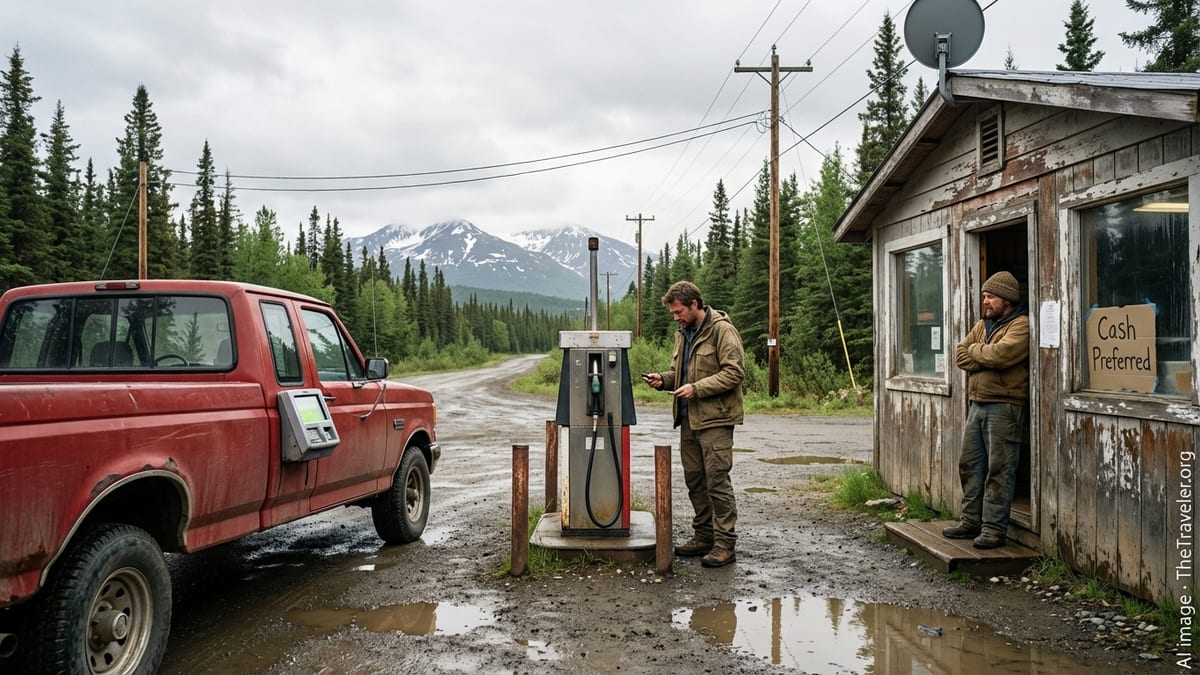
Why Remote Alaska Is Different From the Rest of the U.S.
Alaska’s geography shapes every part of its financial landscape. Hundreds of communities are off the road system, accessible only by air, ferry, or seasonal ice roads. Building and maintaining digital infrastructure across mountains, islands and tundra is expensive and logistically complex, so connectivity that urban travelers take for granted can be fragile or limited. A single damaged fiber line or power issue can leave an entire region with little or no internet or phone service for hours or days. When that happens, any payment system that depends on real-time authorization, including most card terminals, can grind to a halt.
The gap between urban and rural Alaska is also stark. Anchorage, Fairbanks and Juneau generally have modern banking services and widely functional card networks. But smaller hubs and villages often rely on slower satellite links, aging hardware and a patchwork of local providers. An outage in the Southeast Alaska town of Sitka in 2024, triggered by damage to the region’s main communications cable, forced many businesses to revert to cash-only operations while they waited for repairs, highlighting how easily electronic payments can be disrupted when there is no redundant connection to the outside world.
These physical and technological constraints sit on top of a financial environment in which bank branches and ATMs are sparse. While community-focused credit unions and small banks are working to fill gaps, many villages still meet the definition of banking deserts, with the nearest full-service branch located many miles away across open water or remote highways. For travelers, this means that solving a card problem in person, such as getting a replacement card or new PIN, can be difficult once they leave major cities.
Beyond basic access, there is also the issue of how global card networks interface with local systems. Terminals in some remote locations may batch and send transactions intermittently, rely on older protocols, or route authorizations through regional banks that use different filters and risk thresholds. In this environment, even a well-functioning card can behave inconsistently, working in Anchorage or on a cruise ship but failing unexpectedly at a fuel dock or general store in a small coastal community.
How Connectivity Breaks Payments in the Bush
Most modern card readers require at least a brief connection to process a transaction, whether they use dedicated broadband, cellular networks or satellite links. In remote Alaska, each of those channels can be fragile. Many communities have only a single internet provider or a single physical line serving the area. When winter storms, ice, high winds or technical failures disrupt that link, point of sale systems can lose their connection to the card networks. Businesses with backup satellite systems may still be able to operate, but bandwidth is limited and expensive, so not every shop, lodge or charter boat invests in that redundancy.
Even when connectivity is technically available, coverage can be uneven from one end of town to the other. A dockside fuel pump, riverside lodge or roadside food stand might be just far enough from the strongest signal that the terminal struggles to complete transactions. Some merchants report that their systems work better at certain times of day when network congestion is lower, or that terminals become unreliable if heavy rain or snowfall interferes with wireless signals. Travelers accustomed to stable 5G service can be surprised at how often a payment terminal must be restarted, repositioned or abandoned in favor of a handwritten receipt and a cash payment.
When terminals cannot reliably reach processors, merchants sometimes set their systems to operate in an offline or store-and-forward mode. In theory, this allows the card reader to accept a transaction without real-time authorization and upload the batch later, once connectivity is restored. In practice, many banks and card issuers limit or decline such transactions because they carry increased fraud and nonpayment risk. That tension between the needs of remote merchants and the risk management rules of national card issuers contributes to a pattern where terminals appear to accept some cards readily but reject or time out on others.
Connectivity problems extend beyond small villages. Regions that depend on single undersea or overland fiber routes can experience widespread disruption when those cables are damaged. During the extended outage in Sitka, hospital surgeries were postponed and nearly all card-based commerce shifted to cash. Visitors who were carrying enough physical currency managed, while those relying solely on cards suddenly found themselves searching for scarce ATMs, negotiating IOUs or cutting short excursions until systems came back online.
The Role of Bank Security Filters and Fraud Systems
From the perspective of major banks in the Lower 48, a sudden charge from a remote Alaskan fuel dock, floatplane operator or village store can look unusual, especially if it appears alongside a string of more typical urban purchases. Automated fraud systems are designed to spot anomalies and stop potentially risky activity before losses occur. Unfortunately, those same protections can flag legitimate transactions in places that fall outside a cardholder’s normal pattern. A traveler who forgets to set a detailed travel notice or whose bank does not use location-aware mobile tools may find their card abruptly declined just as they are trying to pay for fuel, lodging or last-minute gear in a remote area.
Different issuers also handle small, isolated merchants in varying ways. Some banks are quick to block transactions that come through processors they associate with higher fraud rates or that originate from terminals operating in offline or batch modes. Others are more tolerant but may still require additional authentication, such as a verified text alert or app confirmation, before approving unusual charges. In an environment where cell phone coverage can be patchy or non-existent, a bank’s attempt to reach a traveler for verification may fail, turning what would otherwise be a brief inconvenience into a stranded-card situation.
Security rules around chip-and-pin, contactless payments and card-not-present transactions can further complicate matters. Terminals in remote Alaska may not always support the latest security standards, and when they fall back to older methods such as swiping a magstripe, some issuers automatically restrict or decline the transaction. To the traveler at the counter, it can be hard to tell whether the problem lies in the local hardware, the connection to the processor, or the bank’s own risk protocols. The end result, however, feels the same: a card that worked smoothly in Anchorage suddenly refuses to cooperate in a village store.
Skimming and fraud incidents elsewhere in the state also influence how aggressively banks scrutinize transactions. Law enforcement and federal agencies have warned Alaska consumers about card skimming at gas pumps and ATMs, and while such incidents are not unique to the state, they reinforce banks’ incentives to tighten filters on certain transaction types and locations. For travelers, that heightened vigilance can translate into a higher chance of a perfectly legitimate charge being flagged as suspicious when it originates from an unfamiliar, remote terminal.
Where Travelers Most Often Run Into Trouble
Not all parts of Alaska pose equal challenges for card users. In general, larger cities and popular cruise ports have more robust infrastructure and redundant connectivity, which makes card payments more reliable. Problems become more common as travelers push farther into regions served by single providers, seasonal roads, or small harbors. Charter lodges, wilderness camps, tiny fuel stations and multi-purpose general stores in these areas may depend on older terminals, intermittent satellite links or cellular hotspots that were never designed to support high volumes of real-time payment traffic.
Transportation hubs outside major cities can present particular friction points. Small airstrips and bush plane operators sometimes process card payments through laptops, tablets or mobile readers that require both power and a solid wireless signal, neither of which is guaranteed in all conditions. If travelers arrive assuming they can pay for freight surcharges, extra baggage or last-minute seat changes at the counter by card, they may be disappointed to learn that the terminal is down or unreliable, and that cash is preferred or required that day.
Marinas and coastal communities bring their own quirks. Fuel docks, water taxis and fishing charters often rely on weather-exposed terminals or run transactions from nearby offices, walking slips or docks to capture a signal. System outages, wet hardware and shifting connectivity can all combine to make card processing temperamental. Some operators respond by taking deposits by card while clients are still in urban areas, then settling balances in cash or by pre-arrangement once on site. Travelers who do not read the fine print or email instructions closely can be surprised when they realize that cash payment was always part of the plan.
Even within a single town, acceptance can vary from one business to the next. A well-equipped grocery store or hotel might have a reliable connection and updated terminals, while the small museum, crafts market or roadside food stand down the street requests cash only. For visitors, the unpredictability is often the most challenging aspect. The town name on the map does not always correspond to a uniform level of digital service. Two blocks can make the difference between a smooth tap-and-go experience and a handwritten receipt backed by an improvised IOU.
Working With Local Businesses, Banks and Issuers
One of the most effective ways to prevent card frustrations in remote Alaska is to communicate early and often. When booking small lodges, guided trips or remote transport, travelers should pay close attention to payment policies in confirmation emails and ask direct questions if anything is unclear. Many operators are used to explaining what works best in their specific community. They can often tell guests in advance whether cards are generally fine, whether they prefer particular types of cards, or whether they strongly recommend bringing a certain amount of cash to cover contingencies.
On the banking side, detailed preparation before departure helps. Letting card issuers know the specific regions of Alaska you plan to visit, from larger cities to smaller coastal or interior communities, can reduce the odds of an automated fraud system misinterpreting legitimate charges. Some banks allow customers to specify not only dates but also types of expected transactions, such as fuel, lodging or charter services. Travelers can also confirm whether their cards work well with offline or delayed-presentment transactions, and whether the bank can contact them through multiple channels in case of suspected fraud. Where possible, enabling secure push notifications in a mobile app rather than relying solely on SMS can provide an extra layer of flexibility in areas with irregular cell coverage.
Local Alaskan financial institutions, community banks and credit unions play an important bridging role as well. In some remote communities, these organizations operate small microsites or branches that connect residents and businesses to broader card networks and digital services. Their staff understand both the limitations of local infrastructure and the expectations of visiting travelers. In some cases, opening an account or obtaining a locally issued card is not practical for short-term visitors, but knowing that such institutions exist and where their ATMs or offices are located can provide a backup option if primary cards fail.
Finally, travelers should not underestimate the value of redundancy. Carrying at least two different cards from separate issuers, preferably on different networks, increases the odds that at least one will work in a given terminal or with a particular processor. Adding a debit card linked to an account that can be accessed by ATM within Alaska provides another layer of resilience. By working proactively with both home banks and local operators, visitors can create a payment toolkit that is far more robust than any single piece of plastic.
Practical Strategies to Keep Your Trip on Track
Given the realities of remote Alaska, the goal is not to eliminate all risk of card issues, but to manage and minimize it. The first step is realistic planning. Travelers should assume that card acceptance will become less reliable the farther they venture from the main road system and major ports. Building a budget that includes the possibility of paying for fuel, incidentals or simple meals in cash outside urban areas can prevent surprises. Keeping some flexibility in daily plans also helps. If a terminal is down, the solution might be as simple as returning later in the day after systems come back online, rather than needing to abandon an excursion entirely.
Carrying a reserved stash of cash, divided between secure locations such as a money belt, interior pocket and locked luggage, can act as a safety valve when cards fail. Guides and local residents often recommend bringing a mix of smaller bills to make it easier to pay at very small businesses that may not have much change on hand. At the same time, travelers need to balance convenience and security. Flashes of large amounts of cash in public are unwise anywhere, and Alaska is no exception. Quiet, discreet use of cash is both safer and more respectful.
Digital backups can complement physical cash. Downloading banking apps that allow temporary card locks, limit adjustments, or rapid communication with support agents can be invaluable if a card is declined or flagged. Saving key customer service numbers in an offline document or written notebook ensures that travelers are not reliant on web searches in the moment. In places where voice calls are unreliable but text or limited data connections occasionally work, app-based messaging or secure chat features can sometimes succeed where traditional calls fail.
Above all, patience and a sense of humor go a long way. Many residents of remote Alaska live daily with constraints that visitors encounter only briefly. When a card machine goes down or a bank’s fraud department is slow to respond, local staff are often just as frustrated as their customers. Approaching the situation as a shared problem to solve rather than an individual inconvenience can turn a potential flashpoint into a story shared over coffee in the only cafe in town that still has a working terminal.
The Takeaway
Some credit cards do not work smoothly in remote Alaska not because the state is hostile to modern finance, but because its geography, infrastructure and risk environment push digital systems to their limits. Single communication lines, patchy connectivity, older hardware and cautious bank fraud filters all combine to make a routine tap or swipe less certain than it might be in a big-city supermarket. For travelers, the key is advance preparation, redundancy and clear communication with both card issuers and local businesses.
Bringing a modest supply of cash, packing more than one card, alerting banks to travel plans and asking remote operators exactly how they prefer to be paid can turn potential pain points into minor footnotes on a memorable trip. Those who understand that a village store or harbor fuel dock may operate under very different constraints than a suburban gas station will be less surprised when technology falters. In a place where weather can halt planes, move mountains of snow across roads and interrupt the digital lifelines that link small communities to the wider world, treating payment systems as one more element to plan for is both realistic and respectful.
Travelers who embrace this mindset are better positioned to enjoy Alaska on its own terms. They can step off the beaten path, explore remote coves and interior villages, and support local businesses without being undone by a declined card at the wrong moment. In a state defined by resilience and adaptation, a little flexibility in how you pay is simply part of the adventure.
FAQ
Q1. Do most businesses in Alaska accept credit cards?
Yes, most businesses in larger Alaskan cities and major tourist hubs accept credit cards, but acceptance becomes patchier in smaller towns and remote communities.
Q2. Why would my credit card be declined in a remote Alaskan town if it works elsewhere?
Declines often stem from weak connectivity at local terminals, outdated hardware, or bank fraud systems flagging unfamiliar remote transactions as potential risk.
Q3. How much cash should I carry when traveling off the beaten path in Alaska?
The right amount depends on your itinerary, but many locals suggest carrying enough cash to cover at least one or two days of basic fuel, food and small purchases.
Q4. Are ATMs easy to find in rural Alaska?
ATMs are common in cities and larger hubs but can be scarce or non-existent in small villages, so it is safer to withdraw cash before heading into very remote areas.
Q5. Do certain card networks work better than others in Alaska?
Major networks are generally accepted where cards are taken, but results vary by merchant and processor, so carrying cards from more than one network is wise.
Q6. Will setting a travel notice with my bank prevent my card from being blocked?
Setting a travel notice reduces the chance of a block, but it is not a guarantee, especially when transactions originate from unfamiliar, high-risk or offline terminals.
Q7. Can I rely on mobile wallets like Apple Pay or Google Pay in remote Alaska?
Mobile wallets work where terminals and connectivity support them, but in areas with older hardware or spotty networks, they may fail just as easily as physical cards.
Q8. What should I do if my card is declined and I cannot reach my bank immediately?
First, ask if the merchant can try another terminal or method, then use backup cards or cash if available and contact your bank as soon as you have reliable service.
Q9. Are local Alaskan banks or credit unions more reliable for payments in remote areas?
Local institutions often understand regional infrastructure and may tailor services accordingly, but short-term visitors usually rely on their home banks and should plan backups.
Q10. Is it safe to carry a lot of cash while traveling in Alaska?
Carrying some cash is practical, but divide it into several secure spots, keep amounts discreet and use hotel safes or lockable bags whenever possible.