

More news on this day
From revamped night trains crossing the Pyrenees to nostalgic luxury carriages rolling through Andalucía, a new generation of rail journeys in France and Spain is inviting travelers to treat the journey itself as the heart of the holiday.
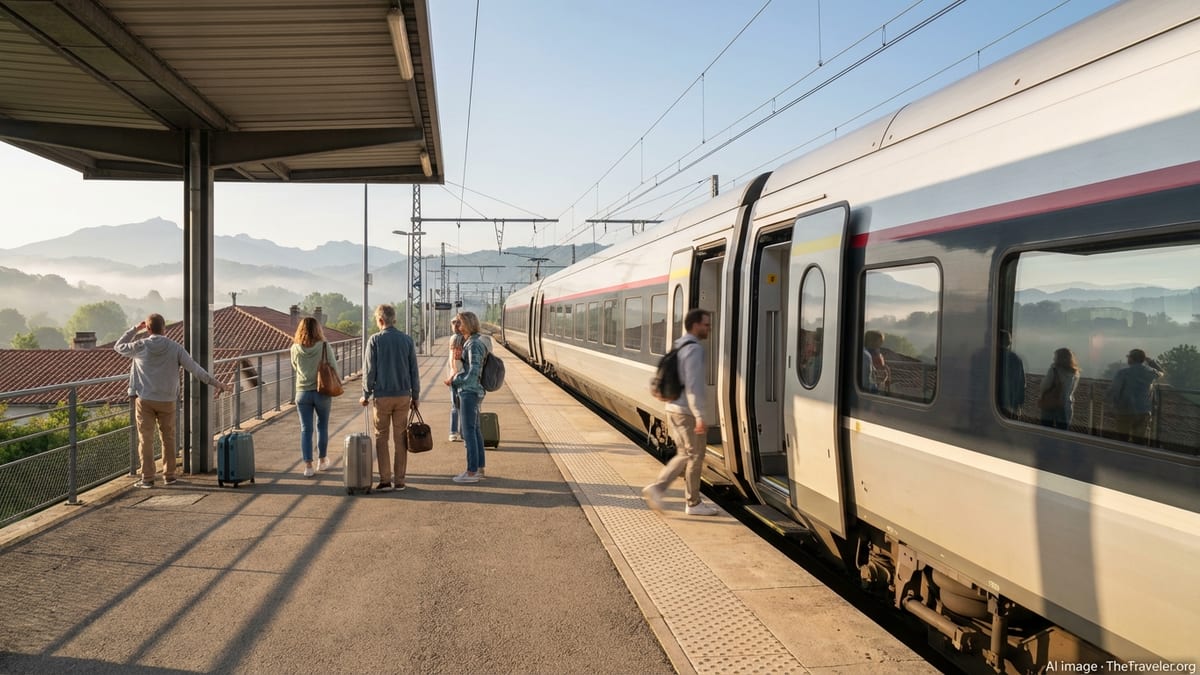
Rail Travel Becomes the Destination
Across France and Spain, rail operators and tourism authorities are investing heavily in routes designed not just to move people efficiently, but to create emotionally resonant journeys. The trend aligns with a wider European shift toward low‑carbon travel and “slow” tourism, in which the time spent between departure and arrival is part of the experience rather than a logistical inconvenience.
Instead of racing from airport to airport, travelers are increasingly choosing to watch vineyards, fishing ports and mountain valleys slip past their window for hours at a time. Railway companies are responding with upgraded rolling stock, curated onboard food and wine, and itineraries that build in time to linger in heritage towns along the way. For visitors, it is an opportunity to rediscover the romance of rail while reconnecting with landscapes that high‑altitude flights only skim from afar.
For regional governments, the emotional pull of these journeys is more than marketing language. It is a tool to spread visitor spending into smaller communities and shoulder seasons, and to showcase lesser‑known wine regions, surf coasts and spa towns that can be reached comfortably without a car. The result is a growing web of “soulful” trains across France and Spain, from overnight sleepers to luxury heritage services.
France’s High‑Speed Makeover Sets the Stage
In France, the transformation begins at the top of the speed spectrum. A new generation of high‑speed TGV INOUI trains is due to begin carrying passengers in early 2026, debuting first on the busy Paris–Lyon–Marseille axis before expanding to other routes. Inside, the focus is firmly on comfort and sociability, with more legroom, redesigned standard and first‑class seating and improved accessibility features to make long journeys feel less like a commute and more like a relaxed interlude.
The most eye‑catching innovation is a two‑storey bar carriage known as Le Bistro, where the upper deck is arranged as a convivial dining space with seating and views, while the lower level offers self‑service fridges, coffee machines and hot food. Seasonal menus based on French bistro classics and ingredients largely sourced from within the country are intended to anchor the train in a sense of place. For travelers heading south to Provence or the Riviera, it turns the TGV into a rolling brasserie rather than a simple mode of transport.
French rail planners are also looking ahead to infrastructure projects that will eventually tighten the country’s link with Spain. A new high‑speed line between Montpellier and Perpignan, now moving through financing and planning steps, is slated to open its first section in the 2030s. While still years away, the project is seen as the missing piece in a continuous high‑speed corridor connecting Paris to Barcelona, and ultimately to Madrid and beyond. For future vacationers, that would mean a seamless flow from the French capital to Catalan beaches and tapas bars entirely by rail.
In the meantime, regional trains and refurbished long‑distance services are being positioned as gateways to more contemplative holidays. From the Atlantic surf towns of the Basque Country to the spa resorts of the Pyrenees, overnight and daytime Intercités routes are being promoted as an atmospheric alternative to driving, especially during winter and mountain seasons when SNCF opens significant extra capacity for ski travelers.
Spain’s High‑Speed Success Fuels Cross‑Border Escapes
On the Spanish side of the border, public rail operator Renfe has spent the past two years building up a high‑speed network that now reaches deep into France. Services from Barcelona to Lyon and from Madrid to Marseille have carried more than a million passengers since launch, linking Catalonia and central Spain with a dozen French cities along the way. Those figures have emboldened planners to prepare an extension to Toulouse from the second half of 2025, further knitting together the Occitanie region with northeastern Spain.
For leisure travelers, the effect is to redraw the mental map of what is realistic for a long weekend or a two‑country break. A visitor can now leave Lyon after breakfast and arrive in Barcelona in time for a late lunch overlooking the Mediterranean, or step aboard in Marseille and wake up in Madrid after a day of high‑speed travel broken by café stops in intermediate towns. With more competition on cross‑border routes, fares have become more accessible, encouraging travelers who may once have defaulted to low‑cost airlines to try the train instead.
Spanish tourism boards are seizing on the new connectivity to promote rail‑based itineraries that dip across the frontier. Suggested routes pair Catalan coastal resorts with French wine regions or combine Gaudí’s Barcelona with the Roman heritage of Nîmes and Arles, all reachable by a combination of high‑speed and regional trains. For those seeking a more introspective journey, inland lines toward Zaragoza, León or Galicia can be added on, turning a simple transfer into a multi‑day voyage through changing landscapes and languages.
The growth in rail travel is also shaping infrastructure at destinations. Stations in cities such as Barcelona, Girona and Figueres have been refurbished with better wayfinding, more natural light and expanded retail and dining options, transforming them into urban gateways that feel more like civic squares than transit hubs. This, in turn, encourages visitors to step outside the station and explore the surrounding neighborhoods on foot rather than heading straight for a hotel or airport shuttle.
Night Trains Return as Romantic Cross‑Border Routes
While high‑speed daytime services grab many of the headlines, the most overtly romantic development for vacationers may be the quiet revival of Europe’s night trains. France’s transport ministry has confirmed plans to tender for a new fleet of overnight rolling stock, paving the way for additional routes by the end of the decade. In the interim, refurbished couchette cars continue to operate Intercités de Nuit services from Paris to destinations such as the Pyrenees, the Mediterranean and the southwest, including the Catalan border town of Cerbère on the edge of Spain.
These overnight trains, once seen as relics of a slower era, are being reimagined as a bridge between city and countryside, workday and holiday. Travelers board in the evening, settle into shared couchettes or private compartments and wake to sea air in the Basque Country or mountain light in the central Pyrenees. For families, the appeal lies in the sense of adventure and the ability to avoid early‑morning airport transfers. For couples and solo travelers, the muted clatter of the tracks and the sight of dawn over vineyards or cliffs can feel like a reset from daily life.
Independent operators are adding to the mix with new international sleepers that feed into the France–Spain rail web. Belgian‑Dutch cooperative European Sleeper, which already runs a night train from Brussels to Prague, plans to open a Paris–Berlin route in March 2026 that will connect through Brussels and northern Germany. Although it does not cross into Spain, the overnight link is expected to dovetail with high‑speed services from Paris and Lyon to Barcelona, making it possible to design longer multi‑day itineraries that zigzag between France, Germany, the Low Countries and Spain entirely by rail.
As more night routes emerge, tour operators are starting to build them into packaged vacations branded around wellness, digital detox and the romance of old‑world rail. Itineraries might combine a Paris–Cerbère sleeper with regional trains along Spain’s Costa Brava, or pair a night train to the Pyrenees with onward travel into Catalonia and Aragón. The result is a new set of holidays where the hum of the sleeper compartment becomes a key memory rather than a forgotten transfer.
Al Ándalus and the Revival of Spanish Rail Glamour
If the night trains tap into nostalgia, Spain’s most notable new luxury service goes a step further, turning nostalgia itself into the product. The historic Al Ándalus train, a 1930s‑era convoy of restored Wagons‑Lits carriages, is set to return to the rails in April 2026 with a redesigned seven‑day, six‑night itinerary looping from Madrid through Andalucía. Carrying up to 64 guests in just 14 carriages, the train is explicitly pitched as a rolling boutique hotel rather than a simple means of travel.
The route winds through Córdoba, Seville, Cadiz, Extremadura and Castilla‑La Mancha, serving multi‑course dinners in four lounge cars and offering Grand Class and Deluxe suites equipped with private lounges and hydromassage showers. Off the train, guests are taken to flamenco performances, palaces, Roman ruins and UNESCO‑listed historic towns, while onboard evenings unfold in a piano bar stocked with regional sherries and wines. Prices starting from several thousand euros per person put the journey firmly in the ultra‑luxury bracket.
Even for travelers who will only ever admire Al Ándalus from a platform, its relaunch is significant. It underscores Spain’s ambition to position rail travel as a symbol of national culture and hospitality, just as the Orient Express once did for France and Italy. The train’s very presence on the network adds atmospheric depth for other passengers, reminding them that the line between transport and travel experience can be porous. For nearby hotels, restaurants and guides in smaller Andalusian towns, the periodic arrival of such a high‑spending clientele is likely to have a ripple effect.
Crucially, the Al Ándalus revival complements, rather than replaces, more accessible forms of soulful rail. Operators across Spain are quietly upgrading regional services with better seating, improved catering and more generous luggage space, so that even a modest two‑hour hop between regional capitals can feel calmer and more considered. Together, they suggest that Spain’s rail renaissance will be experienced at many different price points.
Scenic Corridors Through Vineyards, Coasts and Mountains
Behind the headlines about new trains and luxury services is a more subtle shift in how key corridors between France and Spain are being marketed to travelers. Routes that once carried mainly business people and cross‑border commuters are now promoted for their scenery and cultural potential. In the southwest of France, lines skirting the Atlantic carry surfers and food lovers between Bordeaux, Bayonne and the Basque coast, before dropping them at interchanges where they can continue to San Sebastián or Bilbao by connecting services.
Along the Mediterranean, regional trains between Occitanie and Catalonia trace a coastline of lagoons, fishing ports and fortified towns. Stops such as Collioure, Figueres and Girona, long overshadowed by Barcelona, are being recast as anchors for slower, more introspective holidays that blend art, wine and hiking. Tourism boards on both sides of the border now produce route maps and brochures that treat the rail line itself as a thematic trail, encouraging passengers to hop on and off rather than rush to a single end point.
Inland, the railways that thread the Pyrenees are enjoying renewed attention from hikers and nature lovers who see them as gateways to high‑altitude villages and national parks. Night trains from Paris arrive in foothill towns at dawn, where connecting regional services or buses fan out into valleys known for thermal baths, cheese‑making and mountain festivals. From there, travelers can cross into Spain on narrow‑gauge lines and mountain roads, creating cross‑border loops that feel a world away from the main highways and motorways.
This reframing of existing lines as scenic journeys rather than purely functional corridors dovetails with the broader push for sustainable tourism. Regions that rely on fragile ecosystems, from Atlantic dunes to Pyrenean meadows, are keen to reduce car traffic and parking demand. By making the train ride itself appealing and emotionally resonant, they hope visitors will arrive more relaxed and more inclined to explore on foot or by bike.
Wellness, Climate and the Emotional Case for Trains
The renaissance of rail holidays in France and Spain is not just about nostalgia or scenery. It is also, increasingly, about health, wellbeing and climate‑consciousness. After years of pandemic disruption and flight cancellations, many travelers report that they feel calmer and more in control on a train than in an airport. The ability to walk the length of the carriage, stretch in the vestibules, or simply sit with a book as countryside rolls by has become part of the appeal.
Climate considerations are another powerful motivator. As European governments tighten emissions targets and discuss levies on short‑haul flights, choosing rail is becoming a concrete way for travelers to cut their carbon footprint without sacrificing comfort. French and Spanish operators now routinely highlight the lower emissions of train journeys compared with equivalent flights in their marketing materials, particularly for popular routes such as Paris–Barcelona, Lyon–Madrid and Marseille–Seville.
Emotional storytelling is central to this shift. Campaigns by regional tourism boards, national rail companies and independent operators increasingly feature imagery of couples sharing a quiet breakfast in a sleeper cabin, grandparents and grandchildren playing cards in a bar car, or solo travelers gazing out at mountains from a window seat. The message is that rail holidays offer room to think, to talk and to rediscover a sense of unhurried presence that is hard to achieve in the air.
As new trains roll out, night routes expand and heritage services like Al Ándalus return to the rails, France and Spain are betting that this emotional connection will translate into bookings. For travelers planning their next European escape, the question is shifting from which city to fly to, to which train journey they most want to remember years from now.