

More news on this day
New traffic data and airline schedules show South Africa’s major airports joining leading hubs in Ethiopia, Egypt and Morocco at the forefront of Africa’s air travel recovery, with Cairo, Johannesburg’s OR Tambo, Addis Ababa Bole and Hurghada among the continent’s busiest gateways by passengers and departing seats.
Get the latest news straight to your inbox!
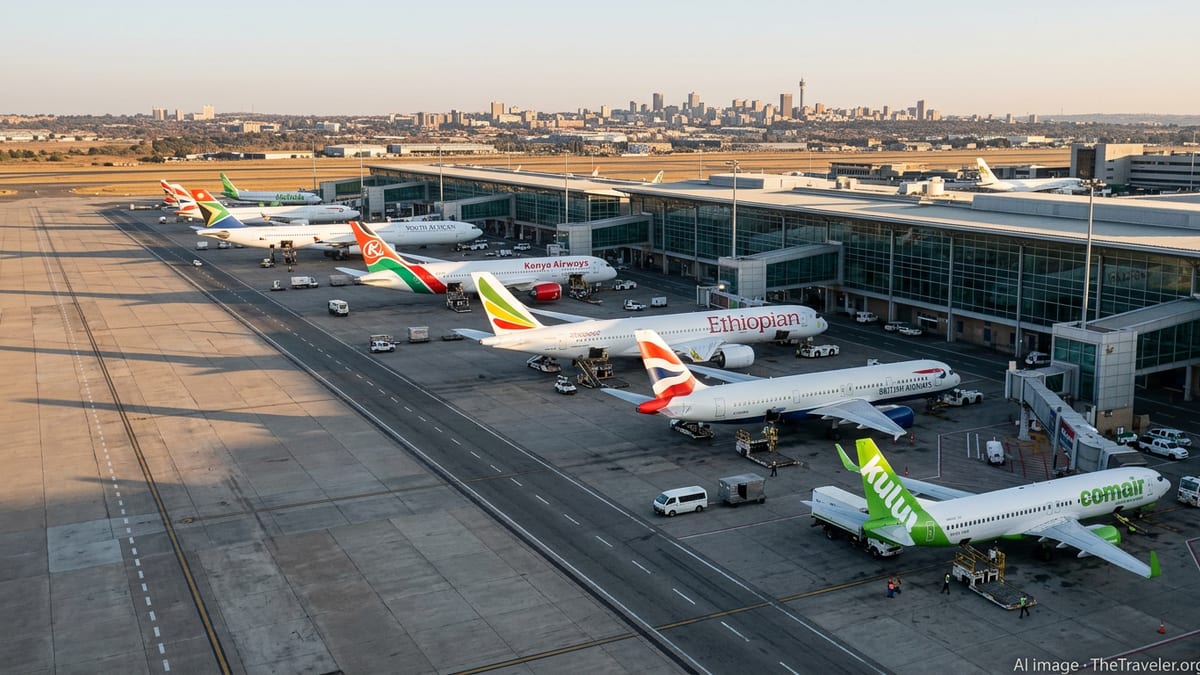
Continental Rankings Put Cairo, Johannesburg and Addis Ababa in the Lead
Recent analyses from aviation bodies and schedule providers highlight a reshaped hierarchy of Africa’s busiest airports, with Cairo International in Egypt, OR Tambo International in Johannesburg, and Addis Ababa Bole International in Ethiopia consistently appearing at the top of continental rankings by passenger traffic and scheduled seats. According to published traffic estimates for 2024, these three hubs together handled a significant share of Africa’s total scheduled flights and passenger movements, underscoring their role as strategic intercontinental gateways.
Industry reports drawing on data from the African Airlines Association and airport councils show that Cairo International has emerged as one of Africa’s busiest airports in terms of total passengers and daily flight movements, supported by strong connections across the Middle East, Europe and Africa. At the same time, OR Tambo remains South Africa’s largest aviation gateway, while Addis Ababa Bole continues to expand as a transfer hub for connections between Africa, Asia, Europe and the Americas.
Seat-capacity rankings for 2025 indicate that Cairo, Johannesburg and Addis Ababa are frequently listed among the top African airports by outbound seats, reinforcing their status as the backbone of the continent’s long-haul and regional connectivity. Publicly available schedules data cited in regional aviation coverage shows that these hubs collectively account for a substantial proportion of Africa’s international passenger flows.
South Africa’s OR Tambo, Cape Town and Durban Reclaim Growth
South Africa’s airport system, anchored by OR Tambo International in Johannesburg, Cape Town International and King Shaka International in Durban, has largely returned to and in some cases surpassed pre-pandemic levels of activity. Airports Company South Africa reporting for the 2024 financial year indicates that passenger volumes across its network have recovered to around 2019 benchmarks, with OR Tambo once again handling well over 18 million passengers a year when domestic and international traffic are combined.
Johannesburg’s OR Tambo has also appeared in global schedules rankings as one of the busiest airports in the broader Middle East and Africa region by total seats, reflecting its importance as a hub for both South African and foreign carriers. In addition to serving as the main entry point to South Africa, the airport’s extensive domestic and regional network allows it to act as a redistribution point for traffic bound for secondary cities in southern Africa.
Cape Town International has emerged as a strong secondary hub, recording around 10 million passengers annually and benefiting from rising demand for direct long-haul services from Europe, the Middle East and North America. Airports Company South Africa and regional tourism bodies have highlighted Cape Town’s rapid growth in international arrivals, with the airport outperforming internal forecasts for 2024 and securing global recognition for service quality and punctuality.
King Shaka International near Durban, while smaller, ranks among the top ten airports in Africa by passenger movements, according to continent-wide listings. Its inclusion alongside OR Tambo and Cape Town in these rankings underlines South Africa’s growing weight in Africa’s aviation network and supports the view that the country now fields multiple hubs capable of handling sustained growth in traffic.
Egypt and Morocco Build Parallel North African Gateways
Further north, Egypt and Morocco are advancing parallel hub strategies that complement South Africa’s southern African network. Cairo International remains Egypt’s principal international gateway and one of Africa’s busiest airports overall, with passenger statistics showing strong growth through 2023 and 2024 on both regional and intercontinental routes. Cairo’s role is reinforced by its position on high-density corridors such as the Cairo to Jeddah route, which appears among the world’s busiest city pairs by passenger numbers in recent international traffic tables.
In addition to Cairo, Hurghada International Airport on Egypt’s Red Sea coast has rapidly climbed African rankings as leisure travel has rebounded. Updated figures show Hurghada handling close to 5 million passengers a year, with year-on-year growth driven largely by inbound tourism from Europe and the Middle East. This performance places Hurghada among Africa’s top ten airports by passengers, alongside far larger metropolitan hubs.
Morocco has likewise strengthened its hub position, with Casablanca’s Mohammed V International Airport repeatedly cited in regional analyses as one of Africa’s top airports by outbound seats and total passenger share. Between January and May 2024, publicly reported data indicates that Casablanca managed a significant proportion of Morocco’s total air traffic, helped by its extensive network into West Africa and onward links to Europe and North America.
These North African hubs, together with South Africa’s and Ethiopia’s leading airports, create a multi-polar structure for aviation across the continent. Travellers from Europe, the Middle East and the Americas now have multiple entry points to Africa, while intra-African journeys are increasingly routed through whichever hub offers the most efficient one-stop connection.
Ethiopia’s Addis Ababa Bole Expands While a New Mega Hub Looms
Ethiopia’s Addis Ababa Bole International Airport continues to play an outsized role in Africa’s long-haul connectivity. Data highlighted in African aviation reports shows Bole handling more than 12 million passengers in 2024, marking double-digit growth compared with pre-pandemic levels. The airport’s growth has been closely tied to the network expansion of Ethiopian Airlines, which has leveraged Addis Ababa’s geographic position at the crossroads of Africa, the Middle East and Asia.
As Bole approaches its design capacity, Ethiopian authorities and industry partners have moved ahead with plans for a new mega airport near Bishoftu, southeast of Addis Ababa. Project documentation and publicly circulated project briefs describe an initial phase designed to accommodate around 60 million passengers annually by the end of the decade, rising to more than 100 million passengers in later phases. This would position the new hub among the world’s largest airports by capacity and signal Ethiopia’s intent to remain a central player in global air traffic flows.
The expansion plans around Addis Ababa mirror broader trends across Africa’s leading hubs, which are investing heavily in terminal upgrades, runway capacity and multimodal surface transport links to handle future demand. Industry forecasts referenced in regional transport studies project Africa’s total passenger numbers to exceed 250 million annually by the mid-2020s, surpassing 2019 levels and pointing to sustained long-term growth.
Economic Ripple Effects Across Tourism, Trade and Investment
The ascent of OR Tambo, Addis Ababa Bole, Cairo International, Hurghada and other leading hubs into Africa’s top tier of busiest airports is having measurable effects on the continent’s economies. Aviation industry assessments link rising passenger numbers to growth in tourism arrivals, hotel occupancy, conference business and related services, particularly in cities directly connected to these airports by nonstop routes.
In South Africa, the near-complete recovery in passenger traffic reported by Airports Company South Africa has coincided with renewed investment in airport infrastructure, with multibillion-rand capital programmes focused on refurbishments and capacity expansion at OR Tambo, Cape Town and Durban. Similar investment drives are visible in Egypt and Ethiopia, where terminal expansions and new-build projects are being pursued to keep pace with anticipated demand.
Beyond tourism, increased seat capacity and improved connectivity at these hubs support trade and foreign direct investment. Enhanced air links reduce travel times for business travellers, facilitate cargo movements tied to high-value, time-sensitive goods, and make it easier for multinational firms to base regional operations in African cities. As a result, policymakers and airport operators are positioning their facilities not only as transit points, but as catalysts for broader economic development corridors.
With Africa’s air traffic expected to keep growing over the coming decade, the combined hub system anchored by South Africa, Ethiopia, Egypt and Morocco appears set to shape how passengers and goods move across the continent. The performance of OR Tambo, Addis Ababa Bole, Cairo International and Hurghada signals that Africa’s busiest airports are not only managing sustained growth, but are increasingly central to the continent’s integration into global air travel and trade networks.