

More news on this day
Newly released aviation and tourism data point to a powerful rebound in South Africa’s air travel sector, with the country outpacing many regional peers in passenger growth and Johannesburg’s OR Tambo International Airport consolidating its status as one of Africa’s central aviation powerhouses.
Get the latest news straight to your inbox!
Record Passenger Volumes Put South Africa Back In The Spotlight
Publicly available data from regional aviation bodies and tourism agencies indicate that South Africa has emerged among the continent’s fastest growing air travel markets, regaining momentum after the pandemic slowdown. Industry reporting on African traffic patterns for 2024 shows South Africa ranking near the top tier of countries by total passenger traffic, trailing only Egypt and Morocco but pulling ahead of several large economies, including Nigeria, and consolidating its position relative to Tanzania, Tunisia, Uganda and others.
Figures released through African aviation associations for 2024 place South Africa’s total passenger traffic at roughly 23 million, behind Egypt and Morocco but ahead of Algeria, Tunisia and Nigeria in overall airport throughput. Analysts note that these totals combine strong domestic flows with a resurgent international segment, particularly on routes linking Johannesburg and Cape Town with key hubs in the Middle East, Europe and the rest of Africa.
Tourism statistics from South Africa’s national authorities add another layer to the picture, showing that arrivals through ports of entry climbed to around 8.9 million in 2024, reflecting a sustained recovery in inbound leisure and business travel. This reinforces the view that South Africa is not only holding its own against North African tourism giants such as Morocco and Egypt, but also strengthening its relative position versus safari-led markets like Tanzania and Uganda and regional economic players such as Nigeria.
Industry commentary suggests that a combination of competitive fares on key regional routes, increased capacity from local carriers and foreign airlines and improving confidence in South Africa’s tourism offer have all contributed to this upswing. Domestic demand has remained particularly resilient, underpinning volumes even as international markets gradually return to and exceed pre-pandemic levels.
OR Tambo Emerges As A Dual Epicenter Of African Aviation
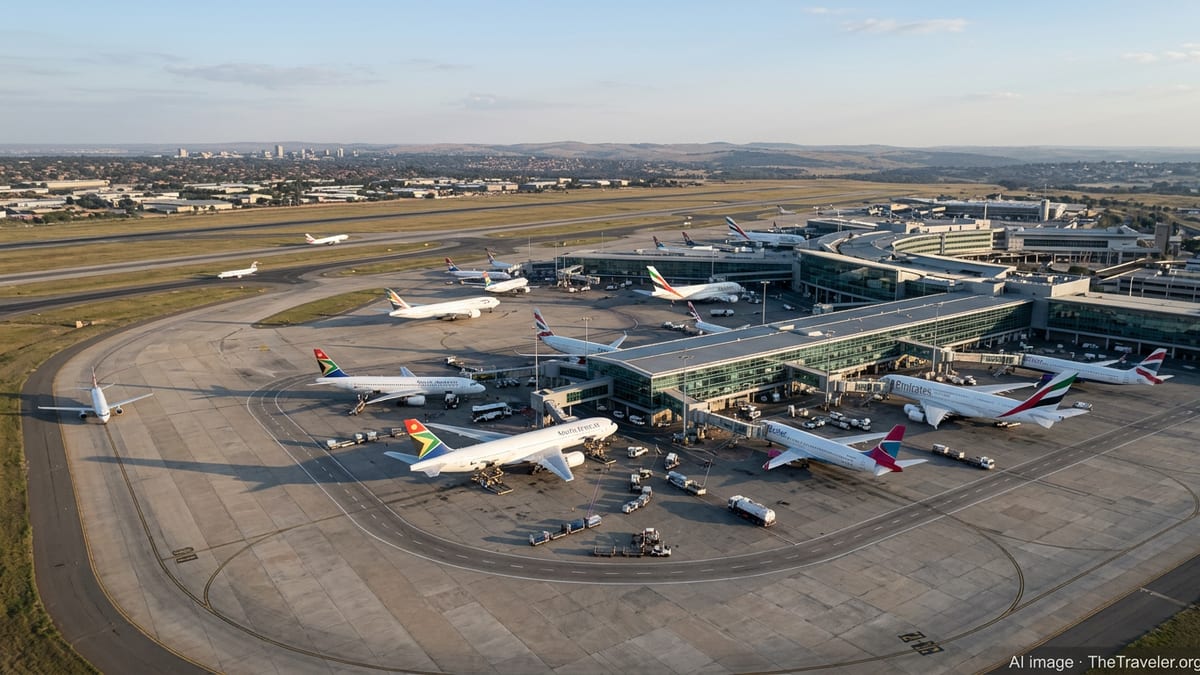
At the heart of South Africa’s aviation resurgence is Johannesburg’s OR Tambo International Airport, which continues to rank among Africa’s busiest and best-connected hubs. Aviation intelligence providers and airport rankings consistently place OR Tambo near the top of the continent’s traffic tables, with recent assessments highlighting year on year passenger growth in 2024 and 2025 alongside expanding route networks.
African aviation analyses published in late 2024 and 2025 identify a small group of airports that dominate the region’s traffic: Cairo, Johannesburg’s OR Tambo, Addis Ababa Bole, Casablanca Mohammed V and Cape Town International. Within this elite cluster, OR Tambo stands out as South Africa’s primary gateway, handling the majority of the country’s international flights and facilitating connections across Southern Africa, the wider continent and intercontinental markets.
Recent reporting referencing Airports Company South Africa indicates that OR Tambo now handles in the region of 18 to 21 million passengers annually, confirming its role as one of Africa’s busiest individual hubs. While Cairo has edged ahead in some rankings by total passengers, OR Tambo remains central to intra-African connectivity and Southern Africa’s long-haul links, positioning it as both an operational epicenter and a symbolic heartbeat of regional aviation.
Industry observers point out that OR Tambo’s dominance is not only a function of raw volume but also of network diversity. The airport serves airlines from five continents, supports a wide mix of full-service and regional carriers, and offers extensive domestic connectivity that feeds long-haul services. This combination has helped keep Johannesburg at the core of route planning for airlines seeking pan-African reach.
Domestic Corridors And Regional Routes Drive Structural Growth
South Africa’s passenger surge is closely tied to the strength of its domestic and short-haul regional corridors, which provide a stable base of demand regardless of swings in long-haul tourism. Aviation route analyses highlight the Johannesburg–Cape Town pairing as one of the busiest air links on the continent, with hundreds of weekly frequencies and a consistent flow of business and leisure travelers.
Additional reporting on South Africa’s route network shows that Johannesburg–Durban and Cape Town–Durban also rank among Africa’s highest-volume domestic city pairs. These corridors, operating at significant frequency and capacity, underpin the overall performance of the country’s airports and help sustain high aircraft movements at OR Tambo, Cape Town International and King Shaka International in Durban.
Beyond the domestic market, OR Tambo’s role as a springboard into the region is reinforced by dense schedules to neighboring countries such as Zimbabwe, Zambia and Mozambique. Industry data for 2024 underline Johannesburg–Harare and Johannesburg–Lusaka as particularly busy international routes, reflecting strong trade, labor and family ties as well as a growing flow of regional tourism.
Analysts note that this pattern of layered demand, combining heavy domestic traffic with robust regional connectivity, offers South Africa a structural advantage over markets that rely more narrowly on seasonal long-haul arrivals. It also helps explain why South Africa’s passenger growth trajectory has exceeded or matched that of several peers with strong inbound tourism profiles but less extensive domestic and regional route ecosystems.
Competing With North And East African Hubs
South Africa’s latest performance comes in a competitive continental landscape, where North and East African hubs are also expanding rapidly. Recent African aviation commentaries point to Morocco’s national airports handling more than 36 million passengers in 2025 and Egypt exceeding 40 million travelers, underscoring the scale of North Africa’s tourism and transit markets.
At the same time, Addis Ababa, Nairobi and Casablanca have solidified their positions as key connecting points for traffic flows between Africa, Europe, the Middle East and Asia. Ethiopian Airlines’ hub and spoke model at Addis Ababa Bole and Royal Air Maroc’s network via Casablanca have drawn significant connecting traffic that might otherwise have routed through Southern Africa in previous decades.
Despite these shifts, OR Tambo has maintained its relevance by leaning into its strengths: a deep domestic market, strong Southern African regional demand and a mix of point to point and connecting services. Passenger growth at the airport in 2024 and 2025 has remained positive, even as rival hubs add capacity and seek new partnerships, keeping Johannesburg in the upper tier of African aviation centers.
Observers suggest that South Africa’s continued outperformance against several sub-Saharan peers, including Nigeria, Tanzania, Uganda and others, reflects this diversified base. While those markets are expanding, they tend to rely more heavily on a narrower set of international tourism or resource-linked routes, making them more exposed to external shocks and policy changes.
Infrastructure, Policy Initiatives And The Road Ahead
The sustainability of South Africa’s current growth spurt will depend heavily on infrastructure planning and policy execution. International bodies such as Airports Council International and the African Airlines Association have highlighted the importance of airport upgrades, airspace modernization and regulatory alignment in supporting further expansion of African passenger traffic.
Within South Africa, capacity enhancement projects at OR Tambo and Cape Town International, together with upgrades at regional airports, are intended to accommodate rising demand, improve on time performance and enhance the passenger experience. Johannesburg’s hub status also ties into broader initiatives aimed at liberalizing air access across Africa, including ongoing efforts under the Single African Air Transport Market, which seek to open routes and enable more direct intra-African flights.
Economic studies and policy documents focused on U.S.–Africa and intra-African markets describe South Africa as one of the continent’s largest aviation demand centers, both for origin and destination traffic and as a connecting point. As global carriers reassess their Africa strategies, Johannesburg’s role as a dependable, high-volume node may further strengthen, particularly on transatlantic and Middle East pairings.
For now, the available data show South Africa moving ahead of many regional competitors in passenger growth while OR Tambo International Airport cements its reputation as both a practical epicenter and an emotional heartbeat of African aviation. The challenge for policymakers, airport operators and airlines will be to convert this momentum into long term resilience, ensuring that the country’s skies remain among the busiest and most connected on the continent.