

More news on this day
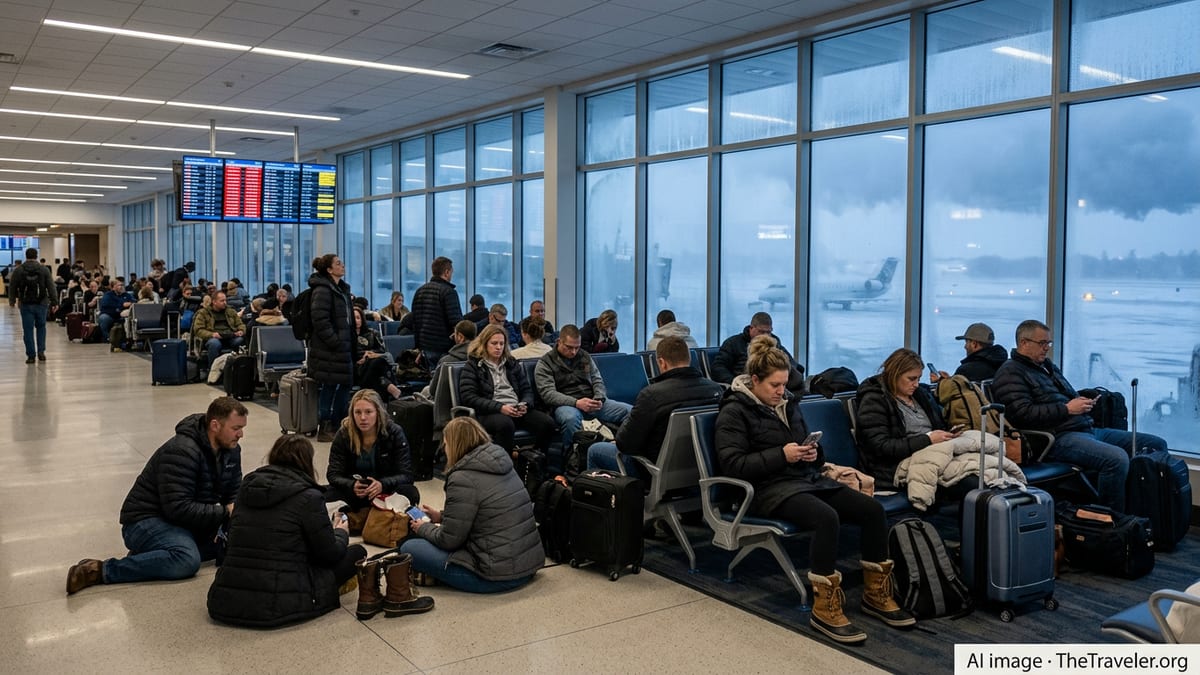
Travelers passing through South Bend International Airport this weekend are confronting hours-long delays, last-minute cancellations and crowded terminals as a powerful Midwest winter storm triggers a cascading air travel meltdown across the United States.
Get the latest news straight to your inbox!
Storm-Fueled Disruptions Hit Key Midwest Gateway
South Bend International Airport, a growing regional hub for northern Indiana and southwest Michigan, has been swept into a broader national travel crisis as severe winter weather disrupts flight operations across the Midwest. Publicly available tracking data shows airlines implementing extensive schedule cuts at airports in the storm’s path, with South Bend included in a systemwide web of affected cities.
Carriers serving South Bend have activated weather waivers covering departures from March 13 through March 20, indicating an expectation of ongoing disruption rather than a brief operational hiccup. These waivers typically allow passengers to change itineraries without additional fees, but they also signal that airlines anticipate sustained capacity constraints and rolling cancellations as aircraft and crews fall out of position.
Reports from major hubs such as Chicago O’Hare describe mounting delays, ground delay programs and waves of scrubbed departures tied to powerful crosswinds and deteriorating conditions, further intensifying the disruption for South Bend travelers who rely on connections through larger airports. With O’Hare and other Midwest gateways serving as primary transfer points, problems there are quickly reflected on South Bend’s smaller departure boards.
The result is a volatile local schedule where flights may appear on time early in the day only to be delayed or canceled as conditions shift and airline networks buckle under the combined weight of weather and congestion.
Thousands Stranded as Cancellations Ripple Through Networks
Across the United States, the same storm system impacting South Bend has led to the cancellation or delay of thousands of flights over the weekend. Flight-tracking platforms and airline advisories point to a patchwork of ground stops, runway capacity limits and crew scheduling challenges that have left passengers marooned at airports far from their intended destinations.
South Bend’s role as a spoke in larger airline networks means that even a limited number of local cancellations can translate into disproportionate disruption for travelers. A single lost departure to a major hub such as Chicago or another Midwest city can sever onward connections to dozens of domestic and international routes, leaving passengers in South Bend with few immediate alternatives.
Nationwide, aviation analysts note that the current chaos is part of a broader pattern in which severe weather events trigger systemwide knock-on effects. Past winter storms have already demonstrated how quickly cancellations can climb into the tens of thousands over several days as carriers struggle to reposition aircraft and restore crew rotations. The latest storm is following a similar trajectory, with South Bend’s passengers experiencing the same stranded hours and crowded gate areas evident at larger airports.
For many travelers, rebooking is complicated by already full flights on remaining routes, reduced schedules during off-peak seasons and lingering operational fragilities that have characterized post-pandemic aviation.
South Bend’s Connectivity Exposes Vulnerabilities
The disruptions come at a delicate moment for South Bend International Airport, which has been working to expand its route map and strengthen regional connectivity. Recent additions and adjustments in service, including links to major hubs, have been pitched as a way to give local travelers more options and reduce the need to drive to Chicago or other larger airports.
This storm-driven crisis underscores the dual nature of that strategy. Stronger connectivity means South Bend residents have greater access to the national air network, but it also makes the airport more exposed to turbulence elsewhere. When hubs like Chicago or other Midwest and East Coast airports experience capacity reductions, South Bend’s flights can be among the first to be trimmed, particularly if airlines are prioritizing longer-haul or higher-demand routes in their recovery plans.
Observers of the regional aviation market note that weather alone does not fully explain the scale of disruption. A tighter labor market for pilots, flight attendants and ground staff, combined with leaner schedules designed to maximize aircraft utilization, leaves carriers with less slack to absorb shocks. In this environment, a single large storm can trigger an outsized operational crisis that filters down to smaller fields like South Bend.
For local communities that depend on South Bend International Airport for business travel, university-related trips and leisure journeys, the current episode highlights the importance of building resilience into both airline schedules and personal travel planning.
Passengers Confront Long Waits, Limited Alternatives
Inside South Bend’s compact terminal, the human impact of the national meltdown is playing out in real time. Travelers face lengthy lines at ticket counters, crowded seating areas near the gates and a constant churn of schedule updates on departure boards as airlines adjust operations in response to evolving weather and air traffic control constraints.
Published guidance from airlines urges passengers across the Midwest to check flight status frequently, use mobile apps for rebooking when possible and consider flexible travel dates. For stranded travelers in South Bend, however, options can be narrow. With only a limited number of daily departures and many flights tied to the same weather-affected hubs, securing a new seat may mean waiting until the storm passes and airlines can restore more of their schedules.
Some passengers are turning to ground transportation as a last resort, opting to rent cars or share rides to reach larger airports with a wider range of flights. Others are accepting overnight stays and multi-day rebookings, recalibrating personal and professional plans around the realities of a strained aviation system.
The atmosphere at South Bend mirrors scenes at airports across the country, where a combination of uncertainty, fatigue and frustration is becoming increasingly familiar whenever severe weather collides with tight airline operations.
Ongoing Weather Threat Raises Fears of Prolonged Chaos
Meteorological outlooks indicate that the storm complex affecting the Midwest is part of a broader system expected to bring heavy snow, high winds and hazardous conditions to a wide swath of the northern United States. Blizzard and winter storm warnings remain in effect for key aviation corridors across the Great Lakes region, raising the possibility that cancellations and delays at South Bend and elsewhere could persist beyond the current weekend.
Industry observers note that recovery from such events often lags behind the immediate improvement in weather. Even after runways are cleared and visibility improves, airlines must reposition aircraft, reset crew schedules and work through backlogs of displaced passengers. In previous winter crises, that process has taken several days, especially when storms impact multiple hubs simultaneously.
For South Bend International Airport, the coming days will likely test both operational flexibility and traveler patience. As airlines work to stabilize their networks, local passengers are being advised, through public advisories and airline communications, to monitor conditions closely and prepare for continued volatility in flight schedules.
While the current situation highlights the vulnerability of air travel to severe weather, it also underscores the central role that regional airports like South Bend play in connecting smaller communities to the wider world, even when that connection is temporarily frayed by forces far beyond the terminal’s walls.