

More news on this day
As a partial shutdown of the Department of Homeland Security continues to disrupt airport security operations across the United States, travelers using South Bend International Airport are reporting little to no impact on checkpoint wait times.
Get the latest news straight to your inbox!
Regional Airport Bucking a National Trend
Across the country, publicly available information shows that the shutdown-driven squeeze on Transportation Security Administration staffing has translated into unpredictable wait times, temporary checkpoint closures, and in some cases hours-long lines at large hubs. However, recent traveler accounts and airport throughput data suggest that South Bend International Airport remains an outlier, with security moving at its typically brisk pace.
South Bend is a relatively small commercial facility, handling far fewer daily departures than neighboring major airports in Chicago or Detroit. This lighter schedule appears to be playing a significant role in cushioning the impact of unpaid TSA work and elevated callout rates that have been documented nationally. With fewer banks of early-morning departures and a modest number of gates, the passenger load at checkpoints has remained manageable.
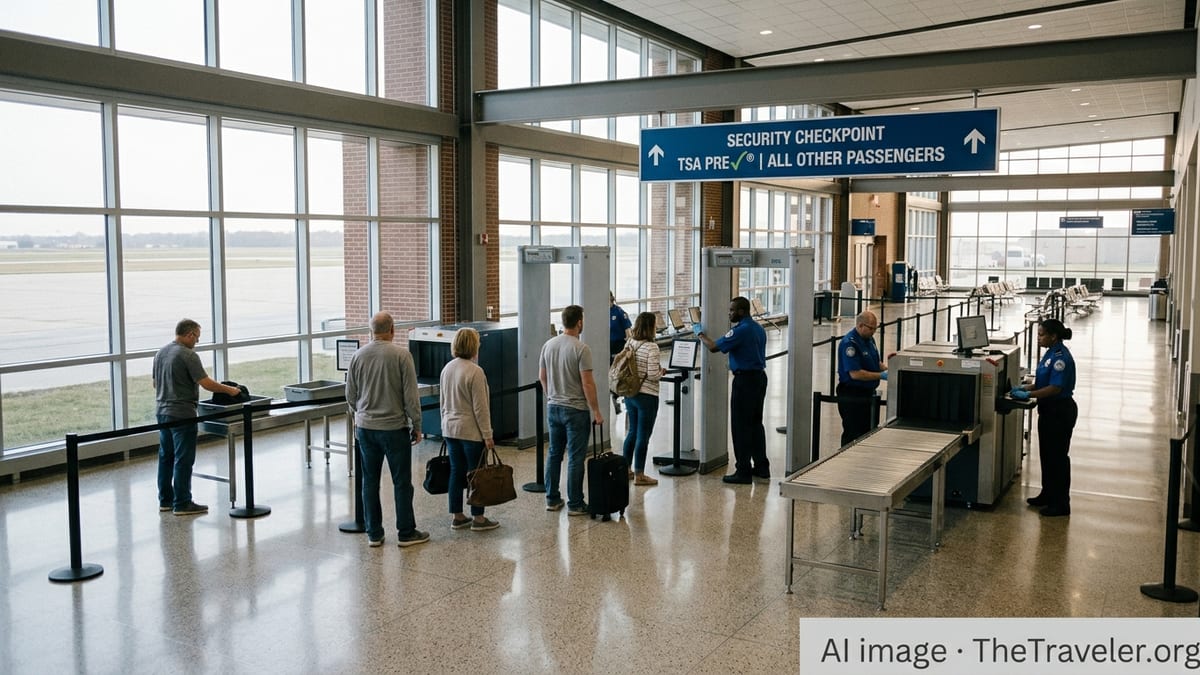
Reports from travelers departing South Bend in recent days describe security lines that are short, often measured in minutes rather than the extended waits seen elsewhere. Some passengers indicate they encountered no line at all in the mid-morning hours, reinforcing the picture of an airport where operations remain close to business as usual despite the broader federal funding impasse.
Publicly available TSA throughput statistics also point to a steady, low-volume pattern at South Bend. The airport’s daily checkpoint counts rank among the smallest in the region, which reduces the risk that even a modest uptick in sick calls would translate into visible bottlenecks for travelers.
Why Smaller Airports May Be More Resilient
The experience in South Bend illustrates how airport size and scheduling patterns can influence the way a shutdown is felt on the ground. Industry guidance released for travel advisers during earlier funding lapses noted that while all airports depend on TSA’s federal workforce, smaller facilities with limited daily departures may be able to process passengers with fewer screeners on duty, at least in the short term.
At a hub airport processing tens of thousands of passengers each day, a double-digit percentage of screeners calling out can quickly overwhelm available lanes, leading to closures and delays. In contrast, South Bend’s more modest passenger volumes allow the checkpoint to keep pace even if staffing is leaner than usual. As long as the number of open lanes generally matches the flight schedule, most travelers will see little change.
Another factor is the concentration of departures. At major hubs, numerous flights often leave in tightly packed waves at the beginning of the day, magnifying the impact of any staffing shortfall during peak hours. South Bend’s departures are spread over a smaller schedule, which can reduce the intensity of those peaks and make it easier for on-duty screeners to keep lines moving.
Aviation analysts following the shutdown’s effects have pointed out that this type of resilience has limits. If federal funding lapses were to drag on, additional resignations among unpaid screeners or broader federal directives to reassign staff to larger airports could eventually filter down to smaller regional facilities such as South Bend.
Traveler Experience: Calm Checkpoints, Routine Advice
For now, travelers moving through South Bend International appear to be experiencing a calmer reality than the one described at some of the country’s busier airports. Recent public posts from passengers describe passing through TSA in roughly 10 to 15 minutes during common departure windows, with several noting that they were the only people in line at certain times of day.
These accounts align with South Bend’s longstanding reputation for quick security screening. Local flyers often contrast the airport’s ease of use with the more time-consuming experience at large hubs, describing SBN as the kind of facility where arriving an hour before departure has historically been more than sufficient for most domestic flights.
Travel experts continue to recommend that passengers build in a buffer, even at generally low-stress airports. The shutdown has introduced an element of unpredictability nationwide, and schedules could shift with little notice if TSA staffing were to change. For South Bend travelers, that typically means arriving earlier than usual for very early morning or heavily booked flights, while recognizing that current conditions still compare favorably with many larger airports.
For connecting itineraries, publicly available guidance suggests that travelers originating at smaller airports like South Bend should pay closer attention to total journey time. Even if the first leg begins at a checkpoint with minimal lines, onward connections through busy hubs could still be affected by longer waits or altered screening procedures.
Shutdown Context and Ongoing Uncertainty
The continuing partial shutdown of the Department of Homeland Security, which funds TSA, has sparked broader debates about the vulnerability of aviation security to federal budget standoffs. National news coverage in recent days has highlighted mounting sick calls among unpaid screeners, discussions about potential closures of smaller airports in extreme scenarios, and emergency measures considered at the highest levels of government to keep critical transportation functions operating.
While South Bend’s experience so far remains relatively stable, it unfolds against this backdrop of tension. Industry groups representing airports and airlines have previously warned that protracted shutdowns can erode the resilience of the aviation system, particularly if staffing shortages intersect with peak travel periods, severe weather, or other operational challenges.
Some policy proposals emerging from recent shutdowns have focused on insulating core aviation functions, including TSA and air traffic control, from future funding lapses. These ideas range from creating dedicated trust funds to establishing automatic continuing appropriations for essential security activities so that screening operations would be less vulnerable to political impasses.
Until any structural changes are enacted, however, airports of all sizes remain tied to congressional budget cycles. South Bend’s relatively smooth experience during the current episode underscores how smaller facilities can, at least temporarily, avoid the worst of the disruption. At the same time, it serves as a reminder that national policy decisions can ripple unevenly through the country’s diverse network of airports.
What Travelers Through South Bend Should Watch
Looking ahead, travelers planning to use South Bend International during the shutdown period are being urged by travel advisers and airline communications to stay informed, even as conditions at the airport remain largely normal. Because TSA does not always update wait-time tools consistently during funding disruptions, passengers are turning more to airline notifications, airport social channels, and real-time reports from other travelers to gauge what to expect.
Published guidance for navigating shutdown-affected travel suggests several strategies that are relevant even at airports with minimal delays. These include checking in online to reduce time spent at ticket counters, packing carry-ons in a way that speeds security screening, and allowing some additional time before departure in case of unexpected slowdowns at the checkpoint.
For South Bend specifically, the main risk factor in the near term may lie beyond the local checkpoint. If the shutdown continues and larger hubs experience worsening congestion, travelers connecting through those airports may face tighter connections or schedule adjustments, even if their initial screening at SBN remains quick and predictable.
For now, however, the story at South Bend stands in contrast to many of the headlines from around the country. Despite a national climate of uncertainty for air travelers, current observations indicate that security lines at this northern Indiana airport have not yet borne the brunt of the shutdown, offering a measure of reassurance to those departing from one of the Midwest’s smaller commercial gateways.