

More news on this day
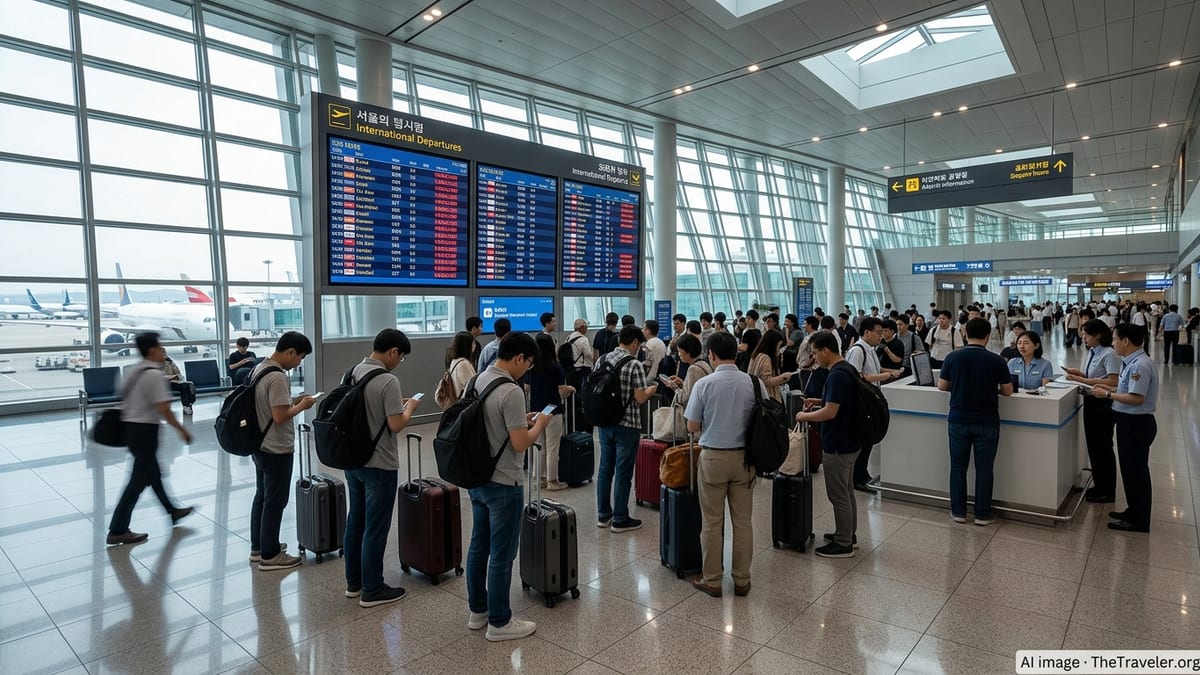
South Korea has joined a growing list of governments urging citizens to closely follow foreign office travel advisories for dozens of destinations, as the Iran war and wider Middle East crisis continue to close airspace, disrupt flights and derail travel plans across key global routes.
Get the latest news straight to your inbox!
Escalating Iran Conflict Triggers Wave of Travel Warnings
Publicly available information shows that the United States and Israel began coordinated military operations against Iran in late February 2026, triggering a regional conflict that has rapidly spilled into the civilian aviation system. Coverage of the crisis indicates that missile and drone exchanges, strikes on infrastructure and retaliatory actions have prompted multiple Middle Eastern states to restrict or fully close sections of their airspace.
Data cited in recent aviation and travel industry reporting indicates that thousands of flights originating in or transiting through the Middle East have been cancelled or heavily rerouted in the weeks since the conflict began. Major hubs such as Dubai, Doha and other Gulf and Levant gateways have experienced repeated shutdowns or sharply reduced operations, pushing airlines to divert traffic via longer, more expensive routes.
These conditions have led foreign ministries and crisis response units in many capitals to strengthen or expand their travel advisories. The focus extends well beyond the immediate war zone to a wider group of countries where airspace access, overflight permissions or security conditions could change with little notice, directly affecting international travelers and transit passengers.
According to published travel risk assessments, the net effect is a patchwork of heightened warnings now covering more than 30 countries linked to the Middle East conflict through geography, airspace, military basing or onward connections, complicating trip planning for leisure and business travelers alike.
South Korea Aligns With US, Iran, Thailand, Singapore and Israel
Against this backdrop, South Korea has updated its own travel guidance, urging citizens to exercise heightened caution and to monitor official advisories for a wide group of destinations. Public information on consular notices shows that Seoul has now aligned its messaging with that of other key nations including the United States, Iran, Thailand, Singapore and Israel, all of which have warned citizens about elevated risks linked to the conflict.
In practice, this means South Korean travelers are being asked to check security levels and potential airspace restrictions not only for countries directly involved in the confrontation, such as Iran and Israel, but also for a broader list of transit and neighboring states. Consular alerts have emphasized that conditions may deteriorate rapidly, with flight cancellations, diversions and airport closures possible at very short notice.
Similarly, US travel advisories currently urge Americans to avoid or depart a cluster of Middle Eastern and Gulf countries due to serious safety risks and unstable aviation conditions, while Israel, Singapore and Thailand have each reinforced their own outbound guidance. In some cases, these governments have organized or prepared repatriation efforts for nationals stranded by airspace closures and suspended commercial services.
Iran, for its part, has issued its own warnings concerning foreign military activity and travel risks in surrounding waters and air corridors, adding to the complex web of advisories now shaping how citizens of many nations approach travel to and through the region.
Foreign Office Warnings Now Span 33 High-Risk Destinations
According to comparative reviews of official travel advice from multiple governments, foreign ministries are now flagging elevated risk levels for approximately 33 countries linked to the Middle East conflict and its ripple effects. While the exact composition of this list varies by nation, it typically includes Iran, Israel and the Palestinian territories alongside key Gulf states such as Saudi Arabia, the United Arab Emirates, Qatar, Bahrain, Kuwait and Oman.
Other countries often included in this enlarged caution zone are Lebanon, Syria, Iraq and Yemen, where the potential for spillover incidents, proxy activity or attacks on infrastructure is considered higher. Certain North African and Eastern Mediterranean destinations, including Egypt and parts of Turkey, are also subject to more detailed security guidance due to their proximity to affected air corridors and their role as major tourism and transit hubs.
Several European and Asia Pacific governments have stressed that these advisories apply not only to travelers whose final destination lies within the high-risk group, but also to those merely transiting through regional hubs. Passengers connecting via airports in the Gulf, Levant or Eastern Mediterranean are being advised to consider alternative routings where possible, or to build additional flexibility into their itineraries.
Travel risk analysts note that the convergence of multiple foreign office warnings on a similar group of around 33 countries is unusual outside of a global health emergency. The current pattern closely reflects how deeply the Middle East sits at the crossroads of international air traffic, with disruptions in this region quickly radiating into Europe Asia flows and beyond.
Flight Cancellations and Rerouting Reshape Global Itineraries
As the conflict has intensified, airlines across Europe, Asia and the Americas have suspended or reduced services to affected destinations and diverted flights to avoid closed or contested airspace. Industry trackers and aviation news outlets report that many carriers have temporarily halted operations to Iran and Israel, while also scaling back or suspending flights to neighboring countries where airspace access is uncertain.
Even when flights continue to operate, rerouting away from Iranian and adjacent airspace has significantly altered long haul networks. Routes between Europe and East Asia, in particular, have been pushed north or south of the Gulf region, increasing flight times, fuel consumption and operational costs. This in turn has contributed to higher fares and tighter capacity on some corridors that would normally overfly the Middle East.
Travel disruption has not been limited to point to point services into the Gulf and Levant. Widespread cancellations and delays at major regional hubs on days of peak tension have cascaded across global schedules, affecting passengers whose journeys begin and end far from the conflict zone but rely on Middle Eastern connections. Reports from consumer travel outlets describe travelers stuck in airports, facing lengthy rebooking queues and struggling to reach airlines or tour operators during peak disruption periods.
According to recent travel advisories and consumer guidance, passengers are being encouraged to maintain close contact with their airlines, use official apps and alerts where available and consider more flexible booking options. Some carriers have introduced limited fee waivers, rebooking windows or alternative routing options, but access to these measures can vary widely by ticket type and sales channel.
What Travelers Are Being Advised to Do Now
Across South Korea, the United States, Thailand, Singapore, Israel and other countries that have strengthened travel warnings, common themes are emerging in official and industry guidance for travelers. Citizens are being urged to consult their own government’s foreign office or state department advisory pages before booking and again shortly before departure, paying close attention to any change in alert levels or new restrictions affecting transits.
Travelers already holding tickets that involve any of the 33 higher risk destinations are being advised to verify the status of both their outbound and return flights, including any connections. Consumer advocates recommend checking whether travel insurance includes coverage linked to foreign office advisories, as many standard policies exclude disruption caused by war or political unrest unless specific riders are in place.
Public guidance also encourages travelers to keep essential documents and contact details readily accessible, to register with consular services where this option exists and to be prepared for unexpected changes to itineraries. For those who decide to proceed with trips to countries adjacent to the conflict zone, recommendations typically include avoiding demonstrations and large gatherings, staying informed through trusted news outlets and local announcements, and following any instructions issued locally in airports or transport hubs.
For now, reports indicate that the situation remains fluid, with airspace restrictions, airline schedules and foreign office advisories all subject to rapid revision. With South Korea now adding its voice to a broad coalition of states urging caution, travelers planning routes through the Middle East or to nearby regions are being reminded that vigilance and flexibility are essential as the crisis continues to reshape global mobility.