

More news on this day
South Korea’s role as a major gateway between North America and Asia is under strain as soaring jet fuel prices drive airlines into emergency cost-cutting, triggering sharp reductions on transpacific and regional routes and leaving travelers facing higher fares and fewer options.
Get the latest news straight to your inbox!
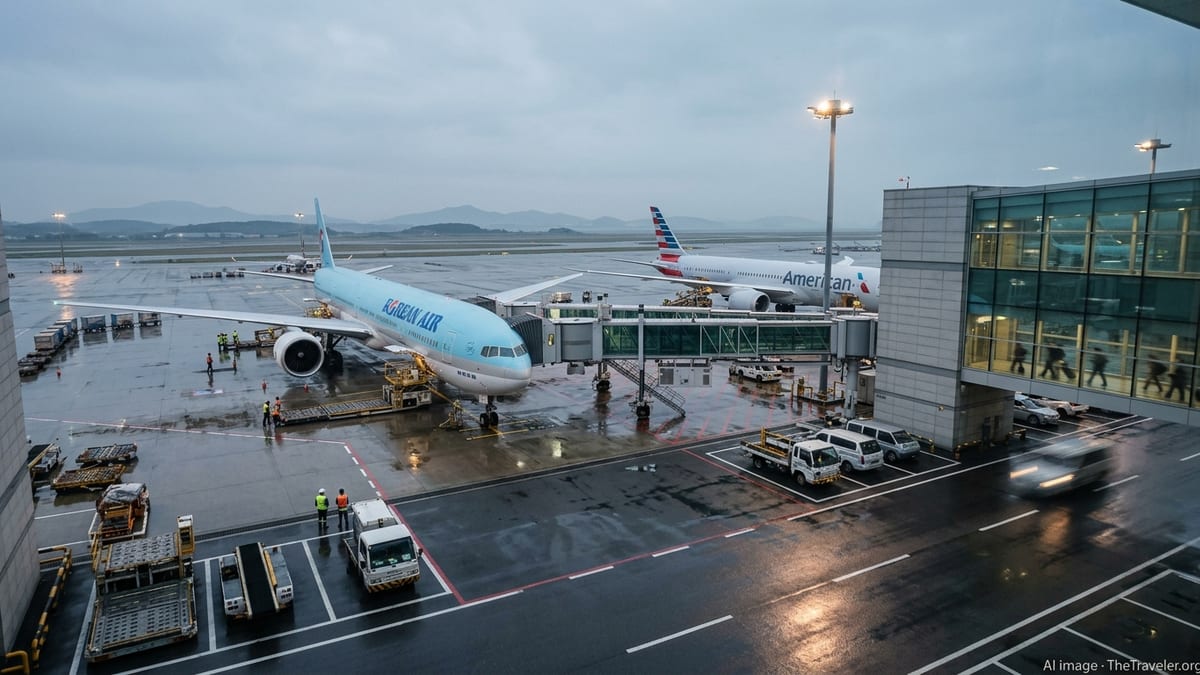
Fuel Shock Pushes Korean Carriers Into Emergency Mode
A spike in global oil prices linked to the conflict around the Strait of Hormuz has rapidly fed through to aviation fuel costs, hitting South Korean airlines that rely heavily on Middle East energy supplies. Industry coverage describes jet fuel benchmarks rising more than 50 percent since late February 2026, forcing carriers to reset their business plans practically overnight.
Korean Air has shifted into what company statements describe as “emergency management” for April, after a sharp jump in fuel surcharges on international tickets departing South Korea at the start of the month. Publicly available information shows that the surcharge on the longest routes, including services from Incheon to major North American hubs such as New York and Chicago, has more than tripled compared with March, adding the equivalent of several hundred US dollars to the cost of a round trip.
Asiana Airlines and major low cost rivals including T’way Air have also moved into emergency management structures, according to local business media and aviation-focused reports. These frameworks typically involve rapid reviews of route profitability, accelerated capacity cuts and tighter control of non-essential spending, signaling that the current disruption is expected to last beyond a few weeks of volatility.
Observers note that while South Korean carriers had some fuel hedging in place, the speed and scale of the recent spike has outpaced earlier assumptions. Refining margins on jet fuel have widened sharply, meaning that even airlines partially protected against crude oil fluctuations remain exposed to higher end-user prices for aviation fuel.
US Routes Bear the Brunt of Capacity Cuts
The most immediately visible impact for international travelers is on South Korea’s high profile connections to the United States. Tracking data and airline schedule snapshots compiled by travel industry outlets indicate that more than ten flights linking Seoul Incheon and Jeju with major long haul destinations, including New York, Boston, Los Angeles and Dallas, were cancelled between late February and early March.
On the South Korea United States corridor, Korean Air has reduced frequencies on some of its flagship services, trimming departures to the US East Coast and West Coast as it prioritizes aircraft and crew for the strongest revenue generating routes. Parallel cuts by US partners on connecting sectors into and out of Los Angeles and other gateways are tightening capacity further, effectively shrinking the number of available itineraries between secondary American cities and Seoul.
Reports from consumer focused travel platforms show that last minute cancellations and schedule changes at Incheon International Airport have left transpacific passengers scrambling for alternatives, often being rebooked one or two days later or rerouted through other Asian hubs. The pullback is especially painful on routes that previously supported multiple daily departures, where removing even one frequency can wipe out significant seat capacity and push remaining fares sharply higher.
Industry analysts warn that if emergency measures continue into the northern summer, corporate and leisure travelers may see a structurally leaner schedule between South Korea and the United States. Combined with ongoing consolidation between Korean Air and Asiana, the present fuel shock is reinforcing a longer term trend toward fewer, more expensive nonstop options.
Regional Asia Links Also Trimmed as Costs Climb
The pressure is not limited to long haul flights. South Korean carriers and their regional competitors are also pruning networks across Asia as operating shorter routes at current fuel prices becomes increasingly difficult. Trade publications covering the Asia Pacific aviation sector describe a broad wave of cancellations and timetable adjustments, with airlines in South Korea, Thailand and elsewhere paring back frequencies and suspending lightly loaded services.
For South Korean travelers, this has translated into thinner schedules to popular nearby destinations such as Japan, Southeast Asia and parts of China. Low cost carriers that built their business models on dense, high turnover short haul flying are particularly exposed, as fuel now accounts for a larger share of each ticket and leaves less room for discounting.
Elsewhere in the region, airlines including Thai Lion Air, Nok Air and Thai AirAsia X have announced route suspensions under their Summer 2026 plans, citing the need to contain losses from the fuel surge. While these carriers are not based in South Korea, their cuts intersect with Korean outbound travel patterns and connecting traffic, further complicating itineraries for passengers who used Bangkok or other hubs as stepping stones between Korea and secondary Asian cities.
Analysts tracking capacity across Asia note that the simultaneous retrenchment by multiple airlines is tightening seat supply on key tourism and business corridors. This is amplifying price increases triggered by South Korea’s distance based surcharge system, under which levies are recalculated monthly based on jet fuel benchmarks and exchange rates.
Sharp Fare Increases Hit Korean Travelers
For consumers, the most immediate sign of crisis is the cost of tickets. Local economic media report that fuel surcharges on long haul departures from South Korea in April have surged to more than three times their March level, lifting one way surcharges to over 300,000 won on some North American routes. Families booking peak season trips now face additional charges that can run into the millions of won once multiple tickets are factored in.
Business and travel news coverage indicates that total international airfares issued in April are expected to be at least 100,000 won higher per ticket than those bought in March for comparable routes, even before any base fare increases. Travel agencies in Seoul have described customers shelving or scaling back overseas plans as the full impact of new surcharges appears during the booking process.
Budget conscious travelers who might previously have relied on low cost carriers for cheaper options are finding less relief, as these airlines pass on higher operating costs through their own surcharges and targeted capacity reductions. With few signs of a rapid easing in oil markets, passenger advocates are warning that international flying from South Korea is shifting from a mass market product toward a more discretionary, premium purchase.
At the same time, frequent travelers and corporate buyers are attempting to adjust by booking further in advance, locking in itineraries before possible new rounds of surcharges take effect in subsequent monthly resets. However, the volatility of fuel prices and the possibility of fresh route cuts mean that even early planners are navigating an unusually uncertain environment.
Middle East Conflict and Structural Risks to Korea’s Hub Status
Underlying the immediate disruption is a broader structural vulnerability in South Korea’s aviation system. The country sits at the terminus of supply chains that funnel crude oil and refined products from the Middle East through the Strait of Hormuz, a maritime chokepoint that has seen significant instability since late February due to the Iran related conflict.
Economic analyses of the crisis highlight that a large share of the crude and liquefied natural gas transiting the strait is destined for Asian markets, including South Korea. Any sustained interruption or risk premium applied to these flows quickly feeds into higher energy costs across the region, with aviation particularly exposed because fuel already represents a substantial portion of airline operating expenses.
South Korea’s strategy of positioning Incheon as a premier hub between North America and Asia depends on dense, competitively priced scheduling. Prolonged fuel shocks erode that model by forcing airlines to raise prices or cut capacity in order to remain financially viable. The current wave of schedule reductions on US and Asian routes offers a live test of how resilient the hub strategy is under extreme cost pressure.
Policy discussions in Seoul and within the aviation industry are increasingly focused on how to reduce long term exposure to such shocks, including through more diversified fuel sourcing, accelerated investments in fuel efficient aircraft and support for sustainable aviation fuel. For now, however, travelers see the most visible effects in the form of thinner route maps, higher surcharges and a sense that South Korea’s once abundant flight options are no longer guaranteed.