

More news on this day
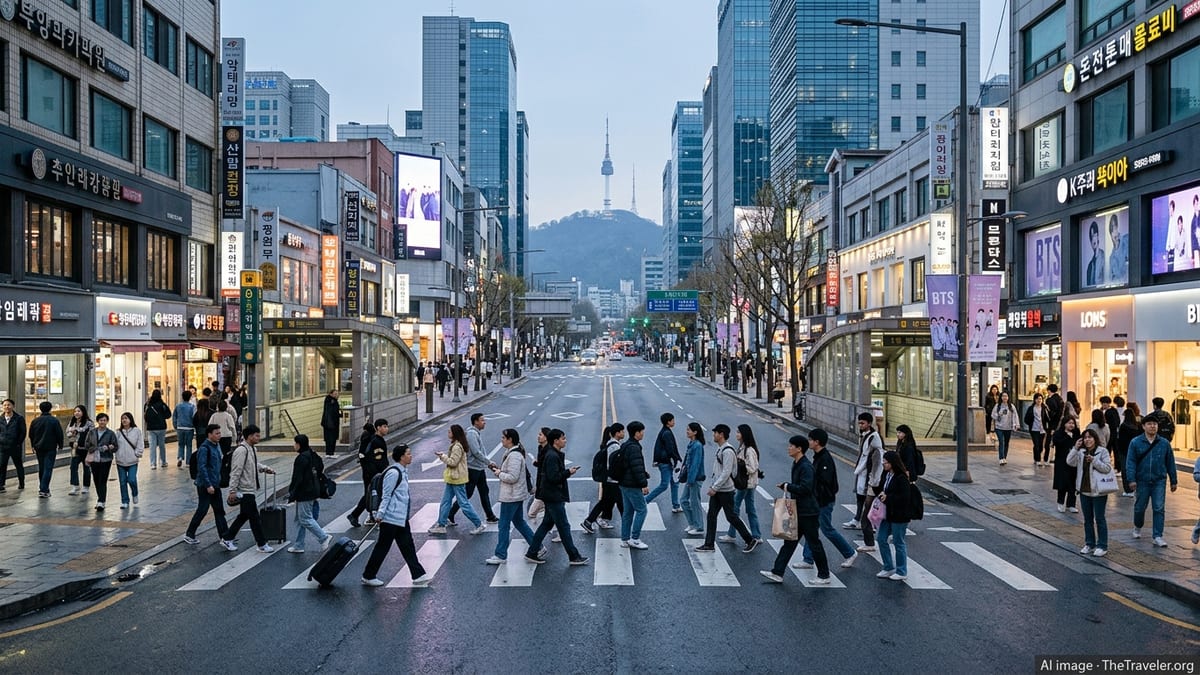
South Korea is surging to the top of global travel wish lists in 2026, as fresh visitor records, a full-force BTS comeback and a wave of new international flights converge to create one of the world’s most closely watched tourism booms.
Get the latest news straight to your inbox!
From Recovery To Record-Breaking Momentum
After a rapid post-pandemic rebound, South Korea has entered a new phase of sustained growth that analysts describe as one of the fastest in the world. Published tourism data shows that the country welcomed around 16.3 million international arrivals in 2024, a jump of nearly 49 percent on the previous year and a recovery to roughly 94 percent of its 2019 peak. Reports indicate that by mid 2025, monthly arrival figures were regularly surpassing pre-pandemic levels, underscoring the strength of pent-up demand.
Government projections for 2025 set a target of 18.5 million foreign visitors, with policymakers and industry groups discussing a path toward an eventual era of 20 million inbound travellers a year. Industry briefings note that younger, independent travellers make up a growing share of arrivals, with survey data showing that more than a third of inbound visitors in 2023 were under 30 and the vast majority were not on package tours. This shift is reinforcing Seoul’s image as a flexible, do-it-yourself city break destination and pushing visitors into neighbourhoods beyond the traditional downtown core.
Seoul itself is already seeing the impact in real time. Official statistics from the capital show that the city welcomed more than 900,000 international tourists in January 2025 alone, surpassing its previous January record from 2019. Municipal leaders have tied that performance to intensive global marketing drives and new large-scale festivals, as the city positions itself as a year-round events hub rather than a purely seasonal destination.
Behind the headline numbers, the travel sector’s role in South Korea’s wider economy is becoming more visible. Market research reports estimate that tourism accounted for around 3 to 5 percent of national GDP in recent years, with ripple effects that stretch from hotel development and retail to cultural exports. The acceleration now unfolding in 2025 and 2026 is reinforcing expectations that travel will remain one of the country’s most dynamic growth engines.
BTS Return Turns Hallyu Interest Into Bookings
The global fascination with Korean pop culture has been central to South Korea’s tourism narrative for more than a decade, and that influence is intensifying as BTS returns to full group activities. All seven members completed their mandatory military service by mid 2025, and coverage from international and Korean media throughout 2025 detailed how fans from around the world descended on events marking each milestone. Economic analyses cited in those reports estimated that at the height of their pre-hiatus popularity, BTS generated around 0.3 percent of South Korea’s GDP, the equivalent of billions of dollars each year.
Those figures are now being revisited as the group re-enters the global touring circuit. Research by the Korea Culture and Tourism Institute, highlighted in regional media, has suggested that a single BTS concert in Seoul can inject up to hundreds of millions of dollars into the economy when visitor spending on accommodation, food, retail and domestic transport is included. That impact is magnified when concerts are paired with multi-day fan festivals, exhibitions and pop-up experiences that encourage longer stays.
New coverage from Korean outlets in March 2026 describes how Seoul was transformed for a major BTS comeback performance, with skyscrapers lit in purple and tens of thousands of international fans flying in for a free show. Social media activity around hashtags linked to “BTS pilgrimage” itineraries has surged, with fans sharing routes that connect music video filming locations, favourite food spots and merchandise stores. Travel agencies in several markets have responded by packaging themed tours that fold BTS sights into wider K-wave experiences including K-drama locations and K-beauty districts.
The group’s upcoming Arirang World Tour, reported in entertainment business media as their largest yet, is also expected to feed directly into inbound demand. Ticket sales in key markets are generating intense online attention to Seoul, Busan and other Korean cities, with flight searches and hotel lookups rising around announced dates. Industry observers note that for many international fans, visiting South Korea itself has become the logical culmination of years of engagement with Korean music, television and food from afar.
Air Capacity Surges As Carriers Bet On Korea
The scale of the travel boom is evident in aviation statistics. Data from South Korea’s Ministry of Land, Infrastructure and Transport, reported in national newspapers in January 2026, shows that total air passenger traffic at Korean airports reached a record 124.8 million in 2025, up 3.9 percent on the previous year. International passengers to and from Korea rose by more than 6 percent, while domestic traffic dipped slightly, a pattern that underlines how Korea’s growth is increasingly outward-facing and globally driven.
Major and niche carriers alike are now betting on Seoul as a long-term hub. A recent announcement from a European long-haul airline detailed plans for new daily services between its London base and Incheon International Airport from late March 2026, adding another nonstop option between Europe and Korea. In North America, Alaska Airlines has begun positioning Incheon as a key Asian gateway, with its Seattle to Seoul route, launched in 2025, already carrying tens of thousands of passengers and slated for frequency increases over the 2026 summer season.
Regional low-cost airlines are simultaneously thickening the web of short-haul links that feed leisure travel into Korea. Press releases from Japanese budget carrier Peach Aviation highlight additional round trips on its Osaka to Seoul route, with capacity scheduled to rise again in early 2026 after strong demand. New and revived Korean operators are also entering the market, with regional airlines obtaining operating licences, taking delivery of aircraft and outlining plans to connect secondary Korean cities to destinations in Japan, Vietnam and the United States.
Industry analysts describe this combination of flagship long-haul launches and dense short-haul networks as critical to sustaining the tourism boom. More direct connections cut travel times for first-time visitors who may previously have transited through other Asian hubs, while added low-cost capacity encourages repeat visits and spur-of-the-moment city breaks from neighbouring countries. Airports from Incheon to Gimpo and Busan are responding with new retail, upgraded terminals and expanded transport links to distribute growing passenger volumes more smoothly.
K-Culture, City Festivals And New Tourism Campaigns
While BTS commands global headlines, the wider Korean Wave continues to underpin travel decisions. Travel and culture reports published in 2024 and 2025 point to a powerful mix of K-dramas, K-pop, esports and food content driving interest in locations ranging from Seoul’s palaces and hanok villages to filming sites in provincial towns. A national “Visit Korea” campaign spanning 2023 and 2024 was designed to capitalise on that visibility and, according to industry summaries, set an ambitious goal of drawing 30 million tourists by 2027.
On the ground, cities are experimenting with major festivals and light shows to turn seasonal peaks into extended travel windows. Seoul’s large-scale winter and summer events have been promoted as centrepieces in the city’s long-term “3·3·7·7” tourism vision, a strategy that aims to increase visitor numbers, average length of stay and spending through a blend of culture, shopping and urban nature. Reports from those events indicate that they have attracted millions of domestic and international visitors, reinforcing the idea that Seoul’s tourism appeal now stretches across multiple niches.
Younger travellers, who make up an outsized share of arrivals, are shaping how the boom looks at street level. Many are seeking neighbourhoods with independent cafes, live music venues and galleries rather than traditional tour circuits, pushing demand into areas such as Hongdae, Seongsu and Ikseon-dong. Social media friendly backdrops, from mural-lined alleyways to night markets, feature prominently in user-generated content, effectively turning visitors into unpaid marketers for the next wave of trips.
Regional destinations are working to capture some of that momentum. Jeju Island remains a favourite for its coastal landscapes and volcanic heritage, while cities like Busan, Daegu and Gwangju are increasingly investing in waterfront redevelopments, film festivals and cultural precincts to entice international visitors beyond the capital. With domestic infrastructure improving and air links multiplying, tourism planners argue that 2026 offers a rare opportunity to spread benefits more evenly throughout the country.
Why 2026 Is Shaping Up As The Year Of Korea
Several converging factors are leading travel analysts to single out 2026 as a potential tipping point for South Korea’s global tourism profile. The expected crossing of the symbolic two million mark in monthly arrivals during peak seasons, combined with multi-city BTS events and new long-haul links from Europe and North America, is projecting an image of a destination operating at full international scale. Travel platforms already rank Seoul among the most searched Asian city breaks for 2026, signalling strong forward intent.
Price dynamics are also playing a role. While the won has fluctuated against major currencies, the relative affordability of Korean dining, public transport and cultural attractions compared with some rival destinations in East Asia is frequently highlighted in consumer travel coverage. That perception is being reinforced by a growing range of accommodation, from boutique hanok stays to international five-star brands and hostels aimed at budget-conscious backpackers.
At the same time, South Korea’s tourism authorities and local governments are navigating familiar challenges, from crowding in popular districts to the environmental impact of high visitor numbers. Policy discussions in 2025 referenced the need to balance growth with sustainability, encouraging dispersal to less-visited regions and promoting off-peak travel periods. Industry observers suggest that how the country manages these pressures in 2026 will help determine whether today’s boom evolves into a stable long-term success story.
For now, flight schedules, hotel pipelines and fandom-fuelled demand all point in the same direction. With BTS back on stage, air traffic at record highs and a generation of travellers treating Korean culture as part of their daily lives, South Korea’s travel surge in 2026 is less a surprise than the logical next step in a story that has been building for years.