

More news on this day
South Korea is preparing for a landmark year in global aviation as national and foreign carriers roll out new long-haul routes for 2026, strengthening Seoul Incheon’s role as a premier hub between Europe, North America and the wider Asia-Pacific region.
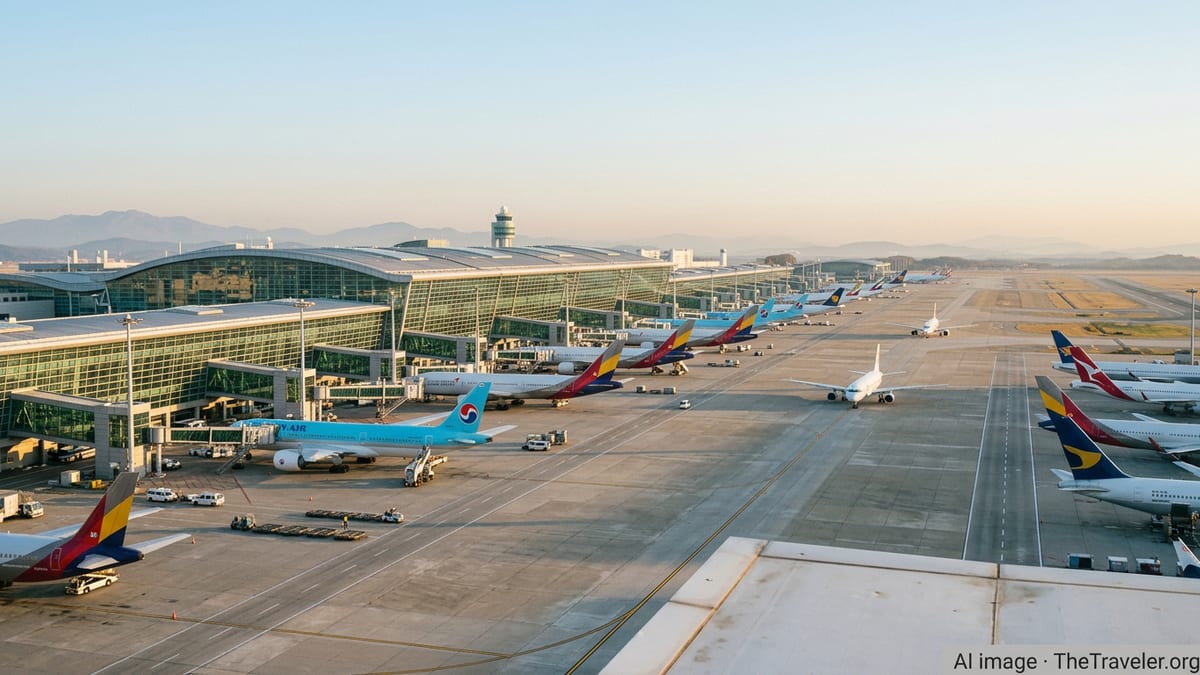
Korean Air Leads a Post-Merger Push Across Continents
Korean Air, newly enlarged as it absorbs Asiana Airlines under a merger scheduled to see the Asiana brand disappear by the end of 2026, is positioning itself at the center of the country’s long-haul expansion. Recent schedule filings for the northern summer 2026 season show a more diversified global network, with capacity being shifted to high-demand corridors linking South Korea with North America, Europe and key Asian gateways.
Industry analyses of the airline’s 2026 strategy highlight a dual focus: deepening coverage in established markets such as the United States and major European capitals while using the larger combined fleet to refine connections across Northeast and Southeast Asia. Additional widebody capacity, supported by a multibillion-dollar aircraft order book, is expected to underpin more nonstop options and higher frequencies on trunk routes, particularly to North America where connecting traffic from across Asia flows through Incheon.
The merger-driven restructuring also allows Korean Air to reduce overlap on routes historically served by both it and Asiana, freeing aircraft for new city pairs and extra frequencies on high-yield services. For travelers, the result in 2026 is anticipated to be more seamless one-stop itineraries between secondary cities in Asia and destinations across Europe and the Americas, as schedules are optimized around banked connections at Incheon.
At the same time, Korean Air is using its expanded scale to pursue partnerships that extend its reach even further. A growing relationship with North American carriers, including investment ties, is designed to funnel additional passengers into the Incheon hub from Canada and the United States, reinforcing the airport’s status as a preferred transfer point between the Western Hemisphere and Asia.
European Links Multiply as Carriers Target Seoul
On the Europe side, 2026 is shaping up as the year Seoul becomes firmly embedded in more continental networks. Korean Air is already adding new long-haul links westward, including services to emerging leisure and business markets such as Portugal that are being rolled out from the second half of 2025 and ramped up into 2026. These routes ride on fuel-efficient widebodies like the Airbus A350, giving the airline the economics to connect Korea with thinner but fast-growing European destinations.
Foreign carriers are also moving in. Scandinavian Airlines has announced a direct link between Copenhagen and Seoul, due to launch ahead of the boom period and feed two-way traffic by the time the 2026 summer season arrives. The route is designed to give Korean travelers a one-stop path into Scandinavia and Northern Europe, while Europeans gain direct access to South Korea and onward Asian destinations through partner connections at Incheon.
In the United Kingdom, Virgin Atlantic plans to launch daily flights between London Heathrow and Seoul Incheon from late March 2026. The service plugs the British carrier into a major Asian gateway where it can feed alliance and codeshare partners onward toward Japan, China and Southeast Asia. For South Korean passengers, it adds another nonstop option to one of Europe’s biggest long-haul hubs, complementing existing services by Asian and European competitors.
Smaller and hybrid carriers are not standing still either. South Korean long-haul low-cost and mid-market airlines that had already ventured into Europe before the pandemic recovery are now using 2026 to consolidate. Operators such as Air Premia, which has been building a footprint on routes like Incheon to Frankfurt, are expected to refine schedules and product offerings as they compete for cost-conscious leisure travelers heading to and from the continent.
North America Sees More Nonstops and Stronger Partnerships
Across the Pacific, North America remains the single most important long-haul market for South Korean aviation, and 2026 will see that relationship deepen. Korean Air is planning further expansion on its transpacific network, supported by fleet renewal and capacity freed up by the integration of Asiana. Analysts expect the airline to focus on thick routes to major U.S. and Canadian gateways, where demand from both point-to-point passengers and connecting travelers remains robust.
New entrants are adding fresh competition. Alaska Airlines, which began nonstop flights between Seattle and Seoul Incheon in 2025, is set to grow its presence through 2026 as it beds in the route and aligns schedules with its domestic network in the Pacific Northwest. By offering direct service from a key U.S. tech and cruise hub, Alaska gives American travelers another path into Korea and onward to other Asian cities via Incheon.
Partnership activity is also reshaping the landscape. Korean Air’s deepening ties with a range of North American carriers, including a strategic equity stake in Canada’s WestJet, are designed to expand the feed of passengers from secondary cities across Canada and the interior United States. These partnerships make it easier for travelers in places far from traditional gateways like Los Angeles or New York to access one-stop itineraries into Asia via Seoul.
For South Korean travelers, the effect is an increasingly dense web of options to North America. Whether flying on Korean Air metal or connecting through partner hubs, passengers in 2026 will see more choices in schedules, cabins and price points, from full-service premium offerings to more competitively priced itineraries that marry low-cost domestic legs with long-haul segments.
Asia-Pacific Connectivity Powered by Low-Cost and Hybrid Carriers
While the spotlight often falls on long-haul routes, the 2026 boom is equally about how South Korea connects to its regional neighborhood. Korean Air’s network plan for 2026 includes an expansion of Japan services, increasing the number of routes between the two countries and linking more secondary cities on both sides of the Korea Strait. This expanded short-haul web is critical to feeding long-haul banks at Incheon, especially for traffic bound for Europe and North America.
Low-cost carriers are a central part of this strategy. South Korean budget airlines have spent the past few years preparing for long-haul competition, acquiring larger aircraft and experimenting with routes beyond their traditional short-haul markets. Carriers like T’way Air have been adding capacity aimed at markets such as North America, while simultaneously cementing their role on high-density regional routes to destinations including Bangkok, Ho Chi Minh City and Tokyo.
These airlines, together with hybrid long-haul operators, are increasingly positioning themselves as connectors that can offer lower-fare itineraries from regional Korean cities via Incheon and other domestic hubs into the broader Asia-Pacific. For many travelers, especially younger and budget-focused passengers, the combination of a low-cost leg into Seoul with a competitively priced long-haul flight opens up new travel possibilities that were previously unaffordable.
The rise of these players also pushes the full-service carriers to refine their own regional offerings, leading to schedule increases, product upgrades and sharpened pricing in 2026. As competition intensifies, passengers across Asia are likely to benefit from more frequent services and better-coordinated connections through South Korea’s airports.
Incheon Airport Consolidates Its Role as a Super-Connector
All of these developments converge at Incheon International Airport, which enters 2026 with its role as a northeast Asian mega-hub firmly reinforced. The airport’s infrastructure projects and terminal expansions over the past several years were designed with exactly this moment in mind, providing the capacity to handle more widebody movements, transfer traffic and cargo flows linking Europe, North America and Asia.
With Korean Air emerging as a single national champion and foreign carriers adding new Seoul services, Incheon’s wave system of departures and arrivals is expected to become even more finely tuned. For travelers, that translates into shorter layover times, a wider choice of onward flights and better chances of same-day connections between distant city pairs such as mid-sized European markets and secondary cities across Japan or Southeast Asia.
The 2026 schedule will also showcase Incheon’s role as a competitive alternative to other regional hubs. As airlines deploy new-generation aircraft with longer range and better fuel efficiency, routes that once required a stop elsewhere can now be operated nonstop into Seoul, while still offering onward connectivity. This dynamic is especially visible on services from Europe and North America, where carriers are using Incheon as a bridge to reach deeper into Asia.
For South Korea, the emerging pattern of routes underscores broader economic and tourism ambitions. By drawing more travelers through its main gateway and multiplying direct links to key markets, the country is leveraging aviation to support inbound tourism, trade and cultural exchange. If current plans hold, 2026 will mark a pivotal year in confirming South Korea’s place near the center of the global air travel map.