

More news on this day
South Korea’s sweeping relaxation of visa requirements for Filipino travelers, effective February 20, 2026, is setting the stage for a sharp spike in demand on routes operated by Philippine Airlines, Korean Air, AirAsia, and Cebu Pacific between the two countries.
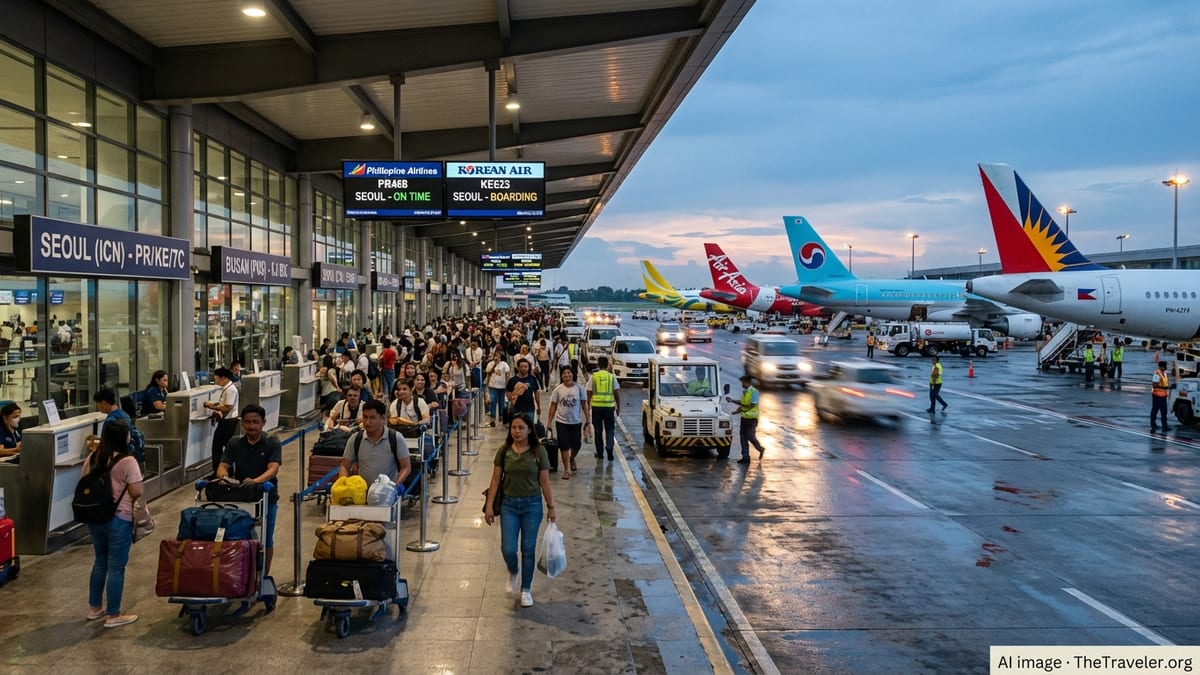
Visa Hurdles Fall as Seoul Courts Filipino Travelers
Beginning February 20, the Korea Visa Application Center in Manila is implementing a slate of easier requirements that significantly lowers the paperwork barrier for Filipinos heading to South Korea. The most eye-catching change is the removal of the long-mandatory three months of bank statements for visa applicants, a document that has often been cited by Filipino travelers as one of the most intimidating parts of the process.
Students, families, and groups will also benefit from streamlined rules. Student applicants now need to submit only either an original school certificate or a copy of their student ID, instead of both, while groups or families lodging applications together can file just one set of common supporting documents under a designated representative. Employment-related requirements are likewise relaxed, as certificates without landline numbers or bearing electronic signatures are accepted as long as email or mobile contact details are provided.
These changes build on earlier policies that already made South Korea more accessible to Filipinos, including a simplified visa scheme for qualified credit card holders, elected officials, and their families, and a group visa fee waiver for C-3-2 visas that has been extended until at least mid-2026. The cumulative effect is a markedly more welcoming environment for Filipino tourists at a time when South Korea is aggressively chasing higher inbound arrivals.
While a visa is still formally required for Filipino passport holders, the cost and complexity of securing one have dropped sharply. With visa fees waived for most tourist categories and the documentation burden eased, travel planners expect many would-be visitors who were previously discouraged by red tape to finally book their long-delayed trips to Seoul, Busan, Incheon, and beyond.
Philippine Airlines Gears Up Its Korea Network
Philippine Airlines, the country’s flag carrier and one of the largest operators of direct services to South Korea, is closely watching the visa shift as a powerful catalyst for bookings across its Manila, Cebu, and Clark gateways. Even before the latest changes, PAL had been rebuilding and expanding its Korea network in response to robust demand from Filipino leisure travelers and overseas workers, alongside growing two-way traffic from Korean tourists visiting Philippine beach destinations.
Industry sources indicate that PAL expects a surge in economy and premium leisure traffic on its Manila to Seoul Incheon and Busan routes, as well as on Cebu-originating flights that are popular with travelers from the Visayas and Mindanao. With visa costs effectively at zero and documentation easier to assemble, tour operators partnering with PAL are already promoting bundled air-plus-hotel packages targeted at first-time visitors who might previously have been put off by the application process.
The carrier is also in a strong position to capture group traffic benefitting from South Korea’s extended fee waiver on C-3-2 group visas. PAL’s charter and block-seat agreements with major Philippine travel agencies could see renewed activity, especially for school and barkada trips built around cherry blossom season, autumn foliage, and K-pop concert tours. Travel agents note that as long as groups can coordinate their supporting documents, the simplified visa rules should cut lead times between planning and departure.
Operationally, PAL is expected to adjust capacity through a combination of upgauging aircraft on high-demand rotations and adding frequencies on peak travel days such as Friday departures and Sunday or Monday returns. The airline’s revenue management teams will also be closely monitoring fare trends, as strong demand could gradually lift average ticket prices even as promotional sales seek to stimulate off-peak bookings.
Korean Air Targets Higher-Yield Two-Way Traffic
Korean Air, which has long treated the Philippines as a strategically important leisure and migrant-worker market, stands to gain not only from Filipino outbound tourism but also from stronger connecting flows via its Seoul Incheon hub. Easier visa access for Filipinos is likely to produce a wave of travelers combining Korea city breaks with onward long-haul journeys to North America and Europe, a segment where Korean Air has deep network strength.
With South Korea removing a key psychological barrier to travel, Korean Air can more aggressively market stopover products and multi-city itineraries to Filipino customers. Travel advisors expect an uptick in bookings where travelers spend several days exploring Seoul or Busan before connecting to destinations such as Los Angeles, New York, or Paris, capitalizing on competitive fares and the convenience of a single-ticket journey.
On core point-to-point routes between Manila, Cebu, and Seoul, the visa easing is likely to amplify demand in both directions. South Korean holidaymakers continue to flock to Philippine resorts like Boracay, Cebu, and Palawan, and increased Filipino outbound travel helps smooth seasonality by filling seats on traditionally softer dates. Korean Air could respond by fine-tuning schedules, introducing additional early-morning or late-night departures tailored to maximize connections through Incheon while giving Filipino travelers more flexibility.
Analysts note that as Filipino load factors climb on Korea-bound services, Korean Air will have room to adjust its cabin mix, potentially adding more economy seats while maintaining a steady share of premium cabins for business travelers and high-spending tourists. The carrier is also expected to deepen its partnerships with Philippine travel agencies and online booking platforms to highlight the simplified visa process in promotional campaigns.
Low-Cost Leaders AirAsia and Cebu Pacific Smell a Tourism Windfall
For budget carriers AirAsia and Cebu Pacific, both of which rely on high-volume leisure traffic and sharp pricing, South Korea’s softer visa regime is poised to be a major demand driver. These airlines have spent the past few years restoring and expanding their Korea routes, with services linking Manila, Cebu, Clark, and other Philippine hubs to Seoul Incheon, Busan, and occasionally secondary Korean gateways.
AirAsia, with its strong digital presence and aggressive fare promotions, is expected to quickly pivot marketing to emphasize that bank statements and certain financial documents are no longer required for Filipino visa applicants. For younger travelers, freelancers, and first-time international tourists who tend to favor low-cost carriers, the combination of cheaper flights and simpler paperwork is especially compelling. Flash sales, zero-base-fare promos, and bundled hotel or tour deals built around K-pop concerts, K-drama filming locations, or food-centric itineraries are likely to feature prominently in the coming weeks.
Cebu Pacific, the Philippines’ largest low-cost airline, has similarly been banking on strong interest in Korea, with popular routes such as Manila to Seoul and Cebu to Seoul often operating with high load factors during peak seasons. The new visa rules are expected to flatten some of the seasonal dips and extend demand beyond school holidays and long weekends. Travel analysts say Cebu Pacific may explore additional frequencies or even new point-to-point routes from secondary Philippine cities if demand proves sustainable.
Both low-cost carriers are also positioned to benefit from the extension of fee waivers for group visas, which could supercharge demand for school trips, corporate incentives, and family reunions packaged by local agencies. With tighter seat pitch and fewer frills than full-service rivals, AirAsia and Cebu Pacific keep base fares low, a crucial factor for price-sensitive travelers who may now feel confident enough to commit to Korea travel plans.
Travel Agencies and Tour Operators Move Quickly
Philippine travel agencies and tour consolidators, long accustomed to coaching clients through the Korean visa maze, reacted almost immediately to the Korea Visa Application Center’s advisory. Many have begun revising their documentation checklists, marketing materials, and package inclusions to reflect the fact that three-month bank statements are no longer mandatory and that student and group requirements are lighter.
Operators specializing in Korea-bound group tours report renewed inquiries for spring and autumn departures, with particular interest from student organizations, church groups, and extended families. The ability to submit a single set of common documents for multiple applicants reduces administrative work on both sides and could shorten the time between inquiry, payment, and visa filing.
Online travel agencies are likewise adjusting their user interfaces and informational pages, highlighting the revised documentary rules and connecting them to available flight and hotel inventory. Dynamic packaging tools that bundle flights on Philippine Airlines, Korean Air, AirAsia, or Cebu Pacific with Seoul or Busan hotel stays are expected to gain traction, especially if airlines respond with tactical seat sales tied to the visa changes.
Agents also point out that while visa processing fees and center service charges remain, the removal of bank statements and other financial paperwork may reduce the need for multiple appointments and resubmissions. That, in turn, increases customer satisfaction and creates a more predictable pipeline of bookings for both travel intermediaries and airlines.
Projected Passenger Surge and Capacity Adjustments
The combination of simplified documentation, zero visa fees for most tourists, and extended validity of special schemes is widely expected to translate into a sharp rise in Filipino visitor numbers to South Korea over the next 12 to 18 months. Pre-pandemic, Filipinos already ranked among the top inbound markets for Korea, and recent data suggest that numbers were approaching record highs again in late 2025 even before the latest rule changes.
Industry analysts say the immediate impact will likely be felt in higher load factors on existing flights between major Philippine and Korean gateways. Philippine Airlines, Korean Air, AirAsia, and Cebu Pacific may initially respond by adjusting fare buckets and opening more low-fare inventory to stimulate forward bookings. If the surge proves durable, capacity increases in the form of added frequencies, larger aircraft, or new city pairs could follow.
Secondary airports in both countries stand to benefit as well. In the Philippines, departure points such as Clark and Cebu could attract more Korea-bound traffic that previously funneled through Manila, easing pressure on the capital’s congested terminals. On the Korean side, airports like Busan may see more Philippine-origin travelers seeking alternatives to Incheon’s crowds, especially for leisure-focused itineraries along the country’s southern coast.
However, the expected boom will also test infrastructure and service levels on the ground. Visa centers, airline check-in counters, and immigration lines may face growing queues during peak travel periods. Carriers and airport authorities will be under pressure to maintain on-time performance and customer experience standards as volume builds.
Opportunities and Risks for the Aviation and Tourism Sectors
For Philippine and Korean airlines, the new visa environment is a clear commercial opportunity but also a strategic balancing act. Aggressively adding capacity too quickly could expose carriers to yield erosion if demand softens after an initial rush, especially in a region already marked by intense low-cost competition. Conversely, moving too cautiously risks leaving seats unfilled by competitors ready to capitalize on pent-up appetite for Korea travel.
Tourism officials in both countries view the relaxed requirements as a tool to deepen cultural and economic ties. Filipino travelers are among the most enthusiastic consumers of Korean pop culture, and many see a visit to Seoul or Busan as a bucket-list goal. At the same time, Korean holidaymakers continue to power visitor numbers to Philippine destinations, making air connectivity and streamlined border processes mutually beneficial.
There are also questions about how long the current wave of leniency will last and whether it could be adjusted if application volumes become unmanageable. The extensions on simplified and group visa policies already come with specific end dates, and while they may be renewed, airlines and agencies will need to factor the possibility of future rule changes into their planning and marketing.
For now, though, the direction of travel is clear. By stripping away some of the most burdensome visa hurdles for Filipinos, South Korea has thrown open its doors wider to one of its fastest-growing visitor markets. Philippine Airlines, Korean Air, AirAsia, and Cebu Pacific are moving to meet that demand, positioning their fleets and fare strategies for what could be one of the most dynamic travel corridors in the region this year.