

More news on this day
Rail passengers using South Western Railway’s Bengaluru division are bracing for extensive travel disruptions in April 2026, as a new round of large-scale cancellations, diversions and timetable changes is scheduled to support major infrastructure and signalling works across the network.
Get the latest news straight to your inbox!
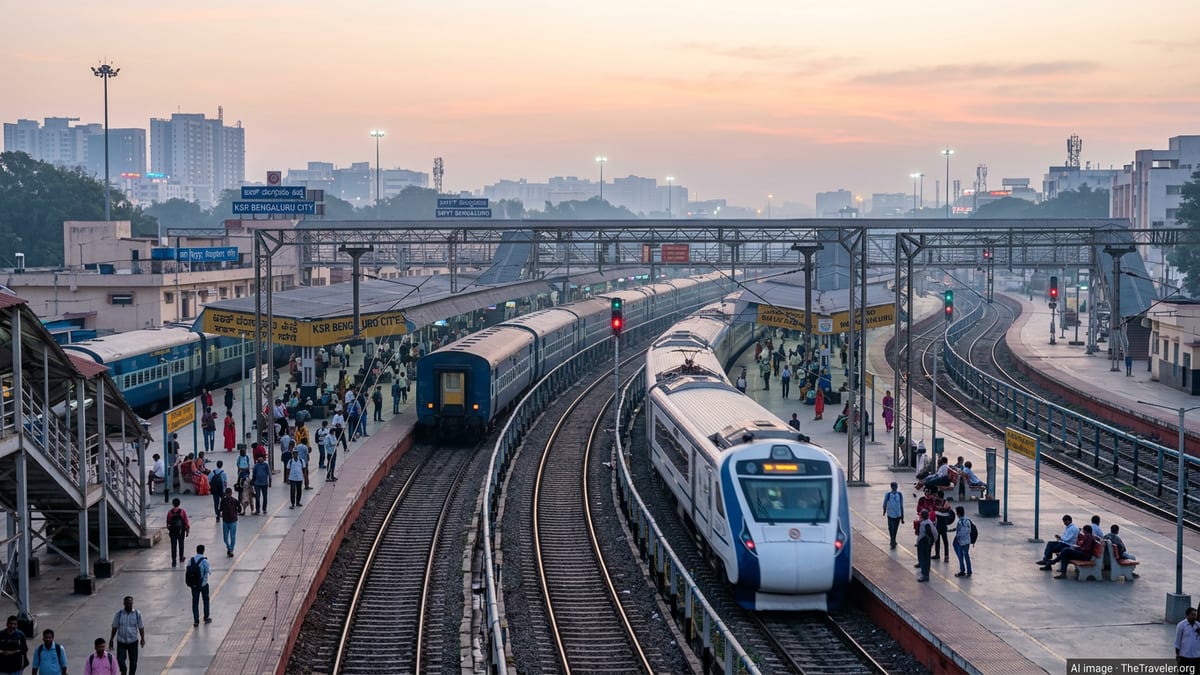
Major Traffic Blocks Planned Around Bengaluru in April 2026
Publicly available railway circulars and regional media coverage indicate that South Western Railway is preparing significant traffic blocks in and around Bengaluru in early April 2026. These blocks are linked to a combination of non-interlocking signalling upgrades, commissioning of new lines around busy suburban corridors, and the tail end of large electrification projects that have been unfolding across Karnataka over the past two years.
The Bengaluru division, which already handles intense commuter, intercity and freight traffic, is expected to be at the centre of these operational changes. Previous notifications for January 2026 showed a pattern of partial cancellations, short terminations and diversions around key junctions such as KSR Bengaluru, Yesvantpur, SMVT Bengaluru, Krishnarajapuram and Yelahanka. Reports suggest that a similar template is likely to guide the April blocks, but with a wider set of trains and longer daytime windows affected.
While detailed train-by-train schedules for April are still being released in stages, advance planning documents and news reports on recent non-interlocking works around Bengaluru point to a concentration of disruptions across weekends and selected weekdays. Rail users are being advised through public announcements and media to treat April as a high-impact month for rail travel into and out of the city, especially during daytime hours.
These operational decisions are unfolding against the backdrop of an almost fully electrified Bengaluru division. Recent coverage has highlighted that close to 99 percent of the division’s track length is now under electric traction, with the final gaps on adjoining routes scheduled for completion around the first quarter of 2026. This transition is allowing the railway to reconfigure sections, relocate signalling assets and rationalise train paths, necessitating short-term pain for longer-term capacity gains.
Daytime and Overnight Services Face Cancellations and Diversions
Travel patterns across Karnataka’s rail network have already been reshaped by a series of earlier blocks, including the suspension of multiple daytime services between Bengaluru and Mangaluru during the 2025 electrification drive on the ghat section. With that project now nearing operational consolidation, attention in April 2026 is shifting towards streamlining heavily used mixed-traffic corridors radiating from the state capital.
Based on how recent blocks have been structured, observers expect several categories of trains to be hit. Popular intercity services that link Bengaluru with coastal Karnataka, Tamil Nadu and Andhra Pradesh are likely to see selected trips cancelled or partially cancelled on work days. Overnight expresses that normally cross critical junctions during block hours may be diverted via alternative routes, adding journey time and skipping intermediate stops around the city.
Long-distance trains passing through the Bengaluru division on their way to eastern and northern India are also at risk of diversions and rescheduling. Earlier advisories in late 2025 and early 2026 showed superfast services being rerouted via outlying chords or suburban lines, especially when key approach tracks to KSR Bengaluru or SMVT Bengaluru were taken out of service. April’s programme is expected to follow this pattern, temporarily altering well-established travel routines for regular passengers.
For shorter commuter runs, particularly MEMU and passenger services feeding into Bengaluru from nearby towns such as Tumakuru, Ramanagaram and Bangarpet, prior experience suggests that partial cancellations and short terminations will be common tools. These tactics reduce congestion around complex work zones but can leave suburban travellers relying on a mix of connecting services and road-based alternatives during peak hours.
Infrastructure Upgrades and Safety Concerns Drive the Disruptions
The immediate trigger for April’s wave of cancellations and diversions lies in infrastructure and signalling works that South Western Railway has been phasing in across its divisions. Recent audit findings and official reports have drawn attention to the need for more reliable signalling systems, particularly in Bengaluru, Hubballi and Mysuru divisions, where a high density of train movements demands robust safety and control mechanisms.
According to these assessments, a sustained programme of modernisation is now underway, encompassing new interlocking arrangements, upgraded communication links, and the expansion of automatic signalling on busy suburban stretches. Executing such works in a live environment requires extended blocks where tracks and signals can be taken over by engineering teams without the risk of conflicting train movements, inevitably forcing large-scale timetable changes.
Parallel to the signalling overhaul, the zone is also closing the final loops of its electrification rollout. Coverage in late 2025 and early 2026 has pointed to targeted completion timelines for remaining unelectrified patches on key routes, particularly in adjoining divisions that feed traffic into Bengaluru. As these sections are wired and commissioned, the railway is revisiting train routings and traction patterns, helping explain the combination of diversions, partial cancellations and new running arrangements appearing in notifications for April.
Observers note that such concentrated periods of disruption, while frustrating for passengers, are often seen around major milestones like the commissioning of new third or fourth lines, doubling projects on congested routes, or the integration of modern safety systems. The Bengaluru division, already a focal point for the emerging suburban rail project and for premium services such as Vande Bharat Express trains, is experiencing these tectonic shifts in a compressed timeframe.
Commuter Impact Across the Bengaluru Metropolitan Region
The April 2026 disruptions are expected to have a pronounced impact on daily life in the Bengaluru metropolitan region, where rail functions both as a long-distance connector and as a pressure valve for the city’s strained road network. Earlier timetable changes on high-profile services like the Vande Bharat trains demonstrated how even modest shifts in arrival or departure times can ripple through office-hour traffic and intercity business travel.
For regular commuters, particularly those living in fast-growing suburbs and satellite towns around Bengaluru, reduced frequencies during block periods may translate into crowded alternative services and a renewed dependence on buses and private vehicles. Local coverage during past block periods has often highlighted snarl-ups at key road-rail interfaces, especially where level crossings or construction around new overbridges intersect with altered train timings.
Passengers starting or ending their journeys at secondary terminals such as Yesvantpur and SMVT Bengaluru may face added uncertainty. In previous non-interlocking works, trains have been short terminated at these points instead of running into KSR Bengaluru, requiring last-mile transfers by road or suburban services. Similar patterns in April could create logistical challenges for travellers carrying luggage or making tight onward connections.
Travel planners point out that Bengaluru’s growing reliance on premium and reserved-category trains intensifies the perceived impact of cancellations and diversions. With reservations on many overnight and intercity services filling up weeks in advance, even one-off cancellations can leave passengers scrambling to rebook or reroute, often at higher cost or with less convenient timings.
What Rail Passengers Should Watch for in April 2026
As the April blocks approach, publicly available advisories emphasise the importance of close monitoring by passengers. Train-specific changes are typically issued in phases, and experience from late 2025 and early 2026 suggests that some adjustments continue to be refined as engineering timelines evolve. Travellers are being encouraged, via media reports and notice boards, to check the latest status of their services repeatedly in the days leading up to their journey.
Rail users with time-sensitive commitments, such as exam schedules, medical appointments or connecting flights, are being urged by travel commentators to build in additional buffers or to consider alternative routes and timings where feasible. In some cases, opting for services that avoid the heaviest block windows or choosing origin and destination stations outside the tightest work zones may reduce exposure to last-minute disruptions.
There is also growing emphasis on understanding refund and rebooking rules in the context of operational disruptions. Past reporting on ticketing trends within South Western Railway has shown significant revenue from cancellations across the zone, underlining how frequently passengers adjust plans in response to changing train operations. Being familiar with the conditions for automatic refunds in the case of cancellations, diversions that skip booked stations, or substantial delays can help travellers protect their costs.
While April 2026 is shaping up to be a difficult month for rail travel around Bengaluru, transport observers stress that the intensity of the planned works signals a decisive push towards a more modern and resilient network. For now, however, passengers in the Bengaluru division face a period where flexibility, advance planning and frequent status checks will be essential to navigating a landscape of cancellations, diversions and rescheduled trains.