

More news on this day
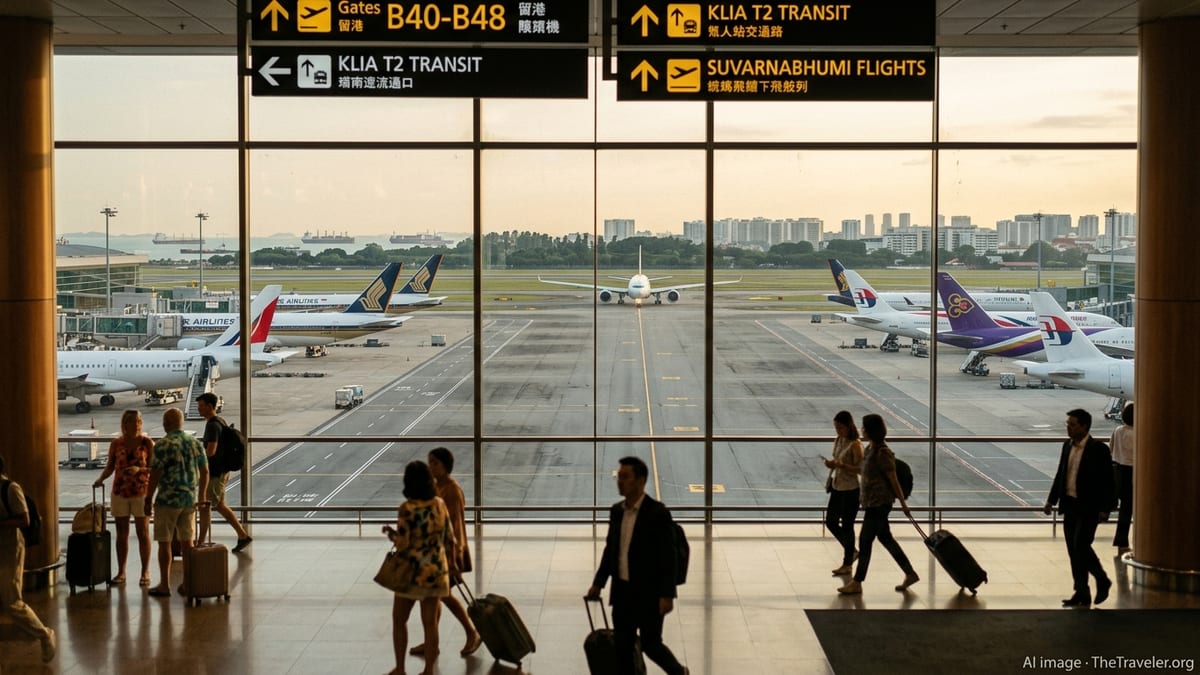
Escalating geopolitical tensions that have disrupted key flight corridors across the Middle East and parts of Europe are rippling through global aviation, raising fresh concerns in Thailand, Malaysia and Singapore that higher costs, longer journeys and shifting travel sentiment could slow the region’s hard-won tourism recovery.
Get the latest news straight to your inbox!
Conflict Zones Redraw Global Flight Corridors
Airlines across Asia and Europe are adjusting flight paths to avoid conflict zones linked to the war in Iran, long-running instability around Ukraine and volatile flashpoints in the wider Middle East. Industry assessments indicate that closures or restrictions in these airspaces have removed some of the most direct links between Asia, Africa and Europe, forcing carriers onto longer routes that add flying time and fuel burn.
Studies published by aviation groups and risk consultancies describe how rerouting around high-risk airspace can add up to two hours to certain long-haul journeys, squeezing airline margins and, over time, pushing fares higher on intercontinental routes. Rising jet fuel prices, influenced by disrupted energy markets and shipping constraints, compound these pressures and leave carriers with limited room to absorb extra costs.
Economic analyses of the 2026 Iran conflict highlight aviation as one of the sectors most exposed to the knock-on effects of war, with regional hub airports operating far below normal capacity and many international services diverted or suspended. As airlines reconfigure their networks, Southeast Asia’s tourism economies find themselves vulnerable to decisions made far beyond their borders.
Thailand’s Tourism Engine Tested by Higher Costs and Regional Strains
Thailand, where tourism accounts for a significant share of national output and millions of jobs, is especially sensitive to any shock that makes long-haul travel more expensive or less convenient. Publicly available visitor data and industry commentary show that international arrivals have not fully regained their pre-pandemic momentum, with softer demand from some key markets adding to domestic concerns about the sector’s trajectory.
Reports from Thai and international media over recent months describe a more competitive regional landscape, with neighboring destinations courting high-spend travelers while Thailand grapples with infrastructure bottlenecks, localized security worries and perceptions of overcrowding in marquee resorts. Any sustained rise in airfare on Europe–Asia routes, driven by detours around conflict zones, risks nudging price-sensitive holidaymakers toward shorter-haul breaks or rival destinations.
Local coverage from early March 2026 noted how the conflict in the Middle East temporarily stranded some travelers and disrupted routes that connect Thailand to the Gulf. A limited reopening of a Qatar air corridor for flights from Bangkok brought partial relief, but the episode underlined how dependent Thai tourism remains on stable global aviation networks and on transit hubs well beyond Southeast Asia.
Malaysia Balances Growth Ambitions With Market Volatility
Malaysia has been working to rebuild and diversify its visitor base, including renewed efforts to attract travelers from the Middle East and other long-haul markets. Tourism promotions and airline partnerships have sought to position Kuala Lumpur and secondary destinations as family-friendly, multi-faith alternatives that offer value compared with some rival hubs.
Analysts in Malaysian business media have recently flagged the current Middle East crisis as a potential headwind for this strategy. Commentaries point to the likelihood that higher fuel costs, longer routings and uncertainty around travel advisories could weaken demand from Gulf states and complicate plans to grow arrivals from Europe. Travel risk forecasts for 2025 and 2026 similarly warn that protracted conflicts in key aviation corridors are likely to raise operating costs and disrupt schedules worldwide.
Malaysia’s tourism sector has weathered geopolitical shocks before, from the Iraq war to previous regional tensions, but the present environment is layered onto existing challenges such as currency volatility and competition from neighboring beach and city destinations. Industry observers note that maintaining air connectivity at competitive price points will be critical if Malaysia is to sustain its recovery and move up the value chain towards higher-spending segments.
Singapore’s Hub Status Under Pressure as Rerouting Reshapes Traffic
Singapore’s Changi Airport, one of the world’s busiest international hubs, sits at the heart of Asia–Europe and Asia–Africa traffic flows that are now being recalibrated. Official traffic figures show that Changi handled close to 70 million passengers in 2025, surpassing its pre-pandemic peak and reinforcing its role as a key gateway for Southeast Asia and the wider region.
However, global risk outlooks for aviation suggest that prolonged geopolitical instability could change how airlines deploy capacity across hubs. With airspace closures stretching from parts of Eastern Europe to sections of the Middle East, carriers are reevaluating the economics of traditional one-stop itineraries. In some cases, that may benefit Singapore if it sits on a viable alternative route, but in others it could push traffic toward different hubs that better fit revised flight paths.
Singapore is responding with large-scale investment in future capacity. Construction is under way on Changi’s Terminal 5, a mega-expansion designed to handle an initial 50 million passengers annually and to support long-term growth in Asia-Pacific travel. Public information on the project highlights its focus on operational efficiency and resilience, an implicit recognition that future aviation shocks, whether geopolitical or environmental, may be more frequent.
Travel analysts caution that even a highly efficient hub like Changi cannot fully insulate itself from external turbulence. If airlines face sustained higher costs across their networks, some marginal routes into Southeast Asia could be trimmed, affecting connectivity for secondary cities in Thailand and Malaysia that rely on Singapore as a transfer point.
Regional Strategies to Shore Up Resilience
Across Thailand, Malaysia and Singapore, policymakers and industry stakeholders are looking to strengthen resilience in anticipation of a more volatile aviation landscape. Risk forecast reports urge airlines and tourism boards to treat conflict-related airspace restrictions as an ongoing feature rather than a temporary anomaly, advocating for more flexible route planning and diversified source markets.
In practical terms, this means deepening intra-Asian tourism flows that rely less on long-haul corridors currently affected by conflict. Airlines in the region have been expanding connections within Southeast Asia and to Northeast Asian markets such as China, Japan and South Korea, which can help offset slower growth from Europe and parts of the Middle East. Tourism agencies are also investing in digital campaigns and niche offerings, from medical tourism to eco-travel, aimed at attracting higher-yield visitors who are less deterred by moderate price increases.
Aviation sustainability and technology initiatives are another pillar of resilience. Regional airports, including those in Thailand and Singapore, are rolling out more advanced security screening and passenger-processing systems that can reduce turnaround times and improve reliability, even as schedules come under strain from longer-haul disruptions. Industry scenario planning suggests that such efficiency gains could cushion some of the financial impact from rerouting and elevated fuel costs.
For now, Thailand, Malaysia and Singapore remain among Asia’s most attractive tourism destinations. Yet the latest round of geopolitical tensions underscores how tightly their fortunes are tied to global aviation. How effectively they adapt to prolonged uncertainty in the skies will help determine whether the region continues its ascent as a premier travel hub or faces a more uneven road ahead.