

More news on this day
A Southwest Airlines Boeing 737 arriving at Hollywood Burbank Airport executed a sudden go-around after briefly touching down, following reports that the runway was not fully clear during the aircraft’s landing attempt.
Get the latest news straight to your inbox!
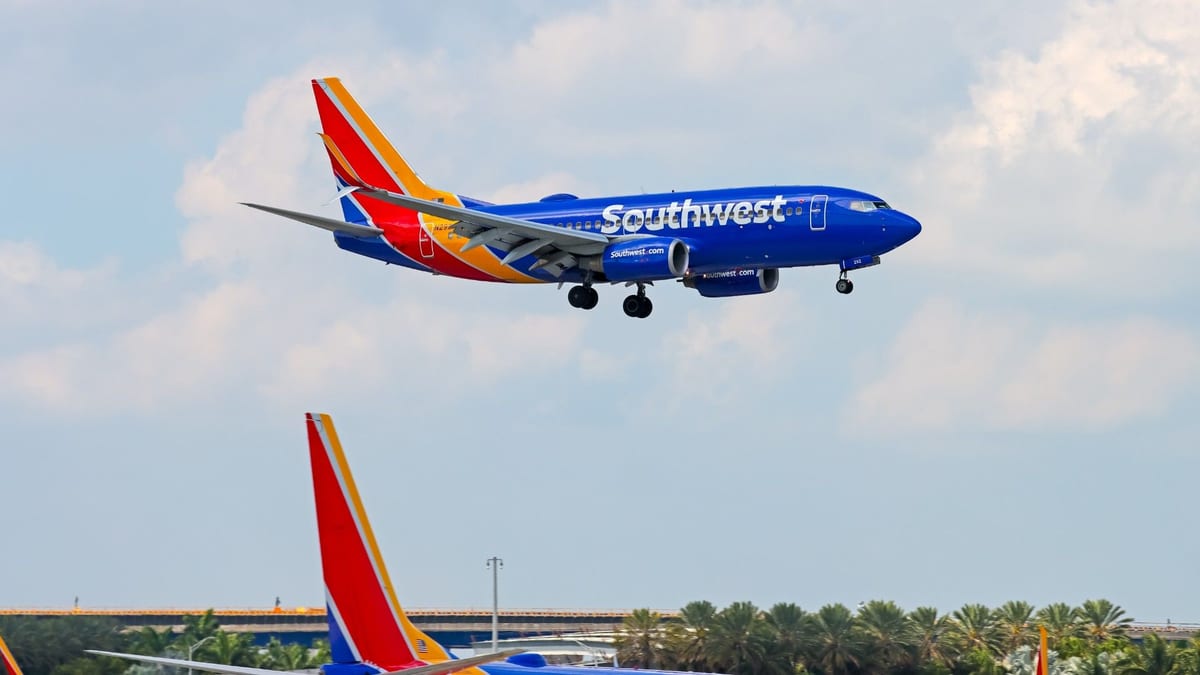
Image by Simple Flying - Aviation News
Close Call on Short Burbank Runway
Early accounts from flight tracking data and aviation community discussions indicate the incident involved a Southwest 737 operating a routine domestic service into Hollywood Burbank Airport. The jet was on final approach to one of Burbank’s relatively short runways, touched down, and then rapidly powered up and climbed away instead of completing the landing roll.
Publicly available flight playback shows a normal approach profile until the last moments, when the aircraft’s ground speed, altitude trace and engine power suggest a brief touchdown followed by a go-around maneuver. Observers note that the climb-out began quickly, consistent with a decision that the runway environment was no longer acceptable for a safe landing.
Initial descriptions shared by passengers and spotters suggest that another aircraft or ground traffic remained on or near the active runway at the time the 737 arrived over the threshold. The phrase “the runway was not clear” has circulated in connection with the event, reflecting a long standing principle in air traffic management that a runway must be completely free of conflicts before a landing clearance can safely be used.
The aircraft later returned for another approach and landed without further incident, based on tracking data. No injuries or damage have been reported, and the flight continued to the gate under its own power.
Burbank’s History and Heightened Sensitivity Around Runway Risk
Hollywood Burbank Airport has an outsized profile in aviation safety circles due to its short runways and the tightly constrained airspace of the Los Angeles Basin. The airport’s operational challenges were highlighted in March 2000 when a Southwest 737 overran the runway after landing and came to rest beyond the airport boundary. That accident prompted significant scrutiny of approach procedures and braking performance at the field.
In the years since, Burbank has seen the installation of safety systems such as engineered materials arresting systems beyond runway ends, and operators have refined training for short field operations into the airport. These measures are intended to ensure that any misjudgment or unforeseen event during landing has additional layers of protection.
More recently, a national focus on runway incursions and near misses in the United States has further sharpened attention on airports like Burbank, where relatively short runways and intersecting traffic flows leave less margin for error. Aviation safety reviews have cited Burbank among locations where complex traffic patterns and heavy regional jet and narrowbody traffic demand strict adherence to spacing and clearance rules.
Against that backdrop, any case in which an airliner needs to power up and go around after contact with the runway is likely to attract interest from investigators and industry observers, even when the maneuver ends uneventfully.
Go-Arounds: A Standard Safety Tool, Even After Touchdown
A go-around is a standard maneuver in which a flight crew discontinues a landing, applies power and climbs away to reposition for another approach. Training materials emphasize that go-arounds are a proactive safety measure and should be used whenever the landing environment does not look or feel right, whether due to unstable approach conditions, weather factors, runway occupancy or last second changes in spacing.
In most cases, go-arounds occur before the aircraft actually touches the runway. However, procedures also allow for a go-around after touchdown if there is sufficient remaining runway and performance to safely accelerate and climb, or if the initial contact is light and the aircraft still has significant flying speed. Pilots are trained to treat such decisions as routine safety calls rather than extraordinary events.
Recent incidents across the United States, including high profile cases in which landing airliners were instructed to go around because another aircraft had entered a runway, have underlined how quickly runway conflicts can develop. Aviation experts often note that the safest option in any doubt is to discontinue the landing and sort out the traffic picture while safely airborne, rather than attempt to salvage a questionable landing.
In the Burbank incident involving the Southwest 737, the rapid transition from touchdown to climb appears consistent with that philosophy. The decision to go around, rather than commit to a full stop on a runway that may not have been clear, aligns with industry guidance that prioritizes conservative choices in time critical situations.
Runway Incursions Under Ongoing National Scrutiny
The episode comes as U.S. aviation regulators and industry groups continue to examine a series of near collisions on or near runways around the country. Public databases of recent events document multiple instances in which landing aircraft were forced to break off their approaches when another jet or ground vehicle occupied the runway unexpectedly.
These events have prompted discussions about improving surface surveillance technology, expanding the use of runway status lights and refining phraseology to avoid ambiguity in clearances. Analysts also point to the role of human factors, such as workload spikes in busy control towers and cockpit task saturation during final approach and rollout.
Hollywood Burbank Airport’s environment, with intersecting arrival and departure flows in close proximity to other Los Angeles area airports, places additional emphasis on clear communication and multilayered safeguards. The latest Southwest incident will likely be examined in that broader context of national efforts to reduce the risk of runway incursions and reinforce best practices among pilots and controllers.
While formal findings about the Burbank event have not yet been published, aviation safety advocates frequently argue that cases where a crew elects to go around, and no collision or overrun occurs, represent the system functioning as intended, even if they can be unsettling for passengers.
Passenger Experience and Operational Follow-Up
Reports from those on board suggest the abrupt change in engine power and angle of climb came as a surprise. Some passengers have described the sensation of a normal landing suddenly turning into a steep ascent, a profile that can be jarring to travelers unfamiliar with go-arounds.
From an operational standpoint, airlines typically review such events through internal safety programs, analyzing flight data and crew reports to confirm that procedures were followed and to identify any lessons for training. Airports may also review surface movement logs and camera footage to understand how vehicles and aircraft were sequenced at the time.
For travelers, the incident is a reminder that modern commercial aviation incorporates multiple layers of protection, including the option for crews to abandon a landing at any point up to and sometimes just after touchdown. Although the headline detail that “the runway was not clear” can sound alarming, the outcome at Burbank underscores that conservative decisions and standardized maneuvers are central to maintaining the high level of safety that underpins everyday air travel.