

More news on this day
Southwest Airlines is preparing to share an updated view of travel demand, network plans, and revenue initiatives at an upcoming J.P. Morgan Industrials conference, offering investors and travelers fresh signals on how the carrier expects the next phase of the U.S. air travel recovery to unfold.
Get the latest news straight to your inbox!
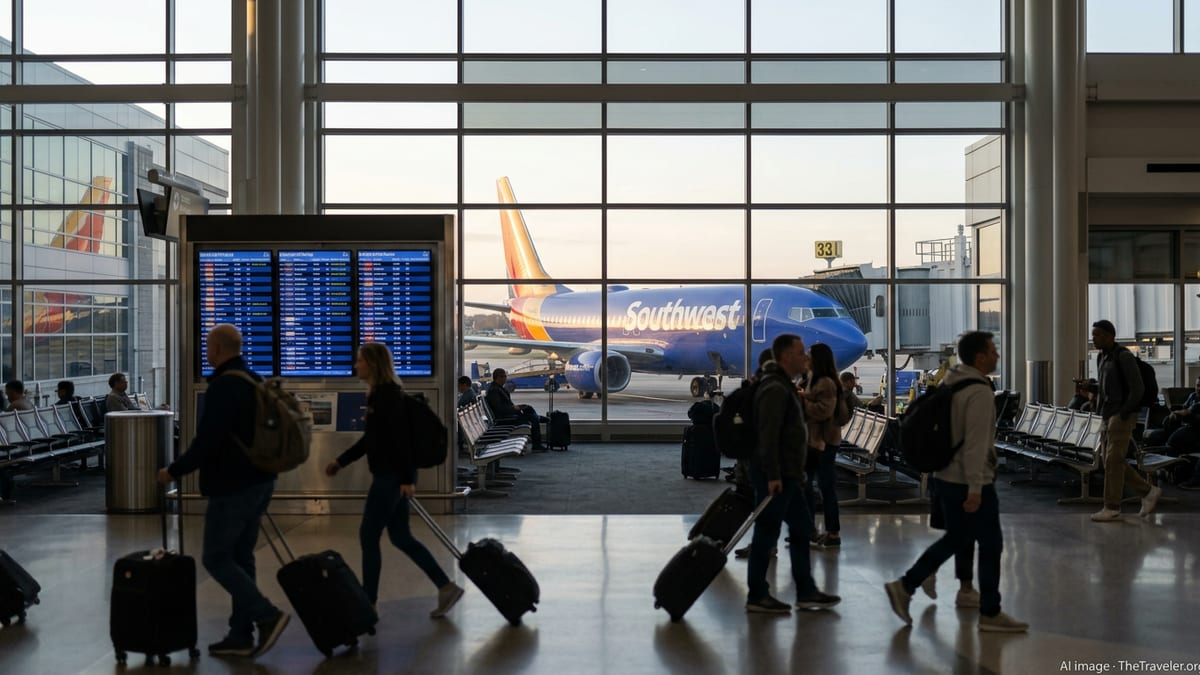
Investor Spotlight On Southwest’s Next Phase
The J.P. Morgan Industrials gathering has become a key stage for major U.S. airlines to outline their near term expectations, and Southwest’s appearance is drawing heightened attention after a period of volatile demand and shifting strategy. The carrier has spent the past two years recalibrating its model in response to softer leisure bookings, higher labor and fuel costs, and operational pressures that affected much of the industry.
Publicly available conference materials from last year’s J.P. Morgan session showed Southwest using the venue to discuss a multi year effort to boost revenue and efficiency, including new product initiatives and cost controls. This year’s discussion is expected to build on those themes, while updating investors on how demand is tracking in early 2026 and how recent strategic moves are resonating with customers.
Market observers note that the J.P. Morgan event typically helps set the tone for airline stocks heading into the busy spring and summer travel seasons. Any shift in Southwest’s unit revenue outlook, capacity plans, or cost guidance could influence how analysts view the carrier’s ability to convert strong passenger volumes into sustainable profitability.
Travel Demand Signals Heading Into 2026
Industry data suggest that overall airline demand is entering 2026 from a position of relative strength, even as economic uncertainty remains. Research from major banks and industry groups indicates that both leisure and corporate travel have largely recovered from earlier downturns, with corporate travel managers signaling expectations for higher passenger volumes and elevated airfares this year.
For Southwest, a carrier heavily exposed to U.S. domestic and near international leisure travel, the key question is how resilient discretionary demand will be if broader economic conditions remain uneven. In 2025, airlines reported periods of softening domestic leisure bookings, particularly at lower fares, as consumers became more price sensitive. Southwest has been working to balance that trend with targeted fare actions, loyalty program adjustments, and expanded distribution through global booking systems.
Travel analysts expect the J.P. Morgan appearance to provide fresh commentary on booking curves for spring and summer 2026, including how far in advance travelers are committing to trips and which regions are outperforming. Any indication that demand is holding up for key vacation corridors, such as Florida, the Mountain West, Hawaii, Mexico, and the Caribbean, would be watched closely by both investors and tourism stakeholders.
Network, Product Changes And What They Mean For Travelers
Southwest enters this year’s J.P. Morgan conference amid notable changes to its business model that will shape the travel experience over the next several seasons. Company filings and investor presentations show that the airline has begun rolling out assigned and extra legroom seating, a significant shift from its long standing open seating approach. The move is aimed at aligning more closely with traveler preferences and unlocking additional revenue per seat.
At the same time, Southwest has been expanding its network, adding new airports and routes for 2026 while maintaining a largely domestic and near international footprint. The carrier now serves more than 100 destinations across the United States, Puerto Rico, Mexico, Central America, and the Caribbean, and continues to rely on its point to point network to offer frequent nonstop options between mid sized cities that may be underserved by larger global competitors.
Travelers can also expect more changes behind the scenes. Southwest has been investing in updated technology, faster turn times at airports, and expanded participation in global distribution systems used by travel management companies and online agencies. The J.P. Morgan presentation is likely to highlight how these steps are intended to capture higher yielding corporate and managed travel while preserving the airline’s appeal to price conscious vacationers.
Revenue Priorities In A Competitive Market
Financial disclosures in recent quarters underscore that Southwest, like many peers, is focused on lifting margins rather than simply growing capacity. Management has been targeting revenue initiatives ranging from fare segmentation and premium seating to refinement of its co branded credit card and vacation packaging. Previous J.P. Morgan conference materials pointed to a multi year “North Star” goal for returns on invested capital, with 2026 emerging as an important milestone.
Against a backdrop of rising costs and limited aircraft deliveries, the airline is expected to use the conference to update investors on how these initiatives are tracking. Topics likely to draw attention include trends in ancillary revenue, the contribution from assigned seating and other product enhancements, and the performance of recently launched routes. Analysts will also be weighing any commentary on cost savings efforts, including efficiency gains in operations and technology.
For travelers, these revenue priorities can translate into a mix of modestly higher average fares, new fee based options, and more differentiated seating choices, alongside continued efforts to promote fare sales and loyalty rewards. The balance Southwest strikes between preserving its reputation for value and pursuing higher revenue per passenger will be a central theme as it outlines its outlook at the J.P. Morgan event.
Why The J.P. Morgan Outlook Matters For Destinations
The signals Southwest sends at the J.P. Morgan conference extend beyond investors and into the tourism economies that rely on the carrier’s dense domestic network. Many U.S. and near international destinations depend on Southwest’s point to point routes for a substantial share of inbound leisure visitors, especially in secondary cities and resort areas that lack extensive service from larger global carriers.
If the airline emphasizes continued growth into vacation markets, stable capacity, and constructive demand trends, local tourism boards and hospitality businesses may take that as a positive indicator for hotel occupancy, rental demand, and visitor spending through 2026. Conversely, any suggestion of capacity pullbacks on underperforming routes or a shift of aircraft into more business heavy corridors could prompt destinations to revisit their own marketing and air service strategies.
As Southwest details its travel outlook at the J.P. Morgan event, destination marketers, hotel groups, and airport authorities will be parsing the same data points as Wall Street. The carrier’s view on leisure demand, corporate travel recovery, fuel and cost pressures, and network growth will help shape how travelers move across the United States and nearby leisure regions in the coming year.