

More news on this day
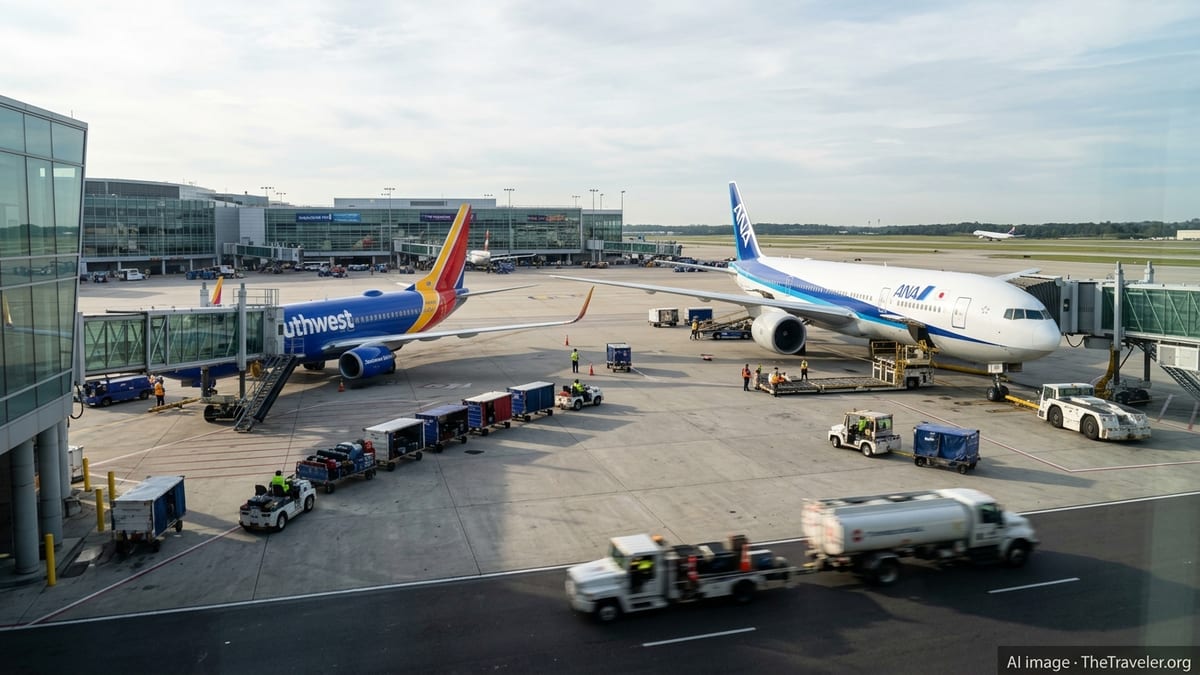
Southwest Airlines and All Nippon Airways have launched a new interline partnership that creates streamlined connections from U.S. cities to Japan and onward across Asia, marking a significant shift in how many American travelers can reach the region.
Get the latest news straight to your inbox!
A New Phase in Southwest’s International Strategy
Publicly available information indicates that Southwest has been steadily building a portfolio of interline partners to extend its reach beyond North America, and All Nippon Airways now appears among those partners. Recent updates to Southwest’s network descriptions and industry reporting list ANA alongside carriers such as Icelandair and several transpacific airlines, signaling a strategic push to give Southwest customers structured access to long-haul international routes.
For Southwest, which historically focused on domestic and near‑international flying, formal cooperation with a major Japanese carrier represents a notable evolution. The airline has traditionally avoided complex global partnerships in favor of a point‑to‑point model, but recent disclosures describe an initiative to grow international connectivity through interline agreements. ANA’s addition aligns with that strategy, particularly for demand to Northeast Asia where Japan serves as a critical gateway.
On ANA’s side, the partnership complements a global network that already relies on feeds from numerous North American carriers. ANA is a key player at Tokyo’s major airports and operates an extensive schedule across Japan and Asia. By adding Southwest as an interline partner, ANA gains structured access to a large secondary and mid‑size city footprint in the United States that previously required patchwork solutions or separate tickets for many travelers.
Industry analysts view this move as part of a broader trend in which large domestic carriers without long‑haul fleets are turning to interline and similar arrangements instead of full codeshares. This allows airlines like Southwest to expand choice for customers without committing to their own widebody aircraft or complex joint ventures.
What the Interline Deal Means for U.S. Travelers
The new arrangement is designed to let travelers book itineraries that combine Southwest segments within the United States and ANA flights across the Pacific and within Asia on a single ticket, purchased via participating booking channels. Under a typical interline structure, this can mean one reservation record, coordinated schedules on select routes, and through‑checked baggage between the two airlines on eligible itineraries.
For passengers, the most immediate benefit is a smoother journey. Instead of buying separate tickets and manually re‑checking bags, eligible customers can in many cases check luggage at their Southwest departure airport and collect it at their final destination in Japan or elsewhere in Asia, subject to local customs and immigration procedures. This reduces the risk and cost associated with misaligned schedules, missed connections, or having to rebook a second, unrelated ticket after delays.
The partnership may also streamline irregular‑operations handling for interline itineraries. While specific reaccommodation policies vary by airline and ticket type, one‑ticket journeys typically make it easier for carriers and agents to adjust onward segments if a preceding flight is disrupted. Travelers connecting from Southwest to ANA at key U.S. gateways are therefore likely to have more integrated options in the event of schedule changes.
At the same time, the interline model remains more limited than a full codeshare or joint venture. Travelers should expect that loyalty program accrual and redemption across the two airlines will be narrower than within a single alliance structure, and not all connecting combinations will be available in every booking channel. For many U.S. travelers focused on convenience rather than complex mileage strategies, however, the simplified ticketing and baggage handling may be the most tangible gains.
Key Gateways and New Route Possibilities
Public discussion of the partnership and employee‑facing materials referenced in online forums indicate that early interline itineraries are available over several major U.S. gateways, including Honolulu, Seattle, San Francisco, Los Angeles, Chicago O’Hare, and Washington Dulles. These airports already host significant ANA operations and connect into Southwest’s domestic network, making them natural first points for coordinated schedules.
From these hubs, ANA operates nonstops to Tokyo and other Asian destinations, while Southwest feeds in passengers from dozens of U.S. cities. A traveler from a smaller market in the American Midwest, for example, could fly Southwest to Chicago and then connect onto ANA to Tokyo, continuing onward to cities across Japan or Southeast Asia, all on a single interline itinerary booked through eligible channels.
Honolulu stands out as a particularly important bridge, given its role as a leisure gateway and its strong existing connectivity to Japan. The interline deal allows Southwest’s extensive Hawaii network to plug more directly into ANA’s Japan services, providing new one‑ticket options for travelers beginning their journey on the U.S. mainland and connecting through the islands on the way to Asia.
Over time, industry observers expect that additional U.S. and Japanese cities could see more coordinated connecting opportunities as schedules are refined and booking platforms ingest the new partnership data. For now, the focus appears to be on high‑demand corridors where both airlines already have strong operations and passenger flows.
How Booking and Baggage Handling Are Expected to Work
Interline agreements typically function behind the scenes for many customers, but there are practical considerations for those planning trips. Travelers will generally need to search for itineraries that explicitly show both Southwest and ANA segments on the same ticket through participating travel agencies, corporate booking tools, or other enabled sales channels. Each airline maintains its own rules, so not every website or app will offer combined itineraries immediately.
Once booked, passengers on an interline itinerary can usually check in with the first operating carrier and receive boarding documents for all sectors, subject to airport capabilities. At eligible U.S. departure airports, this often means receiving boarding passes for both the Southwest domestic leg and the ANA long‑haul or regional segments, although some airports or systems may still require check‑in at a transfer desk.
Baggage rules on such trips are governed by international tariff and “most significant carrier” practices, meaning that ANA’s long‑haul allowances may apply in many cases, even when the journey begins on a Southwest flight. Travelers are advised to review baggage allowances and potential excess charges when booking, as well as airport‑specific guidance for transfers at hubs such as Tokyo Haneda and Narita where procedures can differ between international and domestic segments.
Connection times also remain an important factor. While the interline agreement enables technical connectivity, each airport has its own minimum connection standards, and travelers routing through busy hubs during peak hours may wish to allow additional time for immigration, security, and terminal changes. Practical experience shared in traveler forums suggests that generous buffers are especially valuable when pairing a domestic arrival with a same‑day transpacific departure.
Competitive and Market Implications in the U.S.–Asia Corridor
The alignment between Southwest and ANA alters the competitive dynamics of travel between the United States and Asia, particularly for passengers originating in secondary U.S. cities that are not served by long‑haul carriers. Until now, many travelers in those markets relied primarily on the big three U.S. network airlines and their alliances to reach Japan and beyond. The Southwest–ANA tie‑up introduces a new pathway that leverages Southwest’s scale without requiring it to operate its own transpacific flights.
This development could pressure other carriers to refine their own connectivity strategies, especially in regions where Southwest holds large domestic market share. In cities where Southwest dominates short‑haul traffic, ANA may now be able to attract customers who previously defaulted to a different alliance simply because it was easier to book a single through ticket.
From a broader market perspective, the interline deal also fits into a pattern of airlines forming flexible partnerships rather than fully integrated alliances. For travelers, that can translate into more choice and potentially more competitive pricing on certain city pairs, even if loyalty benefits remain fragmented. For airports, expanded feed from Southwest to ANA may support higher passenger volumes on transpacific services, particularly at gateways where both carriers are investing in growth.
As booking platforms and corporate travel programs update their systems to reflect the new partnership, U.S. travelers are expected to see a wider range of Japan and Asia options surface in search results, anchored by Southwest’s dense domestic network and ANA’s role as a leading Asian hub carrier.