

More news on this day
Southwest Airlines is tearing up some of the core traits that defined its brand for decades, rolling out assigned seating, premium cabin layouts and ultra-fast Starlink WiFi in a sweeping bet that today’s travelers care more about comfort, connectivity and control than nostalgic quirks like open seating. The move has sparked a fierce debate over whether the Dallas-based carrier is making a visionary upgrade or risking the secret sauce that made it a cult favorite.
A Radical Break With the Southwest Playbook
For more than 50 years, Southwest Airlines stood apart from its rivals with a simple promise: open seating, quick boarding, and a one-size-fits-all cabin that felt unconventional but efficient. That era officially ends on January 27, 2026, when all Southwest flights transition to assigned seats, marking one of the most consequential strategic pivots in the airline’s history.
Under the new model, customers will choose specific seats when they book tickets for flights departing January 27 and beyond. The change has been in the works for years, tested in simulations and focus groups and previewed at investor events. Southwest executives argue that the old first-come, first-served seating system was polarizing and a turnoff to many travelers who prefer certainty, especially families and business flyers.
Internally, the shift is framed not as an abandonment of Southwest’s identity, but as an evolution. The airline insists that its hallmarks of friendliness, relatively straightforward pricing and a single aircraft type will remain intact, even as it borrows more from the mainstream playbook of its competitors.
Externally, though, the reaction has been sharply divided. Loyalists who once celebrated the ritual of jockeying for early boarding positions say the airline is erasing what made it unique. Others, particularly occasional travelers, say it is about time Southwest moved into line with the rest of the industry.
From Open Seating to Seat Maps and Premium Zones
The seating overhaul is not just about assigning passengers to rows. Southwest is redesigning the entire cabin, introducing new seats and distinct zones that create, for the first time, meaningful differences in the onboard experience. The most noticeable shift will be the arrival of extra legroom sections, with rows spaced at around 34 inches and positioned in the front and middle of the cabin.
Those roomier seats, paired with refreshed color schemes and materials, are part of a broader fleet modernization that began with the first Boeing 737 MAX deliveries featuring RECARO-designed interiors in late 2025. New cabins bring adjustable headrests, slimmer but more contoured cushions, and power outlets at every seat, along with larger overhead bins designed to swallow more standard carry-on bags.
Southwest has also built a new fare structure around these physical changes. Four main bundles, branded as Basic, Choice, Choice Preferred and Choice Extra, are intended to give travelers a clearer menu of options. Passengers who pay more can secure premium seat locations and better boarding positions, while Basic buyers will face more restrictions and less flexibility, especially around advance seat selection.
In practice, this creates a hierarchy that did not exist in the old Southwest cabin, where every seat was technically identical and strategy mattered more than spending. Now, money and status will more directly determine where and how people sit, a shift that aligns Southwest with competitors but risks alienating customers drawn to its egalitarian image.
Starlink and Free WiFi: A Connectivity Leap
If the seating changes are controversial, the connectivity upgrade is far easier to sell. Southwest confirmed this month that it will begin installing Starlink, the satellite internet system engineered by SpaceX, across its fleet beginning this summer. The airline is promising what it calls the fastest WiFi in the sky, designed to let passengers stream video, join video calls, game and work from gate to gate.
Starlink will build on Southwest’s recent decision to offer free inflight WiFi to members of its Rapid Rewards loyalty program, a perk that rolled out across more than 800 aircraft in late 2025 through a partnership anchored by T-Mobile. Membership in Rapid Rewards is free, making the benefit broadly accessible and turning connectivity into a powerful incentive to join the program.
The combination of free access and significantly higher speeds positions Southwest near the front of the pack in onboard internet, an area where it once lagged behind. Previous WiFi offerings often frustrated customers with slow speeds and inconsistent coverage. By contrast, Starlink’s low-earth-orbit constellation is designed to deliver low-latency, broadband-level performance even on long overwater routes.
For business travelers, the change could reshape perceptions of Southwest, which has historically marketed itself as a leisure-friendly, budget-conscious carrier. Reliable, free WiFi that can handle video conferencing or large file transfers could make the airline more attractive to corporate road warriors who previously avoided it on productivity grounds.
Power, Devices and the New Cabin Experience
Connectivity upgrades will be supported by physical changes throughout the cabin. Newly delivered and retrofitted aircraft are being equipped with power at every seat, including both USB-A and USB-C outlets, a response to the reality that most passengers now rely on their own phones and tablets for entertainment.
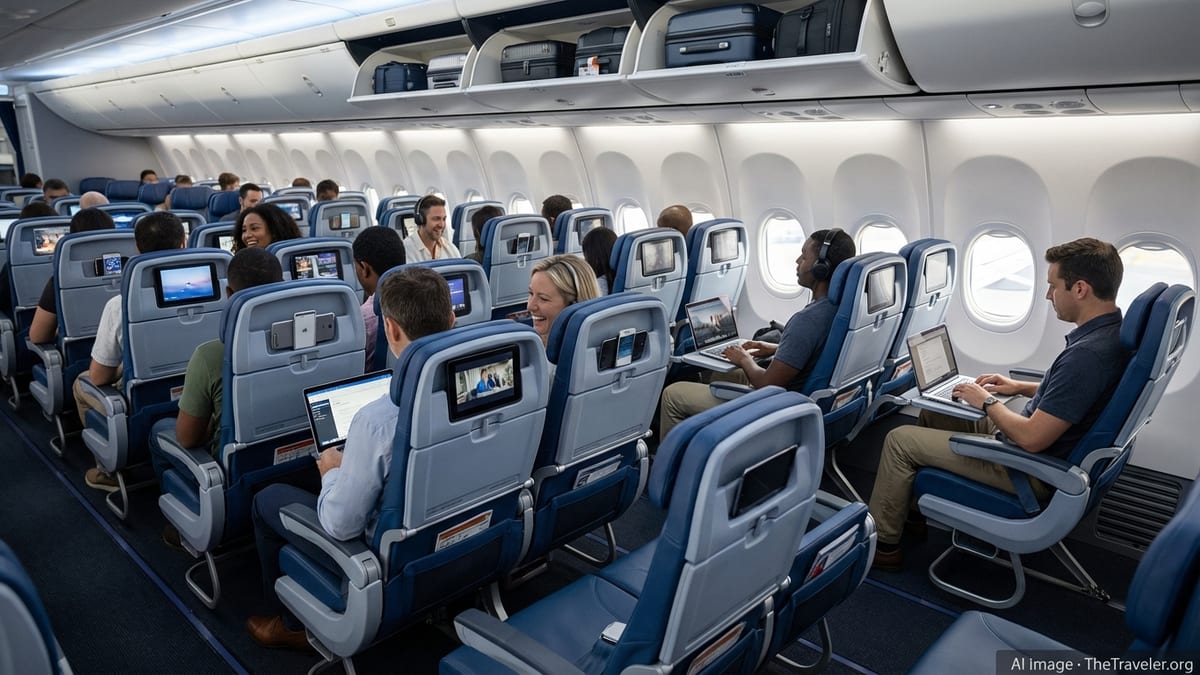
Seatbacks are gaining integrated device holders that can accommodate everything from smartphones to large tablets, effectively turning personal electronics into makeshift screens without the expense and weight of built-in entertainment systems. Larger, reshaped tray tables and reworked under-seat storage areas are intended to make it easier for travelers to work on laptops or juggle devices alongside drinks and snacks.
Lighting and design elements are also changing. Cabin renderings and early customer photos show more muted shades of blue replacing the brighter tones that once dominated Southwest interiors. Carpeting and wall panels are being refreshed to create what the airline describes as a more modern, calming aesthetic that still nods to its heritage without feeling dated.
Together, these design choices push Southwest closer to the look and feel of a contemporary mainstream carrier, while still staying within the constraints of a single-class, 3–3 configuration on all Boeing 737 aircraft. It is a carefully calibrated modernization meant to improve comfort without adding the cost and complexity of multiple cabins.
Customer Backlash and the Risk to Brand Loyalty
The biggest open question is not whether the new seats and WiFi will work technically, but how much they will cost Southwest in terms of goodwill. In recent weeks, the airline has faced a visible wave of criticism online as details of the assigned seating rollout and related policy changes have filtered into the public conversation.
Stories of families struggling to sit together under the new system have quickly gone viral, with social media posts showing toddlers initially assigned away from parents on crowded flights. While those incidents have typically been resolved by other passengers offering to swap seats, they have fueled concerns that the new process reduces Southwest’s once-reliable ability to keep groups together through early check-in and smart boarding strategies.
Another flashpoint has been the carrier’s updated rules for travelers who require additional space, who will now be required to purchase two seats in advance if they encroach on an adjacent seat. Advocates say the policy makes travel more burdensome for plus-sized passengers and undermines a long-standing area where Southwest had been viewed as more accommodating than its rivals.
Some longtime customers frame the combined changes as evidence that Southwest is abandoning the informality and perceived fairness that once distinguished it. Critics compare the transformation to high-profile brand missteps in other industries, warning that the airline runs the risk of becoming just another carrier in a crowded market if it erodes too many elements of its original personality.
Wall Street Cheers While Travelers Debate
Investors, however, are signaling strong support. Financial analysts have argued that assigned seating, premium sections and WiFi enhancements create powerful new revenue streams without fundamentally changing the cost base of operating a single-fleet, point-to-point network. Some estimate that paid seat upgrades and new baggage and ancillary fees could generate billions of dollars in additional annual revenue once fully implemented.
Those projections have led at least one major firm to upgrade Southwest stock in recent days, citing the potential for higher earnings as the new policies ramp up. Confidence on Wall Street has been buoyed by record revenue figures in 2025 and a stock price that has climbed alongside expectations that the airline will be able to monetize its larger customer base more aggressively.
For corporate buyers and travel managers, the arrival of assigned seating and a more stratified cabin may even simplify negotiations and policy design, since Southwest will look and operate more like its peers. Premium seats can be slotted into familiar categories for reimbursement and status qualification, while free, high-speed WiFi becomes a tangible benefit that employers can factor into their travel programs.
The risk is that financial gains come at the expense of customer sentiment, particularly among leisure travelers and small-business owners who were drawn to the carrier’s once-unorthodox approach. Southwest is betting that, over time, improved comfort and connectivity will outweigh backlash over lost traditions.
Will the Strategy Pay Off in the Cabin?
Whether these moves are a masterstroke or a miscalculation will ultimately be decided row by row, flight by flight. If Starlink’s performance matches the marketing, if power outlets work reliably, and if the new seats feel meaningfully more comfortable on three-to-five-hour journeys, many passengers may come to view the changes as overdue improvements rather than betrayals.
Operational execution will be equally critical. Assigned seating must not significantly slow boarding or create chronic overhead bin shortages, and the airline will need robust systems to keep families with young children seated together even at lower fare tiers. Anything less will feed a narrative that Southwest traded simplicity for complexity without sufficient payoff.
The carrier’s leaders frequently note that customer research shows strong broad-based preference for assigned seats and more choice, even among travelers who once tolerated or enjoyed the open-seating scramble. That data underpins their confidence that, despite vocal online opposition, the silent majority will embrace a more conventional but more customizable flying experience.
In that sense, Southwest’s latest reinvention is a high-stakes wager on what modern travelers value most. If the blend of faster WiFi, refreshed cabins and clearer seat options resonates, the airline could emerge with a stronger, more profitable product that still feels distinct enough to stand out. If not, critics may look back on this moment as the one when Southwest traded in its quirky charm for a more generic seat in the sky.