

More news on this day
Rolling disruptions across the US aviation system in early 2026 have left Southwest Airlines facing a wave of regional delays at key hubs, stranding thousands of travelers and underscoring how quickly routine weather and congestion can cascade into large-scale gridlock.
Get the latest news straight to your inbox!
Weather Turbulence Turns Routine Days into Systemwide Snares
Publicly available tracking data for January through March 2026 show that a series of winter storms and severe weather outbreaks set the stage for repeated nationwide flight disruptions. Major events in late January, late February and mid March brought blizzard conditions, ice and high winds to large portions of the country, pushing airports and airlines to the edge of their operating capacity.
Southwest, which operates dense schedules through airports such as Chicago Midway, Dallas Love Field, Denver, Phoenix and Las Vegas, has been repeatedly listed among the most affected carriers during these episodes. Industry summaries for March alone point to multiple days when Southwest logged some of the highest delay counts in the country as thunderstorms and low clouds triggered ground stops at hubs including Chicago and Atlanta, with knock-on effects in the Southwest network.
In several cases, the worst disruptions did not come from a single catastrophic outage, but from persistent, overlapping storms. A late winter blizzard across the Midwest and High Plains in mid March, following earlier systems that swept the South and Northeast, limited runway capacity and lengthened deicing operations. As schedules backed up, aircraft and crews ran out of position, fueling rolling delays that lasted well beyond the immediate weather window.
Travel-focused outlets tracking same-day data have highlighted how these storms translated into concrete numbers on departure boards. On some of the most heavily affected March days, Southwest alone was associated with hundreds of delayed flights across the system, contributing to nationwide tallies of several thousand delays and hundreds of cancellations. Those figures translate directly to hours spent in terminals for passengers holding Southwest tickets at busy hubs.
Regional Chokepoints at Key Hubs Amplify Southwest Disruptions
While delays have been spread across the national network, a handful of regional chokepoints have emerged as particular pain points for Southwest customers in 2026. Operational reports in March described severe congestion at Chicago-area airports after storms and low visibility restricted takeoffs and landings. One travel industry summary noted that an early March weather system helped push Chicago to the top of global delay rankings on a single day, with Southwest among the carriers issuing travel alerts and cutting flights at the city’s major airports.
Further west, Phoenix Sky Harbor has seen its own share of turbulence. Local coverage of a March disruption at Phoenix cited more than one hundred combined delays and cancellations across airlines, with Southwest listed among those experiencing “substantial impact.” Because the carrier uses Phoenix as a key link for routes into California, the Midwest and Texas, delays there rippled outward to destinations including Los Angeles, Denver, Las Vegas and Dallas, where already tight turn times left little buffer for recovery.
On the East Coast, New York’s LaGuardia Airport has also featured in recent disruption tallies. A late March storm and air traffic constraints produced a spike in cancellations and delays at LaGuardia, and aviation trackers noted that Southwest, while smaller there than at its western strongholds, still recorded dozens of late operations. When delays stack up simultaneously at LaGuardia, Chicago and Atlanta, connective tissue in the broader US network frays and Southwest’s high-frequency schedule becomes more vulnerable to rolling disruption.
These regional chokepoints disproportionately affect travelers at nearby hubs. Passengers starting their journeys in places like Phoenix or Chicago may never fly through the exact airports where storms are at their worst, yet they feel the impact in the form of rolling departure pushes, aircraft swaps and missed evening connections as the day’s problems migrate west with the schedule.
Southwest’s Point-to-Point Model Under Pressure
Southwest has long promoted its point-to-point network as a strength, allowing customers to bypass traditional hub-and-spoke congestion. In practice, however, recent disruptions highlight how that model can also spread localized issues across a wider map. Aviation analyses and academic work on delay propagation in US air traffic networks note that when widely used carriers experience bottlenecks at several busy stations at once, individual late flights can quickly cascade into broader schedule instability.
Publicly available commentary by travel analysts emphasizes that Southwest aircraft typically perform multiple short- and medium-haul legs per day. If a morning departure from a weather-affected city leaves an hour late, that delay often travels with the aircraft to its next stops, creating compounding issues by afternoon. Even modest initial disruptions can therefore leave evening flights several hours behind schedule, forcing cancellations when crew duty limits are reached.
Data snapshots from March 2026 make this dynamic visible in real time. On days when severe weather triggered a few hundred cancellations nationally, delay counts often rose into the several thousands, with Southwest frequently near the top of the delay tables. In effect, each grounded or slowed aircraft created its own moving pocket of disruption as it circled the network, challenging the airline’s ability to reabsorb shocks before the end of the operating day.
These pressures come on top of structural challenges that Southwest has been working to address since its high-profile operational collapse during the 2022 holiday period. Company reports in recent years have described new investments in weather resilience and operational technology, but the early 2026 pattern suggests that extreme conditions and dense schedules remain a difficult combination to manage consistently.
Passengers at US Hubs Confront Long Lines and Limited Options
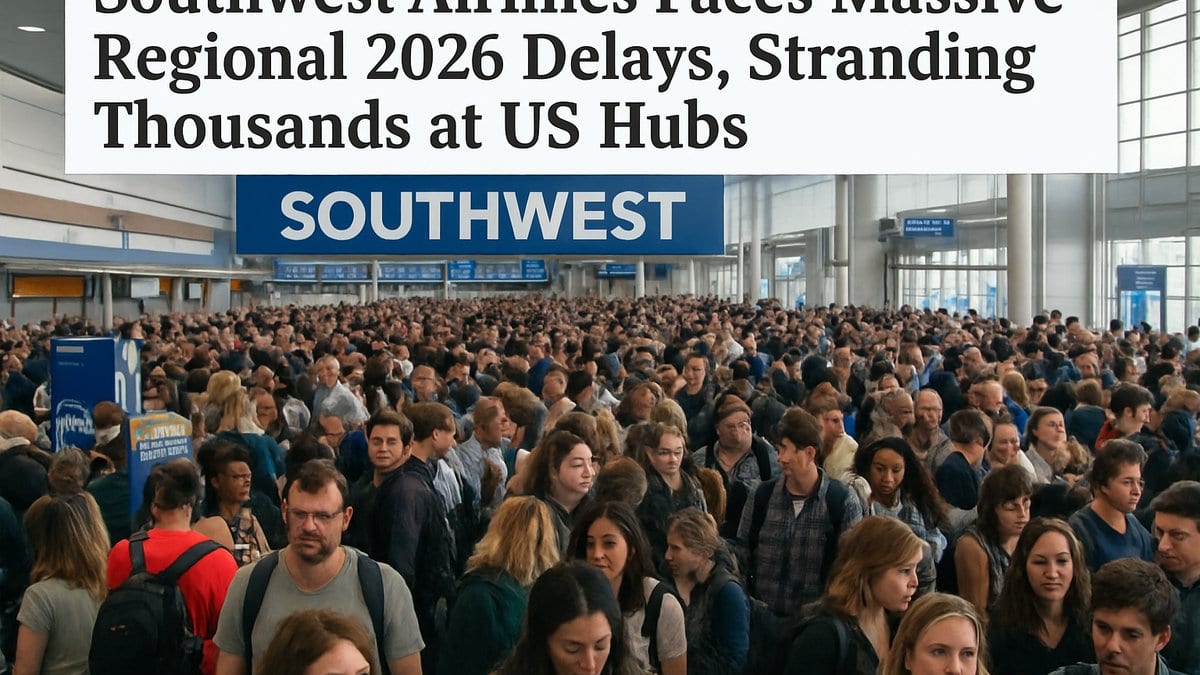
For travelers, the operational story translates into very tangible experiences at airport gates across the country. Images and accounts gathered by travel publications from March 2026 show crowded concourses at airports such as Phoenix, LaGuardia and Chicago, with passengers queueing for rebooking help as departure boards fill with red delay markers. With multiple major airlines operating at or near capacity, alternative same-day routing options can be scarce once disruptions reach a certain scale.
Reports indicate that thousands of passengers have been caught up in these rolling disruptions during the busy late winter and early spring travel period. Southwest’s role as a leading domestic carrier means that even on days when weather-driven cancellations are distributed across several airlines, its customers often form a large share of the stranded population at affected hubs.
Consumer advocates and travel advisers continue to direct affected passengers to the federal passenger rights framework and individual carrier policies, which spell out what travelers can expect in terms of meal vouchers, hotel assistance and rebooking options when delays stretch into overnight territory. However, those protections vary depending on whether disruptions are classified as within an airline’s control or primarily weather-related, leaving many Southwest customers in a gray area when severe storms are the initial trigger.
The timing of this latest wave of disruptions is especially challenging for leisure travelers and families using Southwest for spring break itineraries. With some popular routes already operating near full capacity, rebooking can involve long layovers, detours through unfamiliar hubs or travel pushed to the next day, extending what was intended as a short getaway into a multi-day ordeal in airport terminals.
What the Latest Disruptions Signal for the 2026 Travel Season
For the broader US travel landscape, Southwest’s recent regional delays raise questions about how airlines and airports will cope with the remainder of the 2026 peak seasons. Early-year data indicate that even outside headline-making storms, a combination of tight schedules, labor and equipment constraints, and increasingly volatile weather is keeping on-time performance under pressure across many carriers.
Industry researchers studying delay patterns across the US network have highlighted how high-volume hubs and complex schedules can create self-reinforcing bottlenecks. When several large nodes experience reduced capacity at once, the system becomes more prone to extreme outcomes, even if the initial disruptions are relatively modest by historical standards. That framework helps explain why a cluster of severe weather events this year translated into so many stranded passengers at Southwest stations and other airline hubs.
For Southwest specifically, the months ahead will test whether investments in resiliency, scheduling tools and customer communication can blunt the impact of similar events later in the year. Summer heat, convective storms and the Atlantic hurricane season typically add further stress to aviation operations, and early 2026 has already demonstrated how fragile the balance can be during busy periods.
Travelers planning to rely on Southwest for regional hops between US hubs may respond by building in more buffer time, choosing earlier departures and monitoring weather patterns more closely around their travel dates. The latest disruptions suggest that while individual storms and systems may be short-lived, their effects on major carriers and their customers can persist far longer, shaping expectations for the entire 2026 travel season.