

More news on this day
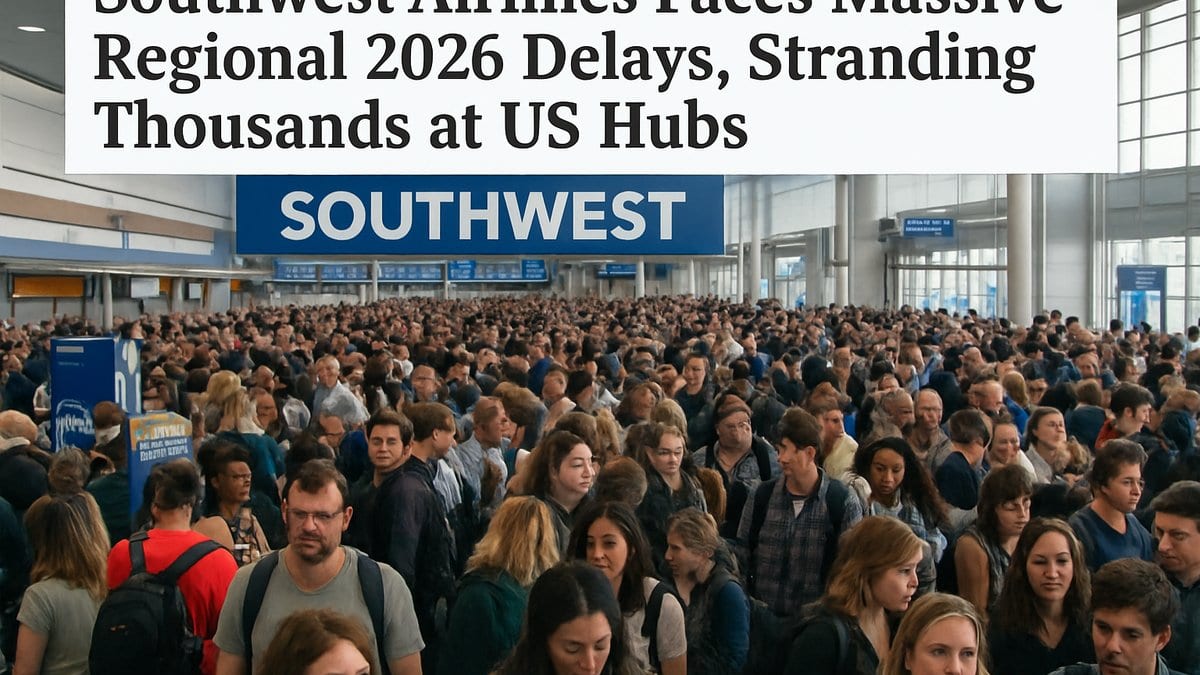
Thousands of Southwest Airlines passengers across the United States are facing hours-long delays in early 2026 as storms, ground stops, and network bottlenecks ripple through some of the carrier’s busiest airports.
Get the latest news straight to your inbox!
Stormy Start to 2026 Creates Prolonged Flight Backlogs
A turbulent winter and early spring have set the stage for widespread schedule disruptions across the US airline system in 2026, and Southwest Airlines has been among the hardest hit. Powerful winter systems, including Winter Storm Fern in January and a major March blizzard across the central United States, triggered large waves of delays and cancellations that continue to echo through the carrier’s point-to-point network.
Publicly available data from national flight trackers in mid-March showed that Southwest, along with several other large carriers, delayed or canceled close to half of its schedule on some days as severe weather swept through Texas, the Mid-Atlantic, and the Southeast. The Federal Aviation Administration responded with ground delay programs at heavily used airports, compounding congestion as aircraft and crews fell out of position.
Even as the most intense storms moved on, the recovery period stretched over several days at a time. Travelers reported extended waits at gates, rolling departure estimates, and difficulty securing alternative routings when flights were scrubbed late in the boarding process. Because Southwest’s model relies on high aircraft utilization and frequent turns, early-day disruptions in one region often cascaded into evening gridlock hundreds of miles away.
By late March, the combination of repeated weather events and residual operational strain had turned what might normally be short-lived interruptions into recurring regional logjams that left thousands of Southwest customers effectively stranded at large US airports.
Major Focus Cities Bear the Brunt of Regional Disruptions
While Southwest does not operate a traditional hub-and-spoke system, several large focus cities have emerged as de facto connection points, and these airports have experienced some of the worst bottlenecks. Airports in Texas and the Mid-Atlantic, along with busy gateways in the Northeast and Southeast, have seen multiple rounds of ground stops and lengthy arrival and departure holds tied to storms and airspace constraints.
In mid-March, national coverage of a severe weather outbreak described extensive delays at New York and Washington airports, as well as at major Southern and Gulf Coast gateways. Southwest, which runs dense schedules through cities such as Baltimore, Houston, and Orlando, saw a substantial share of its flights caught in these traffic management programs. Passengers on through itineraries often missed onward legs when inbound flights landed hours behind schedule.
Travel reports have also highlighted strain at Midwest airports used by Southwest as large focus operations. When snow and high winds limited runway capacity at central US fields, departures to and from the region backed up throughout the day. With aircraft tied up on the ground and flight crews bumping against duty-time limits, later services into secondary cities were delayed or scrubbed, leaving travelers stuck at larger stations where they had not intended to overnight.
As these episodes accumulated through January, February, and March, Southwest’s regional pattern resembled a rolling disruption centered on its busiest US nodes rather than a single isolated meltdown. For passengers on multi-segment journeys, each new weather system carried the risk of being stranded at an intermediate airport with limited same-day alternatives.
Slow Recoveries Highlight Ongoing Network Vulnerabilities
The recent waves of disruption have exposed familiar vulnerabilities in the US airline system, with Southwest’s operational design under particular pressure. The carrier’s point-to-point network enables frequent nonstop service between smaller city pairs, but it also leaves less slack when things go wrong. Aircraft that start the day late often never catch up, and flights that depend on the same jet later in the schedule can be delayed even in regions where weather has already improved.
Industry analyses released after January’s storms noted that early-morning departures remained the most reliable, while mid-day and evening flights became increasingly susceptible to knock-on delays. Advisory documents circulating among travelers in early 2026 explicitly recommended selecting the first departure of the day from busy Southwest stations and considering nearby secondary airports where congestion might be lower.
Publicly available data and traveler accounts suggest that recovery windows have sometimes stretched into a second or third day following the worst weather outbreaks. Even when flight counts begin returning to normal, residual crew shortages, repositioning flights, and aircraft awaiting maintenance inspections can limit flexibility, particularly on shorter regional routes that rely on frequent daily service.
For Southwest customers, this has meant that a nominally short domestic trip can turn into an overnight ordeal if a connection fails or a late-day departure is scrubbed. Crowded terminals, long customer-service lines, and high demand for nearby hotel rooms have become recurring features at several large US airports during each new wave of storms.
Passenger Impact: Long Lines, Limited Options, Rising Frustration
As these regional disruptions have played out across early 2026, the impact on passengers has been immediate and highly visible. Social media posts and local broadcast reports from multiple US cities describe scenes of long queues at Southwest service counters, packed gate areas, and departure boards dominated by yellow and red delay markers.
Travelers whose flights were canceled outright often encountered difficulty securing same-day alternatives, especially when disruptions affected multiple airlines simultaneously. With competing carriers also trimming schedules or operating with heavy loads, open seats on rival flights were scarce, and options for rerouting through less congested airports were limited.
Some consumer guidance articles circulating this year emphasize the importance of monitoring flight status closely, using airline mobile apps, and proactively rebooking at the first sign of cascading delays. They also underscore basic protections available when flights are significantly changed, including options for refunds or alternative itineraries in certain circumstances, although rules vary depending on the cause of the disruption and the specific fare purchased.
For travelers caught mid-journey at large Southwest stations, however, theoretical options have not always translated into practical solutions. When weather, staffing, and airspace restrictions converge over a wide swath of the country, large numbers of passengers can be left in limbo at the same time, overwhelming airport infrastructure and pushing rebooking timelines into the following day.
What Travelers Can Expect as Spring and Summer Approaches
Looking ahead to the remainder of 2026, publicly available forecasts suggest that seasonal thunderstorms and continued high travel demand could prolong a period of heightened disruption risk for US air travelers. For Southwest, which operates thousands of daily flights across more than 100 destinations, any renewed spell of severe weather at one or more key airports could again trigger regional delays that spread quickly through the network.
Travel and aviation analysts note that airlines, including Southwest, typically refine schedules and add reserve capacity heading into the peak summer season. However, when demand remains strong and capacity is tightly utilized, even modest operational shocks can lead to outsized effects on the day-of-travel experience.
Passenger advocates and travel guides are already advising Southwest customers to build additional buffer time into their itineraries for the coming months, especially when connecting to cruises, international departures, or time-sensitive events. They also encourage travelers to remain flexible about routings, consider nearby airports when practical, and keep documentation of delays and cancellations that may be relevant to any future reimbursement requests.
For now, the pattern emerging in early 2026 suggests that while the most acute storm-related meltdowns eventually pass, many Southwest passengers at major US airports are still facing an elevated risk of long delays, missed connections, and unplanned overnight stays as the year’s travel season unfolds.