

More news on this day
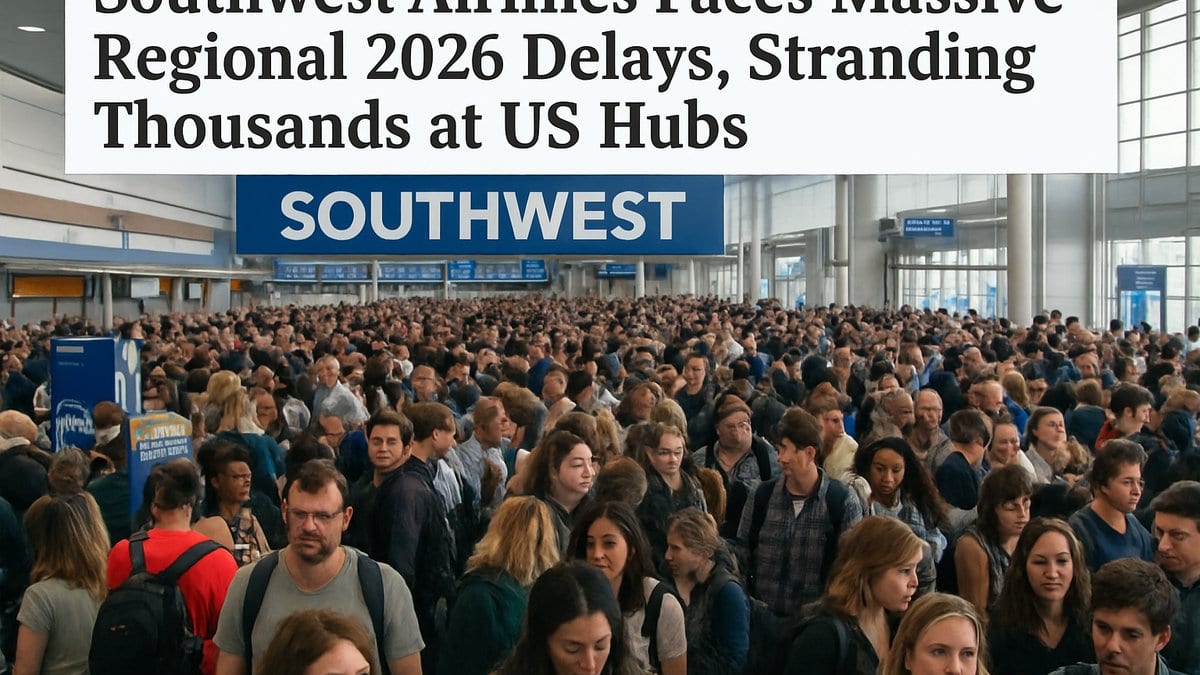
Southwest Airlines is grappling with rolling regional disruptions in early 2026, as a wave of delays and scattered cancellations at key US hubs strands thousands of travelers ahead of the spring travel rush.
Get the latest news straight to your inbox!
Wave of Disruptions Hits Major Southwest Strongholds
Recent disruption tallies across the United States indicate that Southwest has become one of the hardest hit carriers in the latest delay wave, particularly around the start of April 2026. Coverage of systemwide performance points to nearly 1,000 Southwest delays concentrated in a single high impact period, with clusters at Chicago Midway, New York LaGuardia, Los Angeles International and other high volume airports. These rolling delays have left departure boards dominated by late departures and have created long lines at rebooking counters as travelers attempt to salvage connections.
Regional breakdowns show that Texas and the wider central and eastern corridors have been persistent trouble spots. Aggregated data for the first days of April highlight nearly 400 delays across Dallas, Houston and San Antonio alone, affecting multiple airlines but hitting Southwest particularly hard at its base at Dallas Love Field and at nearby hubs in the state. Earlier in March, large scale weather systems and operational knock on effects had already produced days with more than 2,000 delays across the national grid, with Southwest frequently near the top of the carrier list by disrupted departures.
Observers note that these events do not match the complete collapse seen in Southwest’s December 2022 holiday meltdown, but the pattern in 2026 has been defined by repeated, regionally focused disruptions that ripple across the network for days. The result for passengers is often the same experience of crowded gate areas, rolling departure time changes and limited same day alternatives, particularly on busy weekend periods and peak spring break dates.
Network Structure Turns Local Weather Into Systemwide Gridlock
Publicly available analyses emphasize that the structure of Southwest’s route map remains a critical factor in how quickly small problems escalate. Unlike the traditional hub and spoke model used by some competitors, Southwest leans heavily on a point to point network with short ground times and high aircraft utilization. Industry commentators explain that when a storm band, ground stop or security slowdown disrupts one airport, the affected aircraft and crews often cycle into several more cities over the following 24 to 48 hours.
This operational design has amplified the impact of the March 2026 North American storm systems, which triggered extensive delays across the central United States and into coastal regions. As thunderstorms, high winds and blizzard conditions moved through major metros, flights that did depart often did so behind schedule, and crews bumped up against federally mandated duty time limits. Later in the month, additional severe weather days across large sections of the country again pushed delay counts higher, with Southwest logging several hundred late operations on the worst single days.
Analysts also point to structural strain in the broader US aviation network. Recent research into security and ground processing trends suggests that screening and ramp bottlenecks at high volume hubs are playing a growing role in departure delays, especially when traffic levels surge at the start and end of holiday periods. For a carrier like Southwest that relies on quick turn times, even modest slowdowns when boarding or unloading can ripple outward, particularly when every aircraft is scheduled almost continuously from early morning until late evening.
Stranded Passengers Confront Full Flights and Limited Options
Reports from airports including Chicago Midway, Phoenix, LaGuardia, Dallas area airports and San Diego describe concourses filled with stranded travelers in late March and early April. Images and traveler accounts compiled by travel outlets show long queues at customer service desks, passengers sleeping in gate areas and departure boards stacked with red delay indicators next to Southwest flight numbers. In many cases, same day alternative flights were fully booked, leaving disrupted customers with waits of 24 to 72 hours to secure new itineraries during peak periods.
Consumer advocacy coverage notes that Southwest generally seeks to delay rather than cancel flights when possible, a strategy that can keep itineraries technically intact but can also extend uncertainty for passengers. Rolling delay increments of 30 to 60 minutes have been common on some routes, according to traveler reports, complicating decisions about whether to wait, rebook or seek refunds. For customers with tight connections or fixed event dates, these gradual schedule slips can be as disruptive as outright cancellations.
Accounts from recent weekends indicate that customer support channels have struggled to keep up when disruption totals spike. Travelers have described spending extended periods on hold with call centers, only to find that rebooking inventory was already exhausted by the time they reached an agent. While airline mobile apps and websites have absorbed some of the demand, heavy traffic during large disruption events has at times slowed online tools just as passengers most need rapid updates and self service rebooking options.
Operational Pressures and Financial Headwinds Collide
The operational difficulties of spring 2026 are unfolding against a challenging financial backdrop for Southwest. Market coverage in early April notes that the carrier’s share price has fallen by more than 20 percent over the past month, as jet fuel costs have spiked sharply following disruptions to global energy supplies. Analysts have warned that Southwest’s previously stated earnings targets for 2026, which were based on far lower fuel price assumptions, are increasingly difficult to achieve without either significant cost reductions or stronger revenue performance.
Separate labor communications indicate that Southwest is also in the midst of network and staffing adjustments. Recent union updates describe planned station closures and reductions in force at certain locations, part of a broader effort to realign the route map and reduce expenses. While these moves are intended to improve long term efficiency, they can add short term complexity to crew scheduling and aircraft routing, particularly when overlapping with severe weather events and strong seasonal demand.
Industry observers suggest that the combination of elevated fuel prices, staffing transitions, and infrastructure limits at crowded hubs leaves Southwest with narrower margins for error when disruptions strike. Investments in technology and recovery planning in the wake of the 2022 meltdown have improved some aspects of the operation, according to published assessments, but the carrier remains exposed when multiple stress factors converge in the same week.
What Travelers Can Expect Through Spring and Early Summer
Travel forecasters expect elevated risk of rolling delays to persist into the heart of the spring travel season if volatile weather and tight airline schedules continue. National delay statistics from late March and early April illustrate how quickly conditions can deteriorate on days when strong storm systems cross major population centers. On several recent dates, combined US disruption counts exceeded 2,000 delayed flights, with Southwest repeatedly ranking among the carriers with the highest absolute number of late departures.
Consumer guidance from travel publications emphasizes the importance of proactive planning for those booked on Southwest in the coming weeks. Recommendations include building in longer connection times, avoiding the last flight of the day when possible, and monitoring itineraries closely starting 24 hours before departure, since small early delays often signal broader network stress. Travelers are also encouraged to familiarize themselves with Southwest’s customer service policies, including meal vouchers, hotel coverage in specific circumstances and compensation practices for major controllable disruptions.
Regulatory frameworks and state level consumer laws continue to shape what assistance passengers can seek when stranded for many hours or overnight. While Southwest, like other US carriers, is not obligated to compensate for most weather driven disruptions, published policy summaries note that customers may have stronger claims when delays are tied to controllable factors such as crew scheduling or aircraft maintenance. As 2026’s disruption patterns evolve, advocates are watching closely to see how often passengers receive tangible support when regional delay clusters leave thousands stuck at Southwest’s busiest hubs.