

More news on this day
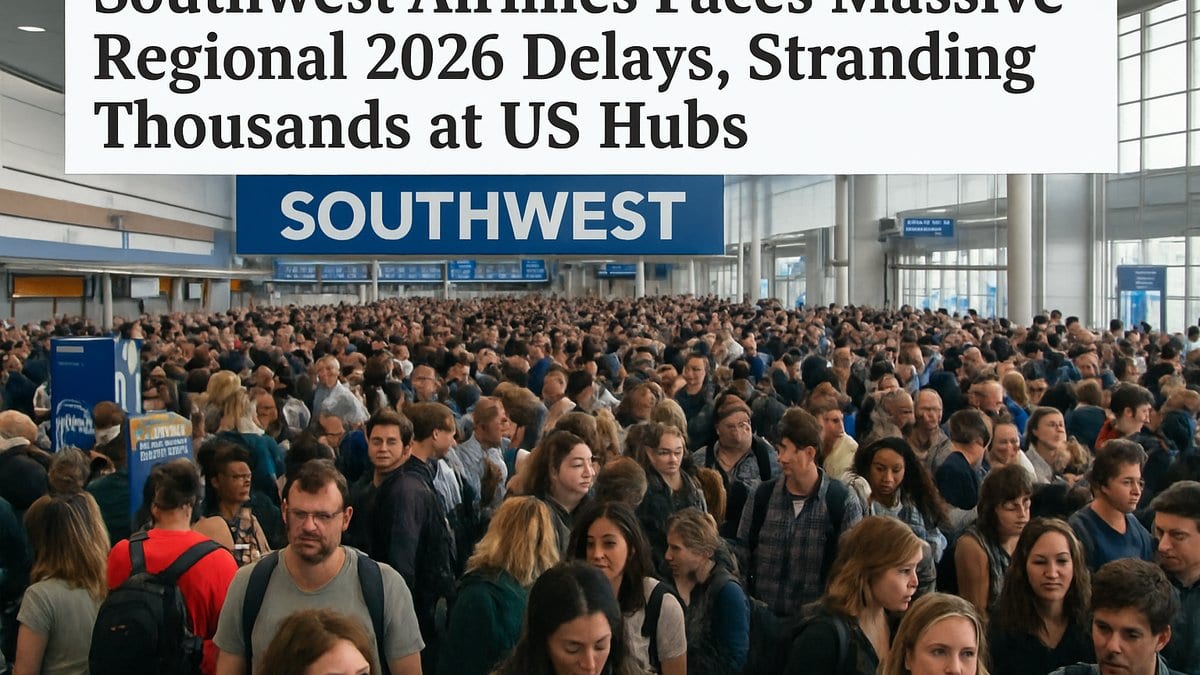
Southwest Airlines is contending with a wave of regional delays across the United States in early 2026, with severe weather systems, operational bottlenecks and hub congestion combining to strand thousands of travelers at key connecting airports.
Get the latest news straight to your inbox!
Weather Turbulence and System Strain Collide
A series of late winter and early spring storms in 2026 has put sustained pressure on the U.S. aviation system, and Southwest’s high-frequency point-to-point model has been particularly exposed. Publicly available flight-tracking data for March and early April indicate that the carrier has repeatedly appeared among the airlines with the highest volume of delayed departures, even on days when cancellation totals remained relatively low.
Coverage of nationwide disruption on March 31 describes more than two thousand delays across U.S. airports, with Southwest accounting for hundreds of those late operations while keeping cancellations to single digits. The pattern points to aircraft and crews still moving around the country, but often out of their planned sequence, triggering rolling holdups across the network rather than outright shutdowns of specific routes.
On several earlier March days, independent aviation trackers and travel-industry outlets highlighted Southwest as one of the most heavily affected carriers by delay counts. Reports describe storms and localized flooding in multiple regions that slowed traffic at major hubs, creating queues that extended into the evening and rippled into the next day’s schedules.
These conditions have amplified the structural challenges that follow any broad weather system: when aircraft and crews cannot be turned on time, knock-on delays compound throughout the day. For a carrier built around tight turns and frequent short-haul sectors, even modest schedule slippage at the start of the morning can cascade into substantial lateness across the network by late afternoon.
Regional Hubs Bear the Brunt
The strain has been particularly visible at Southwest’s core U.S. hubs and focus cities, where dense schedules magnify disruption. Network documents and airport traffic reports for 2026 show the airline operating large regional banks through Denver, Las Vegas, Phoenix, Dallas Love Field and Chicago Midway, with dozens of daily departures linking smaller markets to these centers.
During the late-March disruption period, travel-industry coverage points to Las Vegas and other leisure-heavy hubs among the airports experiencing extensive delay totals that affected multiple carriers, including Southwest. These hubs function as connection points for traffic from secondary and regional airports, meaning a single weather system or ground stop can interrupt journeys for travelers starting in cities across the Mountain West, Southwest, Midwest and South.
In parallel, airports such as Chicago and Boston were highlighted in early April reporting as key nodes in a broader national gridlock pattern, with Southwest again appearing among airlines with sizable delay volumes at those facilities. While the carrier maintains a relatively low cancellation rate in these snapshots, the high number of late flights has meant that passengers frequently face missed connections, forced overnight stays and unplanned rebookings, especially on itineraries that rely on tight connections through a single hub.
The situation is further complicated by forthcoming network changes. Separate industry analyses note that Southwest plans to cease operations at Chicago O’Hare and Washington Dulles in June 2026, consolidating its Chicago presence at Midway and reallocating capacity elsewhere. For regional travelers, the near-term effect is a system in flux, where delays at remaining hubs can feel more acute because there are fewer alternative connecting options within the same airline.
Thousands Stranded by Rolling Delays
While precise passenger counts are difficult to quantify in real time, recent national disruption summaries emphasize that the combination of severe weather and operational strain has affected thousands of travelers on days when Southwest’s delay totals have climbed into the hundreds. With aircraft and crews out of position, some passengers have experienced multi-hour waits on the ground, missed events and disrupted onward travel plans.
Travel sites tracking day-of-operation performance describe late-March and March 31 in particular as high-impact days for U.S. domestic flyers, highlighting a pattern in which overall cancellations remained in the low hundreds nationwide but delays topped the four-thousand mark across airlines. In this environment, a carrier with a large share of domestic departures, such as Southwest, inevitably sees a significant portion of its customers caught by the resulting congestion.
The travelers most exposed are those using regional links into major hubs, where a single missed connection can turn a manageable delay into an overnight stranding. Coverage from consumer-focused travel outlets describes passengers sleeping in terminals after late-evening departures were pushed beyond crew duty limits, as well as travelers unable to depart until the following afternoon while airlines worked through backlogs.
These experiences echo earlier disruption episodes for the carrier, including the high-profile 2022 holiday meltdown that triggered regulatory scrutiny of its technology and scheduling practices. While the current 2026 disruptions have different immediate causes and have not reached the same scale of cancellations, they have renewed attention on how quickly the airline can recover normal operations after a major weather event.
Operational Resilience and Regulatory Backdrop
The latest wave of delays is unfolding against a broader backdrop of questions over operational resilience in the U.S. airline industry. Federal regulators have already targeted individual carriers in recent years for what they describe as chronic delays on certain routes, and Southwest has faced legal action related to earlier disruption periods. Public enforcement records describe how regulators are increasingly focused on patterns where flights arrive late month after month, even outside of extraordinary weather.
Industry analysts observing the 2026 disruptions point to several persistent pressure points: tight staffing in ground and maintenance operations, aging technology at some carriers, and crowded airspace near major hubs. When severe weather intersects with any of these structural issues, even a modest schedule perturbation can quickly expand into a regional problem that is felt across several states.
Southwest has previously outlined plans in public filings and investor materials to modernize its operations technology and refine its network structure, including shifting capacity among hubs and rebalancing seasonal schedules. The heavy delay volumes recorded at regional centers in early 2026 are likely to test those strategies in real time and may influence how the airline adjusts its peak summer schedule.
Consumer advocates monitoring these events argue in media coverage that transparent communication and realistic rebooking options are critical when thousands of travelers face extended waits. They note that, even when weather is the primary catalyst, the customer experience ultimately depends on how quickly airlines can reposition aircraft and crews, and how effectively they manage expectations at crowded terminals from Denver to Dallas Love Field.